
How can you raise the impact of your procurement function?
Most procurement functions that struggle for internal recognition are not underperforming. Many of them deliver more savings than the business realises. The problem is that almost nobody outside procurement sees those savings, and almost everybody inside the business feels the delays.
This is the quiet contradiction at the heart of the procurement reputation problem. A category manager can close a negotiation at 8% below the incumbent price and still be perceived, by the plant director who waited eleven weeks for the contract, as the department that slows things down. Finance discounts the savings figure because it never shows up cleanly in the budget. The operational stakeholder remembers the friction, not the result.
The instinctive answer is to communicate more: a better savings dashboard, a quarterly newsletter, a slot on the executive committee agenda. None of these is wrong. But they treat a structural problem as a marketing problem. Procurement's internal profile is not built by what it says about itself. It is built by what the business experiences each time it needs something bought.
Why Procurement's Internal Reputation Tracks Its Maturity, Not Its Savings Figures
Internal clients do not evaluate procurement against a savings target. They evaluate it against their own experience of the process: how long it took, how predictable it was, whether they understood why a supplier was chosen, and whether the outcome held once the contract was signed. That experience is a direct function of procurement maturity, and it explains why two teams with similar savings performance can have radically different standing in their organisations.
The four positions procurement can occupy in the eyes of the business
Across organisations, the internal perception of procurement tends to settle into one of four positions.
At the lowest level of maturity, procurement is a transactional processor: it issues purchase orders, checks compliance, and is consulted after the supplier has already been chosen. The business sees it as an administrative step. At the next level, it becomes a cost gatekeeper: it negotiates, often effectively, but on a timeline the business does not control and with methods the business does not see. This is where most reputational damage happens, because procurement is now visible enough to be blamed for delays but not transparent enough to be credited for results.
Higher up, procurement becomes a business partner, involved early, able to shape specifications and to explain market dynamics to stakeholders before a sourcing event starts. At the top, it acts as a value architect: it anticipates category risk, sets the negotiation calendar with the business rather than for it, and is asked for its view on make-or-buy and supplier strategy decisions.
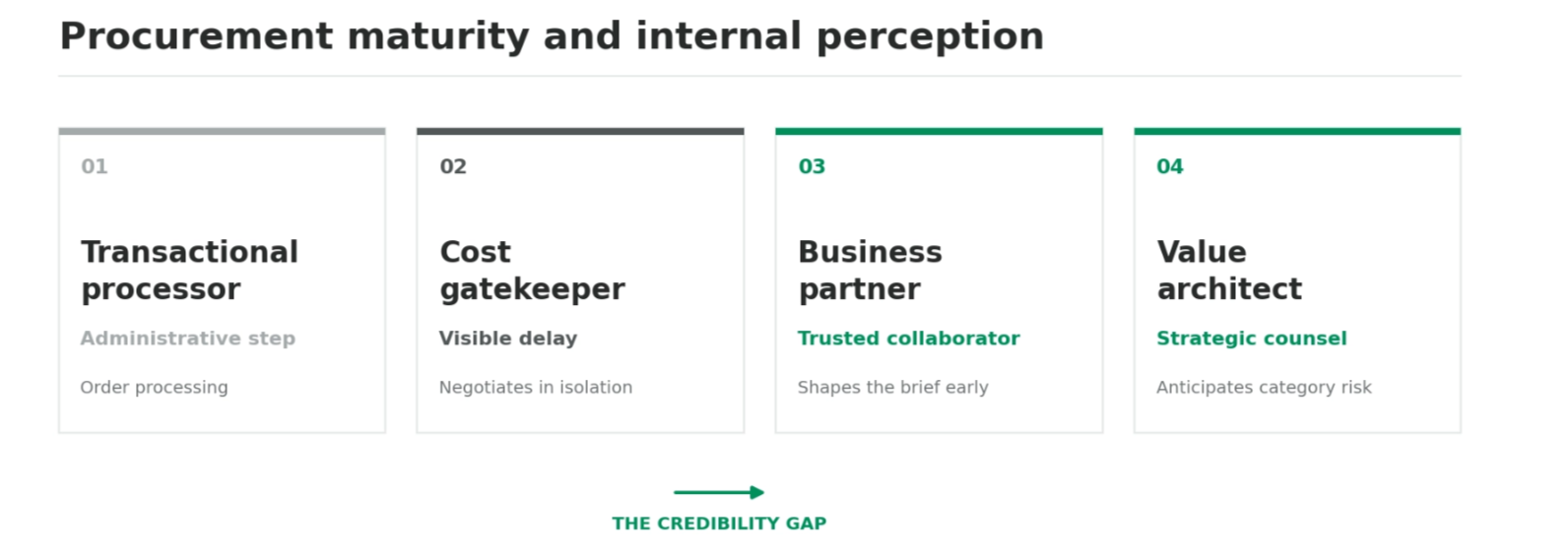
The important point is not the ladder itself. It is that the jump from gatekeeper to partner is the hardest one, and it cannot be made through communication alone. It requires changing what the business experiences.
The credibility trap: savings nobody believes
Savings are procurement's native currency, and they are also its least trusted one. Finance teams routinely discount procurement-reported savings for good reasons: baselines are debatable, volumes shift, avoided costs never appear in a P&L, and the savings claimed on a contract signed in March rarely match what the budget holder sees in October.
The result is a credibility trap. The more procurement relies on self-reported savings to justify its role, the more it invites scepticism. A function that says "we saved €3.2M this year" with no shared baseline and no visible negotiation process is asking to be believed. A function whose stakeholders watched the market set the price is not asking for anything.
What the most respected procurement teams do differently
The teams that break out of the gatekeeper position share a common trait: they manage the perception of time as carefully as they manage price. Consider a multi-site manufacturing group operating with a fragmented supplier base and plant managers used to buying locally. The procurement team's early attempts to centralise spend met open resistance, not because the savings case was weak, but because every centralised tender added weeks the plants did not have.
The turnaround did not come from a better business case. It came from compressing the sourcing cycle on a handful of high-visibility, standardised categories, running those events with the plant managers in the room, and validating the savings baseline with finance before the event rather than after it. Within two quarters, the plants were asking procurement to take on categories they had previously guarded. The mechanism is simple: credibility followed speed and transparency, and savings became the proof rather than the argument.
Building Procurement Credibility Through Execution: Communication, Early Results, and a Readable Process
Once the problem is framed as experience rather than messaging, the levers become clearer. They fall into four areas: how procurement communicates on both sides of the table, which results it chooses to deliver first, how it structures its process, and which execution formats make its value visible by design.
Stakeholder communication: speaking the business's language before the sourcing event, not after
Internal clients do not care about sourcing methodology. They care about three things: will I get what I need, when, and with what risk. Procurement communication that leads with savings percentages answers a question the stakeholder did not ask.
The more effective posture is to involve the budget holder at the moment of scoping, not at the moment of award. Asking a stakeholder to validate the scope, the quantities, and the evaluation criteria before suppliers are approached does two things. It surfaces misaligned expectations early, when they are cheap to fix. And it makes the stakeholder a co-author of the outcome, which is the most reliable way to have that outcome defended later in front of finance or the executive committee.
A useful discipline is to agree, at kick-off, on a single sentence describing what success looks like for the stakeholder. "Secure a second qualified source before Q2 without increasing unit cost" is a sentence a plant director will remember. "Achieve 7% savings on the category" is a sentence only procurement will remember.
Supplier communication: clarity as a performance lever
The same logic applies on the other side of the table, and it is more often neglected. Suppliers form a view of the buying organisation from the way it runs its processes, and that view shapes the quality of the responses procurement receives.
A sourcing process with explicit rules, a published timeline, visible evaluation criteria, and structured feedback reduces supplier frustration and improves the quality of offers. Suppliers who understand how they will be evaluated invest in better proposals. Suppliers who have been through opaque tenders, where the award seemed decided in advance, either do not respond or price in the uncertainty. Procurement's external reputation and its internal one are connected: a supplier base that trusts the process delivers more competitive offers, which in turn produces results the business can see.
This is also where procurement's posture shifts. Instead of acting as the adversarial negotiator, the buyer becomes the guide: explaining the process, helping suppliers prepare, and making the rules the same for everyone. That shift does not weaken negotiating power. It relocates it from the buyer's tactics to the market's own dynamics.
Delivering early results: choose the categories where speed is visible
A procurement function trying to raise its profile cannot afford to start with its hardest category. The first results need to be fast, measurable, and seen by the people whose opinion matters.
The Kraljic matrix is useful here, read not as a sourcing strategy tool but as a credibility sequencing tool. Leverage categories, high spend in competitive markets, are where fast, visible wins are most likely: packaging, logistics lanes, standard components, MRO consolidations, facility services. The market is liquid, specifications can be standardised, and competition produces results that are easy to demonstrate. Non-critical categories offer efficiency gains through standardisation and automation, useful for freeing up buyer time but rarely noticed by senior stakeholders.
Strategic categories are a different matter. There, credibility is built through judgment, supplier relationship management, and long-term risk thinking, not through speed. Trying to prove procurement's value by running an aggressive competitive event on a strategic single-source component is the fastest way to lose the trust of engineering. Bottleneck categories call for supply risk management first; the visible win there is avoiding a disruption, which is real value but rarely celebrated.
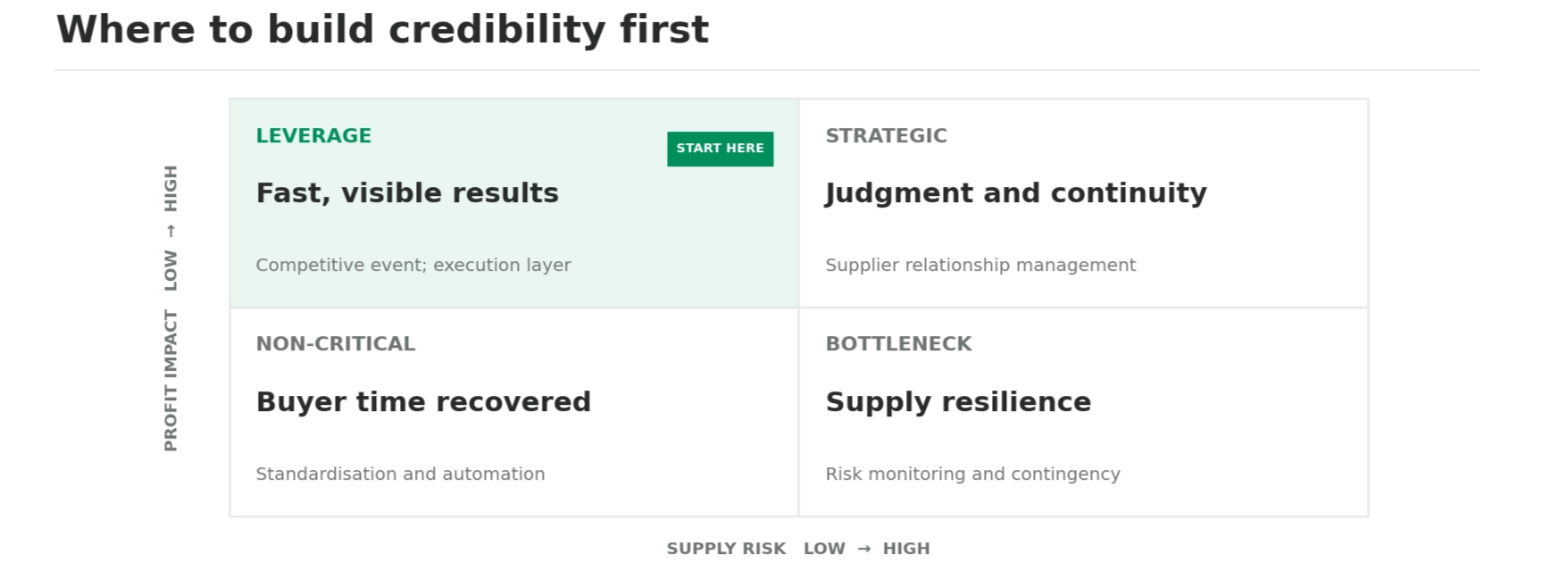
The practical rule: build the first 90 days on two or three leverage categories with engaged stakeholders and clean data. Let those results create the mandate to go further.
Establishing a process: structure as a contract with the business
Process has a poor reputation inside most businesses because it is usually experienced as bureaucracy. But the absence of a readable process is precisely what makes procurement look slow: when stakeholders cannot see the steps, every week feels like an unexplained delay.
A credible sourcing process is short, visible, and shared. It typically rests on five steps: a structured intake of the need, a scope and baseline validated jointly with the stakeholder and finance, a competitive phase with rules communicated to suppliers in advance, an award decision documented against the agreed criteria, and a savings confirmation reviewed with finance after implementation. Each step has an owner and a target duration, and the stakeholder knows where the project stands at any moment.
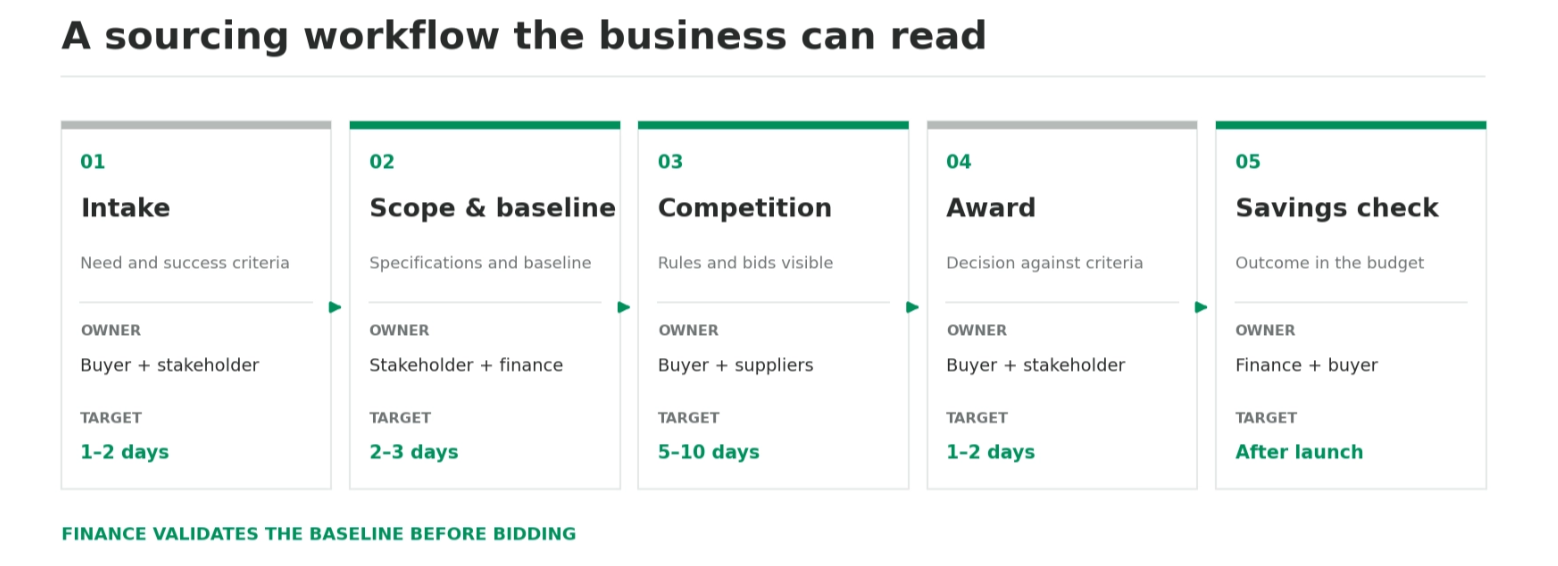
Two details carry disproportionate weight. The first is baseline validation with finance before the negotiation, which removes the main cause of disputed savings. The second is a standard sentence in every RFP reserving the right to choose the negotiation format, including a digital competitive event. It prevents surprises, signals professionalism, and gives procurement the flexibility to pick the most effective route once offers are in.
Reverse auctions as a communication instrument, not only a negotiation tool
Reverse eAuctions are usually discussed as a savings mechanism. Their less discussed property is that they make procurement's work visible.
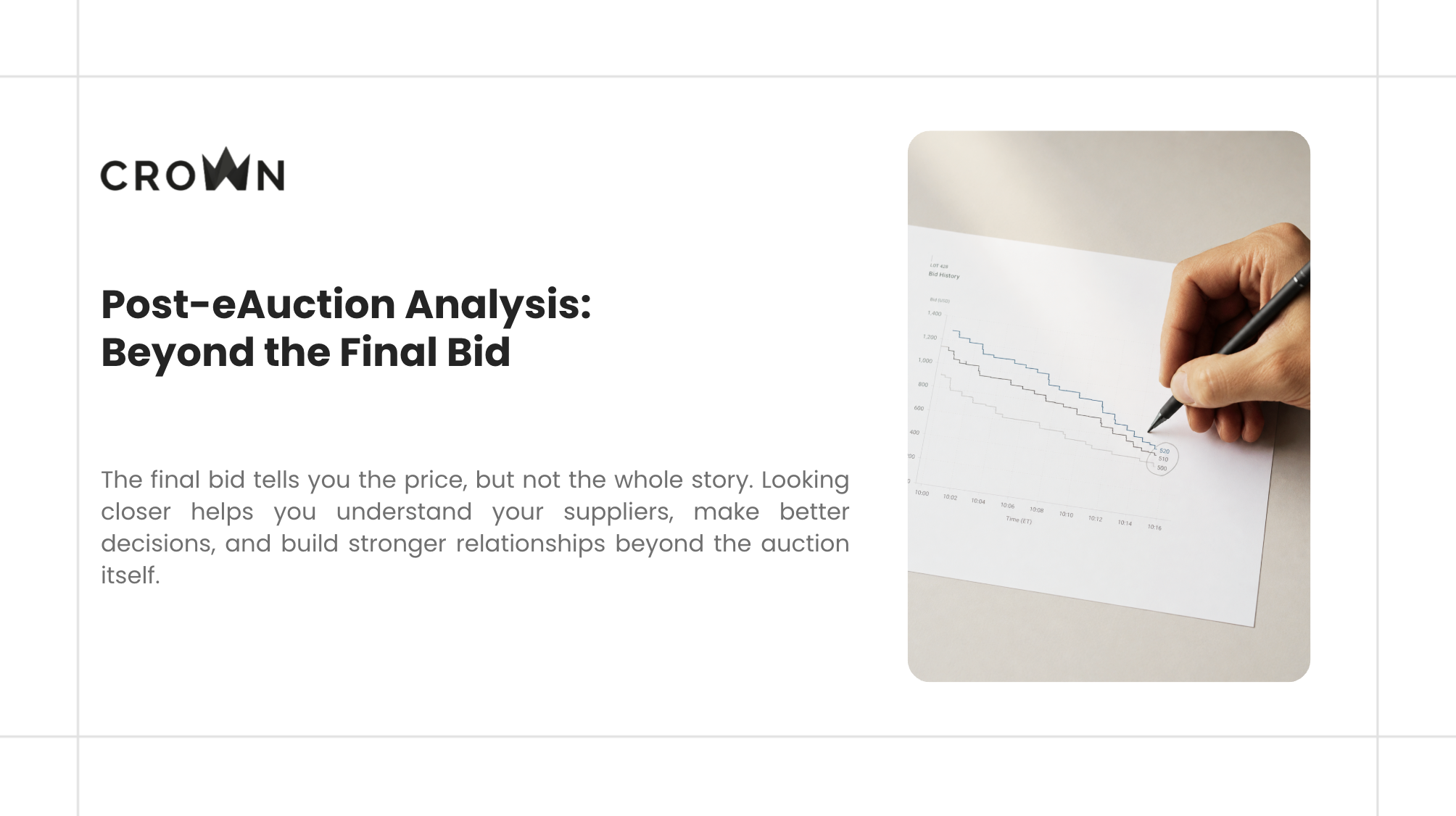
In a bilateral negotiation, the stakeholder sees the starting price and the final price, and must take procurement's word for what happened in between. In a live eAuction, the stakeholder can watch the event. They see suppliers adjusting their bids in real time, the price curve descending under genuine competitive pressure, and the market itself setting the value. The outcome is no longer a figure reported by procurement. It is an event the business witnessed.
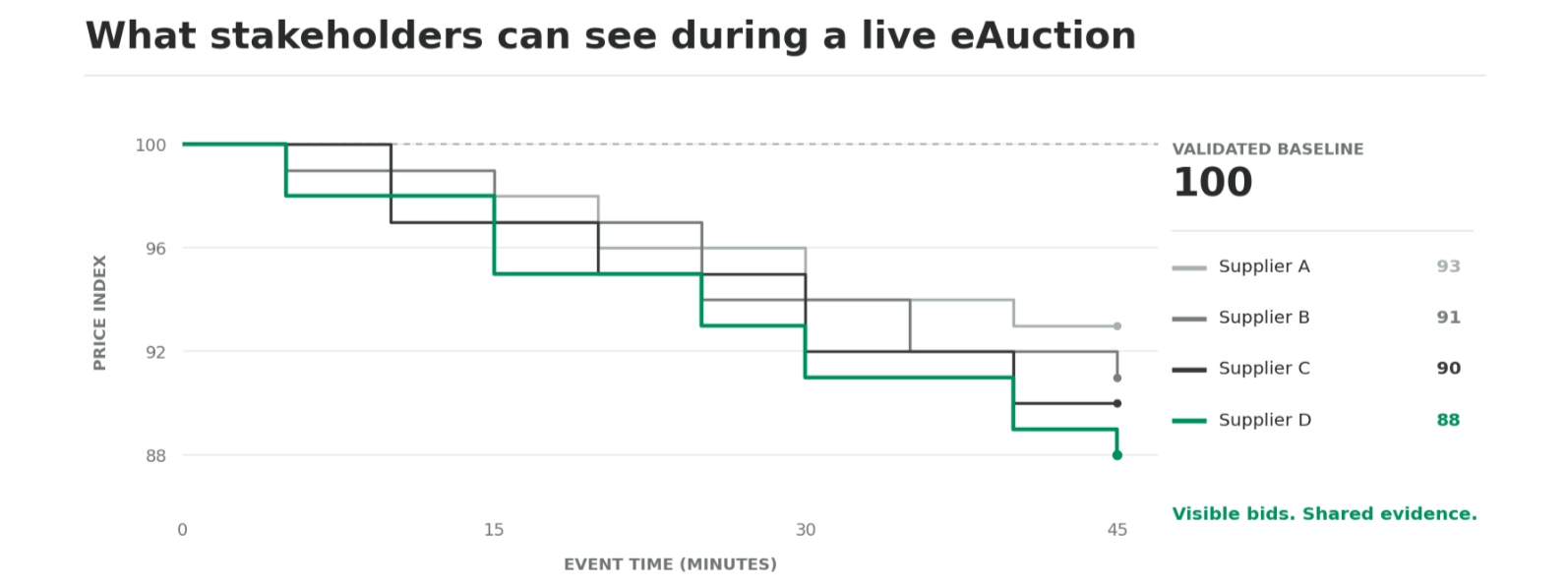
This changes the nature of the internal conversation in several ways. Preparing an eAuction forces stakeholders to clarify their needs upfront: specifications must be complete, quantities agreed, and supplier eligibility validated before the event. That discipline, often perceived as a constraint, is precisely what reduces post-award disputes. The event produces a complete audit trail, which answers the compliance questions finance and internal audit would otherwise ask. And the cycle is short: when the category is ready, the path from offer analysis to live event can be as short as two weeks, with negotiation time reduced substantially compared with successive bilateral rounds.
For suppliers, a well-run eAuction offers what opaque tenders do not: identical rules for every participant, real-time feedback on their competitive position, and a decision based on merit. In practice, many suppliers prefer this format to rounds of negotiation in which they never know where they stand.
The limits must be stated as clearly as the benefits. eAuctions do not work when the spend is too small to attract serious competition, when the market is a monopoly or heavily regulated, when specifications cannot be standardised, or when a stakeholder has already decided on a supplier regardless of terms. Running an eAuction under those conditions damages credibility rather than building it. The discipline of knowing when not to use the format is itself a signal of procurement maturity.
Why transformation programmes rarely fix the reputation problem
Many organisations try to raise procurement's profile through large transformation programmes built around integrated procure-to-pay suites and enterprise AI projects. These initiatives have their place, but they share a structural weakness when the goal is credibility: they deliver results late. Long deployments, heavy IT dependency, and change management across the whole organisation mean that the business often waits eighteen months before experiencing any difference. During that period, procurement's reputation is shaped by the same friction as before, now with an added transformation budget to justify.
Credibility responds to a different rhythm. It is built on executed cycles, visible within weeks, on categories the business cares about.
The procurement functions that command real influence in their organisations did not obtain it by asking for a seat at the executive table. They obtained it by changing what the business experiences: shorter cycles, predictable timelines, outcomes stakeholders witnessed rather than read about, and suppliers who trust the process enough to compete seriously.
This is a shift from procurement as a reporting function to procurement as an execution function. It also reframes the question of tools. The priority is not another system of record. It is an execution layer that allows a buyer to take a leverage category from scoping to a live competitive event in a matter of weeks, with stakeholders and finance aligned on the baseline before the first bid. That is the layer CROWN was built to provide: an infrastructure that compresses the sourcing cycle, makes the negotiation visible, and gives procurement results the business can see for itself.