

Post-eAuction Analysis: Beyond the Final Bid
Procurement teams that judge an eAuction only by its final price and reported savings are missing a large part of what the event actually produced. Post-eAuction analysis is the practice of examining the complete bidding record, not just the winning number, to understand what it reveals about supplier participation, competitive-market structure, award confidence, panel resilience, and the direction of the supplier relationship going forward.
Why the Final Price Is Only Part of the Story
A ranking table and a savings percentage are easy to report and easy to file. They are also a compressed summary of something considerably richer: the positions suppliers opened at, how they moved through the bidding activity, how consistently they engaged, and how tight or loose the field remained as the auction approached close. Most of that detail is discarded once the award is confirmed, because the reporting cycle tends to treat the auction as finished the moment a winner exists.
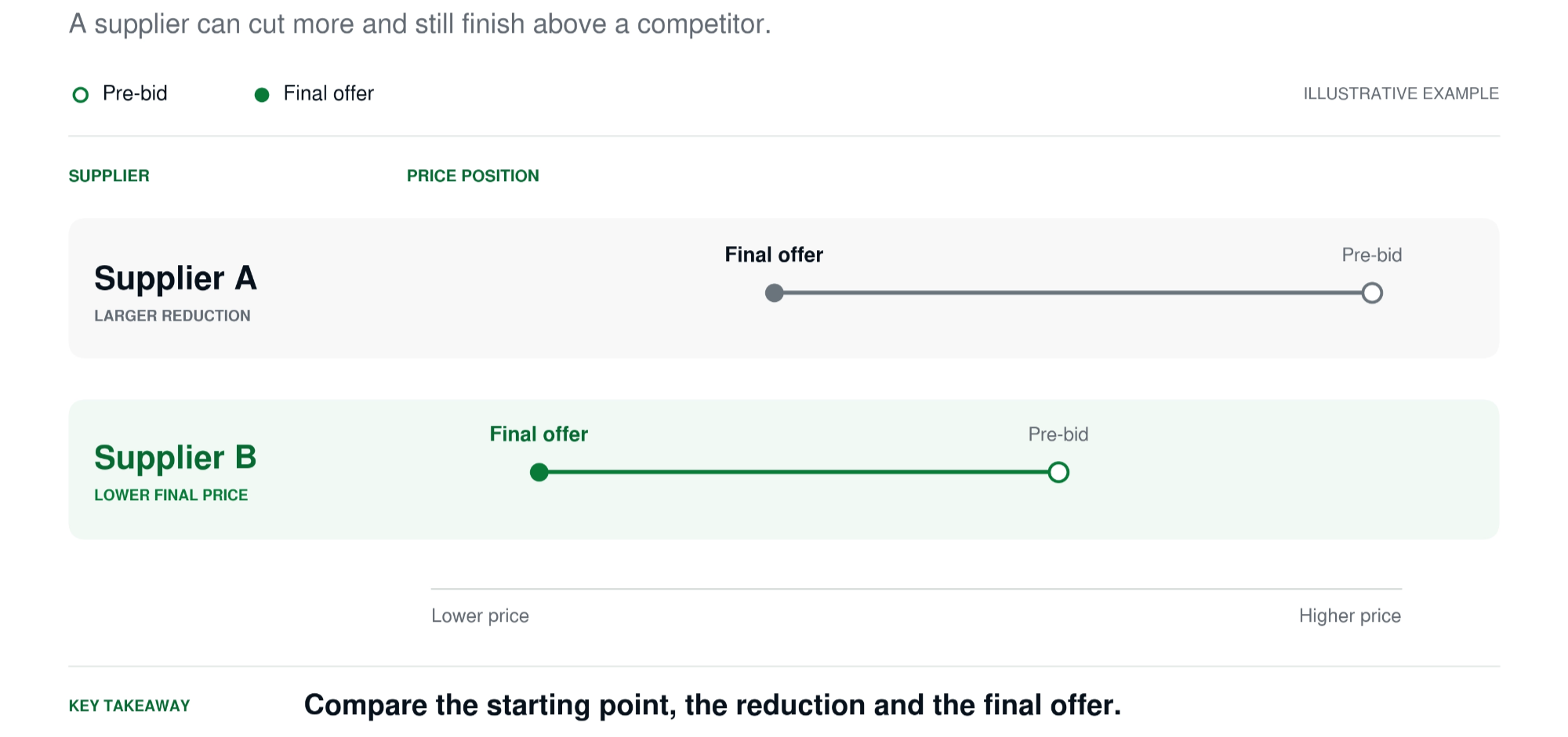
Post-eAuction analysis is not an audit of procedural compliance, and it is not another savings report. It is a structured reading of what the bidding activity revealed about the supplier market, applied before the award decision is finalised, not after. It is a long-established instinct among experienced category managers; the value comes from doing it consistently and with discipline, rather than depending on individual judgement alone.
Reading Bidding Activity: Signal, Not Verdict
Not every eAuction runs in discrete rounds; some formats use continuous, dynamic bidding with no fixed round structure. What can reasonably be examined, across formats, is the bidding activity itself: opening position, bid sequence, the pattern of price movement across the auction timeline, the spread between leading bidders, and the consistency of participation through to auction close.
Visibility also varies by design. Depending on the rules configured for a given event, suppliers may see their rank, the leading price, limited aggregate feedback, or nothing about their competitors at all. A supplier bidding with full rank visibility operates under different pressure to one bidding blind, and that context belongs in the interpretation, not as an afterthought.
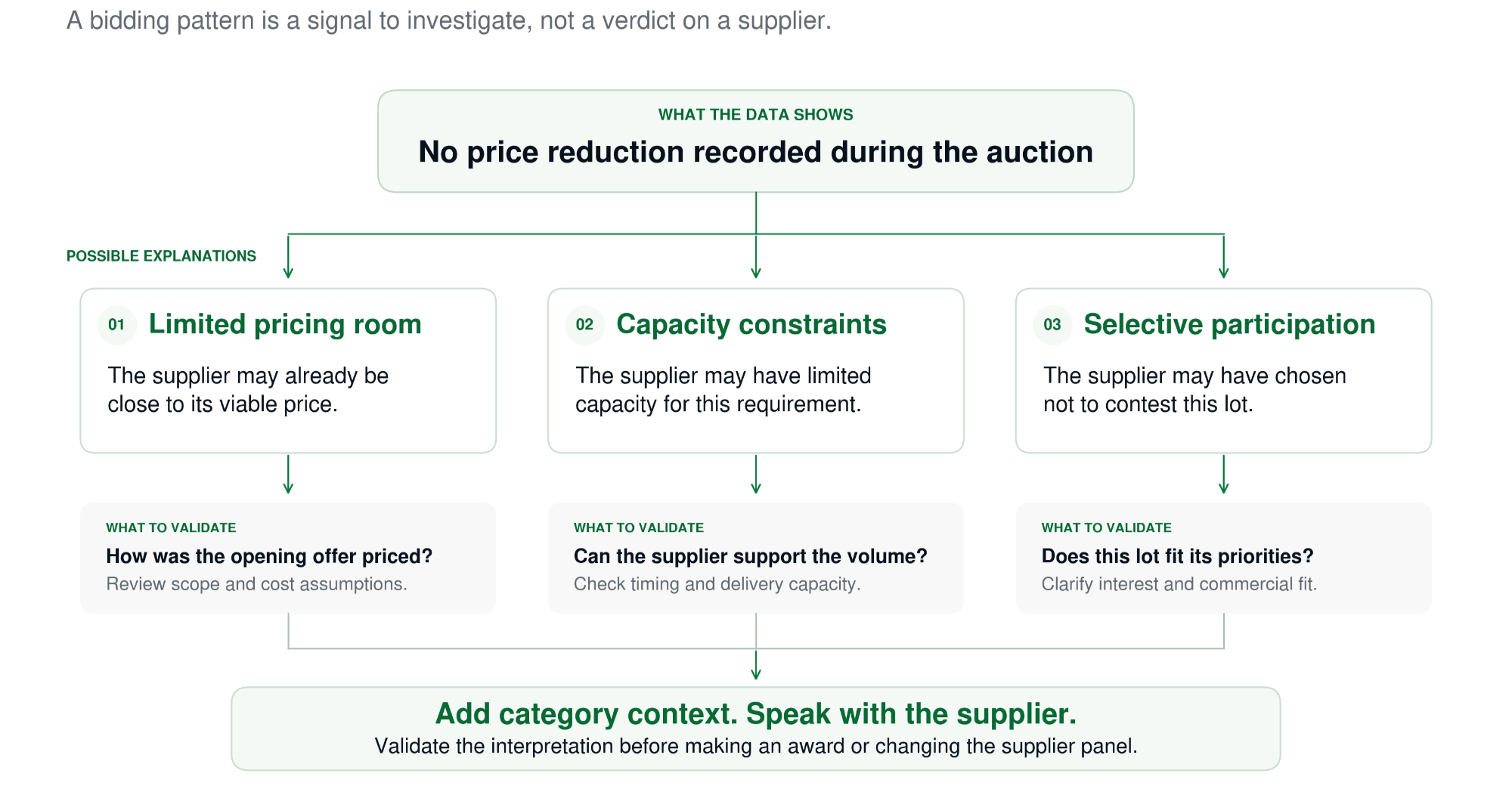
The discipline that matters most is separating three layers: what the data objectively shows, what it may plausibly suggest, and what procurement still needs to validate through additional information or direct supplier dialogue. Response speed shows that a supplier was monitoring the event and chose to react; it does not prove strong commercial engagement, since a fast reaction can come from an automated bidding rule as easily as from genuine intent. Slow or absent movement may point to limited interest, but it may equally reflect capacity constraints, a supplier already close to its floor, or a deliberate choice not to contest that lot, it is a question worth raising with the supplier, not a conclusion to record. A bid trajectory shows how a supplier priced under one specific competitive configuration; it does not reveal that supplier's true commercial floor, since a different set of competitors, volumes or specifications could produce a different result. A stable, narrow gap between the top bidders increases confidence that real competitive tension existed, but on its own it does not validate an award, it needs to sit alongside quality performance, technical fit, capacity, total cost of ownership, financial stability and supply risk. None of this supports awarding automatically to the lowest compliant bid; the auction result is one well-informed input, not the decision itself.
From Signal to Decision: Award and Negotiation
Applied carefully, this reading sharpens two decisions in particular. For the award itself, the stability and size of the gap between the leading bidders, and the credibility of who was actually competing, give procurement a clearer sense of how much confidence the ranking deserves, and where a second look is warranted before finalising.
For negotiation follow-up, bidding patterns can suggest where there might still be room to explore; they do not prove it. A supplier who reduced their price steadily and stopped only when the auction closed may have more to offer in a direct conversation, but that has to be tested through dialogue, not assumed. This matters particularly in technically complex or multi-attribute events, where suppliers may hold back price movement because the auction format itself limits how far they are willing to commit blind.
Panel Composition and Market Resilience
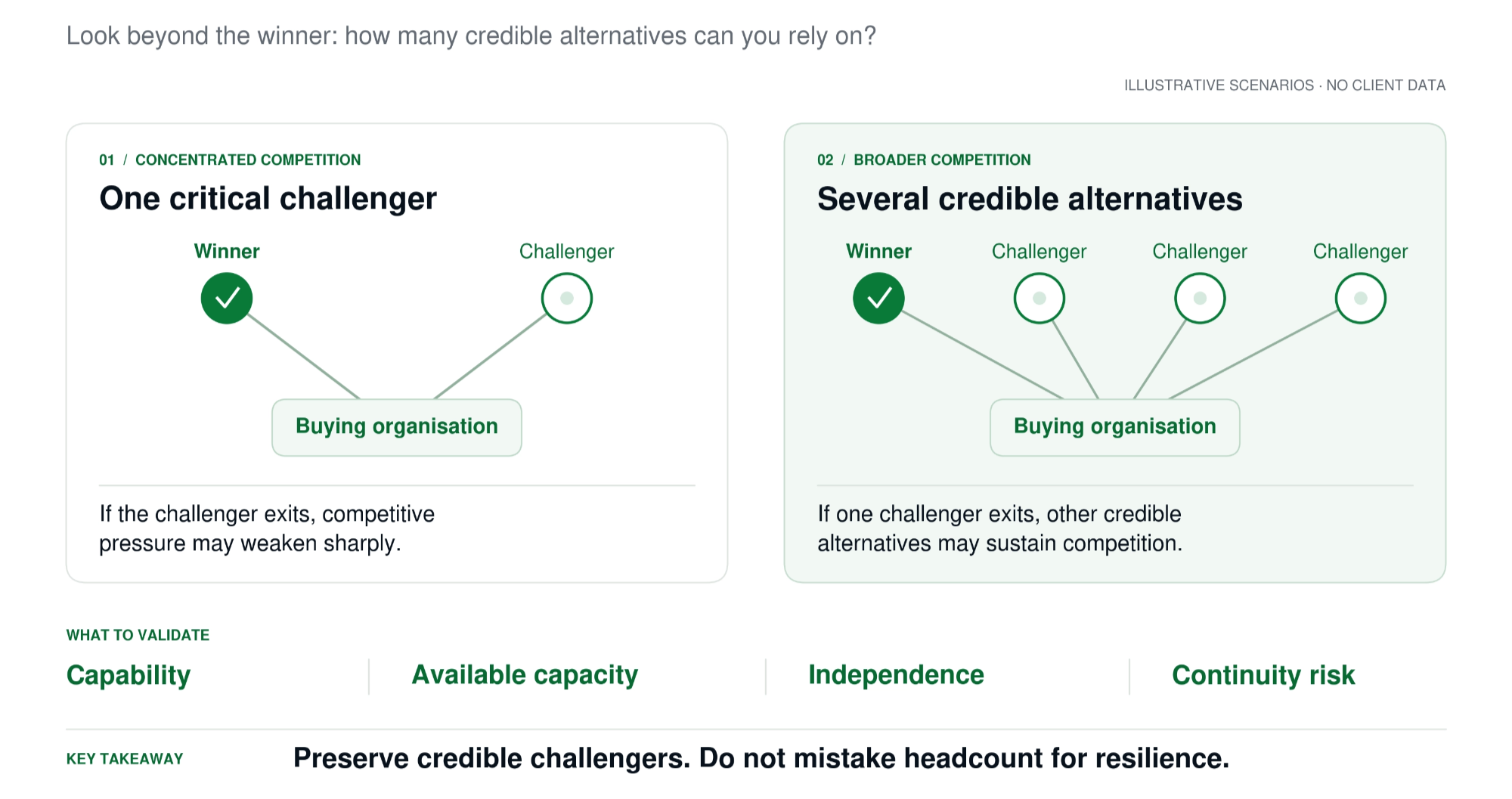
Engagement across a full sourcing cycle, not one isolated event, is a reasonable input into which suppliers stay in a panel, which are worth developing, and which warrant reconsideration. A supplier who competes seriously but loses often sustains more long-term value for a category than a supplier who wins without facing real competitive pressure, since continued participation from strong challengers keeps the field genuinely contested for the next event.
Concentration risk deserves the same scrutiny. If competitive tension in a field depends heavily on one strong challenger, that dependency is worth flagging rather than assuming the panel is resilient by default. These are hypotheses for the category team to test against its own market knowledge, not conclusions the auction data can settle alone.
Where This Analysis Earns Its Keep
The depth of a post-eAuction review should match what is at stake. It adds the most value in competitive supplier markets, categories with significant financial exposure, high-volume direct or indirect spend, technically differentiated bids, multi-lot or multi-attribute sourcing, categories where supplier concentration or continuity risk is material, and industrial markets where the relationship shapes performance beyond the transaction.
A low-value, standardised transactional category rarely justifies the same depth of interpretation as a strategic industrial event. Running a full review on every routine purchase creates administrative load without a proportional return; knowing where to apply that depth is itself part of the discipline.
Making It Systematic: The Role of Technology
Without some structure, this kind of review competes for time against the next sourcing event and tends to lose. Software can help by automatically organising the raw material: opening and final bids, bid trajectories, response patterns, price decrements, ranking changes over the auction timeline, competitive spreads, participation and withdrawal, lot-level outcomes, possible award scenarios, and the specific points that need human validation before being treated as conclusions.
A workable operating model has five steps: technology captures and organises the evidence; the system highlights signals and anomalies worth attention; the buyer adds category and supplier context; procurement validates the interpretation, including through supplier dialogue where needed; and the findings become a concrete award and supplier-action plan. Automation's role stops at organising evidence and supporting analysis. It does not assign motive to a supplier's bidding pattern and it does not make the final decision, that judgement stays with the buyer.
How CROWN Fits Into This Process
CROWN Procurement supports both ends of this process with internal tools, without replacing buyer judgement at either stage. Before a negotiation, CROWN uses an internal diagnostic to map the sourcing pipeline and identify which categories suit a competitive tender or eAuction, weighing factors such as category characteristics, supplier-market structure, spend, specification maturity, supplier availability, and risk.
After a negotiation, CROWN uses an internal post-event analysis tool to structure the outcomes of the eAuction: what happened during bidding, what the results may suggest, what still needs to be validated, and which award, negotiation or supplier-relationship decisions should follow. Both tools are decision-support mechanisms. Neither determines the award automatically, and neither claims to reveal a supplier's true intentions, that interpretation remains the buyer's responsibility.
The Supplier Relationship Dimension
The relational consequences of how a post-eAuction review is conducted are easy to underestimate. Suppliers notice when a buying organisation reduces every interaction to the final price, and strong suppliers factor that into whether they bid seriously next time.
A more considered review supports better supplier debriefs, grounded in an informed reading of what actually happened rather than the ranking alone, and lets procurement explain award decisions in terms losing bidders can respect. It also creates room to preserve credible challengers in the panel, identify suppliers worth developing even when they did not win, and validate a winning bid that looks difficult to sustain before it turns into a delivery or quality problem later. Equally, it guards against penalising a supplier on a superficial reading of their bidding pattern, when a slower or more cautious approach may reflect sound commercial discipline rather than weak interest.
None of this turns post-eAuction analysis into a tool for judging suppliers algorithmically. Its purpose is to support decisions that are proportionate, defensible and fair, and to protect the buying organisation's attractiveness to strong industrial suppliers over successive sourcing cycles.
A Practical Framework for the Post-Event Review
A useful review, whatever it is called internally, tends to produce seven outputs: an event performance summary against expectations; a supplier bidding analysis describing how each participant engaged; a competitive-market assessment of how tight or fragile the field really was; award considerations beyond the ranking; a short list of risks and assumptions still to validate; the implications for how each supplier relationship should be managed going forward; and recommended next actions, whether that means a follow-up negotiation, a panel adjustment, or a well-prepared debrief.
The Close Produces a Price
An eAuction closing produces a number. Whether it produces good judgement depends on what happens next. Disciplined post-eAuction analysis is what turns the complete bidding record into sharper award decisions, better-targeted negotiation follow-up, and a supplier strategy grounded in evidence rather than a single figure on a summary screen.