
Procurement Maturity Model: The 5 Stages Explained
Procurement has shifted from being a back-office support function to a strategic driver of growth, innovation, and resilience. That sentence is now a cliché, repeated in every vendor deck and conference keynote. What gets said far less often is the uncomfortable corollary: the shift is uneven, and most functions overestimate where they sit on the curve. A team can hold a seat at the strategic table and still run a sourcing event that takes eleven weeks and closes at a price the incumbent was always going to accept. The title on the org chart advanced. The execution underneath did not.
This is why the Procurement Maturity Model is useful, and why it is dangerous when misread. It helps companies benchmark their current capabilities and define a roadmap for improvement. But maturity is not a badge you earn once and keep. It is a capability that has to hold up under pressure, the day a supplier reopens a settled price or a key input doubles in a quarter. By identifying which stage of maturity you are in, you can evaluate your procurement function against best practices and, more importantly, see where your claimed maturity and your executed maturity diverge.
What Is Procurement Maturity?
Procurement maturity describes how advanced an organization's procurement function is across areas like organizational role and influence, negotiation and supplier management, processes and operating models, use of technology and analytics, and contribution to business strategy.
Those five dimensions are worth separating carefully, because they do not advance at the same speed. Influence and role tend to move first, they are largely a matter of reporting lines and executive sponsorship. Negotiation capability and technology adoption move last, because they require actual execution capacity, not just a mandate. This asymmetry is the source of most maturity misdiagnosis. A function accumulates responsibilities faster than it accumulates the means to execute them, and ends up strategically broad but executionally thin. It looks advanced on an assessment and underperforms in a contested category.
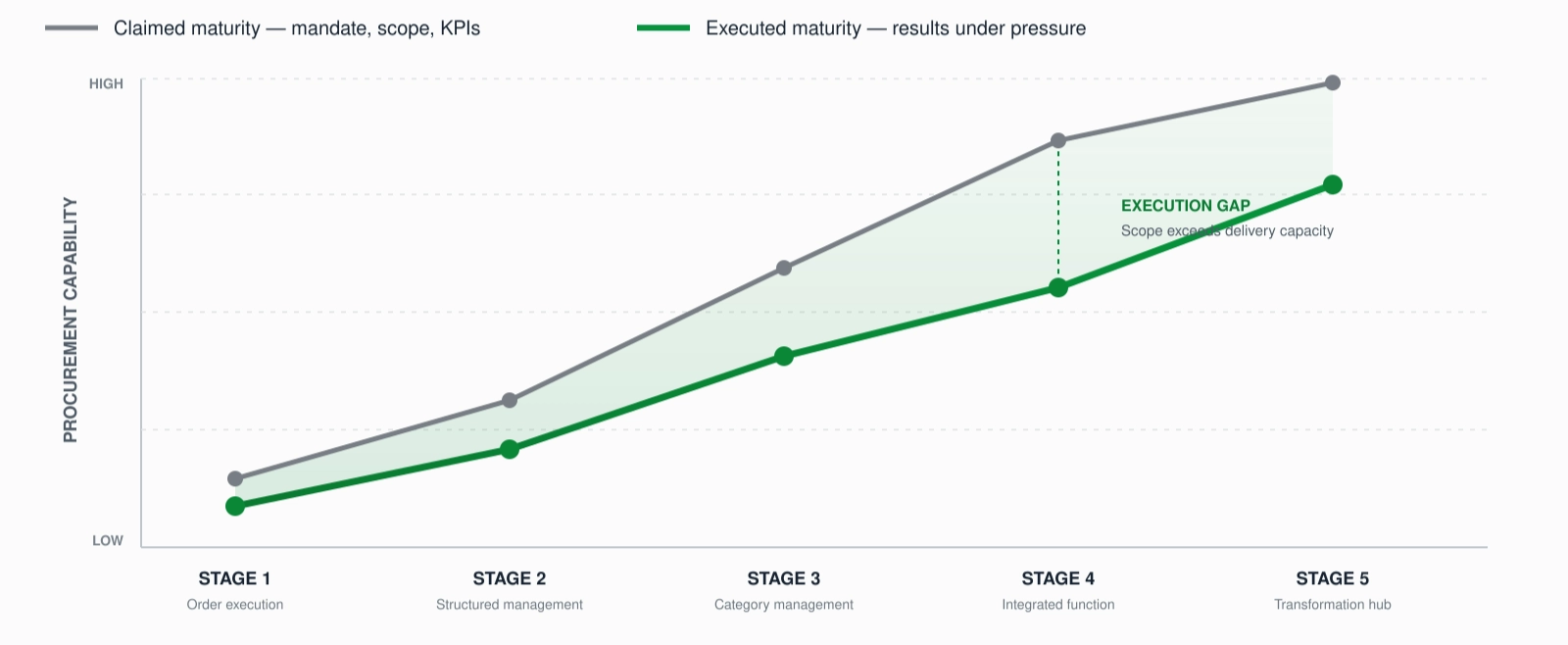
Organizations progress through five stages of procurement maturity, from tactical order processing to becoming a strategic transformation hub. The progression is real. What follows is a closer reading of each stage, including the trap that keeps functions stuck inside it.
The 5 Stages of Procurement Maturity
Stage 1: Order Execution
At this stage, procurement is seen as administrative support. It is focused on processing orders and resolving requests, with little to no supplier strategy or competitive sourcing.
Research insight: companies at this stage operate reactively, with high inefficiencies and no long-term planning.
The defining feature is not lack of effort, it is lack of leverage. Every purchase is handled as an isolated transaction, so the function never builds the two things that create negotiating power: aggregated volume and a credible competitive alternative. A supplier facing a Stage 1 buyer knows there is no second quote coming and no consequence for holding price. The inefficiency everyone complains about is a symptom. The actual problem is that the function has no structural mechanism to make suppliers compete.
Stage 2: Structured Procurement Management
Here the organization adopts standardized processes and spend visibility. Negotiations cover price and lead time but remain transactional, and procurement begins to centralize under operational leadership.
Research insight: savings can be achieved, but procurement is still excluded from strategic decisions.
This is where spend visibility arrives, and where many functions mistake visibility for control. Seeing spend is not the same as shaping it. The centralization is genuine progress, it lets the function aggregate volume for the first time, which is the raw material of leverage. But negotiations stay bilateral: one buyer, one supplier, a conversation that the supplier has run hundreds of times and the buyer runs occasionally. The structural weakness of Stage 2 is that it standardizes the process without intensifying the competition. You get cleaner data and tidier workflows around a negotiation dynamic that still favors the seller.
Stage 3: Structured Purchasing Function
At this stage procurement is recognized as a strategic function. Category management and supplier collaboration are introduced, and processes are optimized and standardized.
Research insight: at this stage, procurement starts to drive economic and quality performance while managing supplier risks.
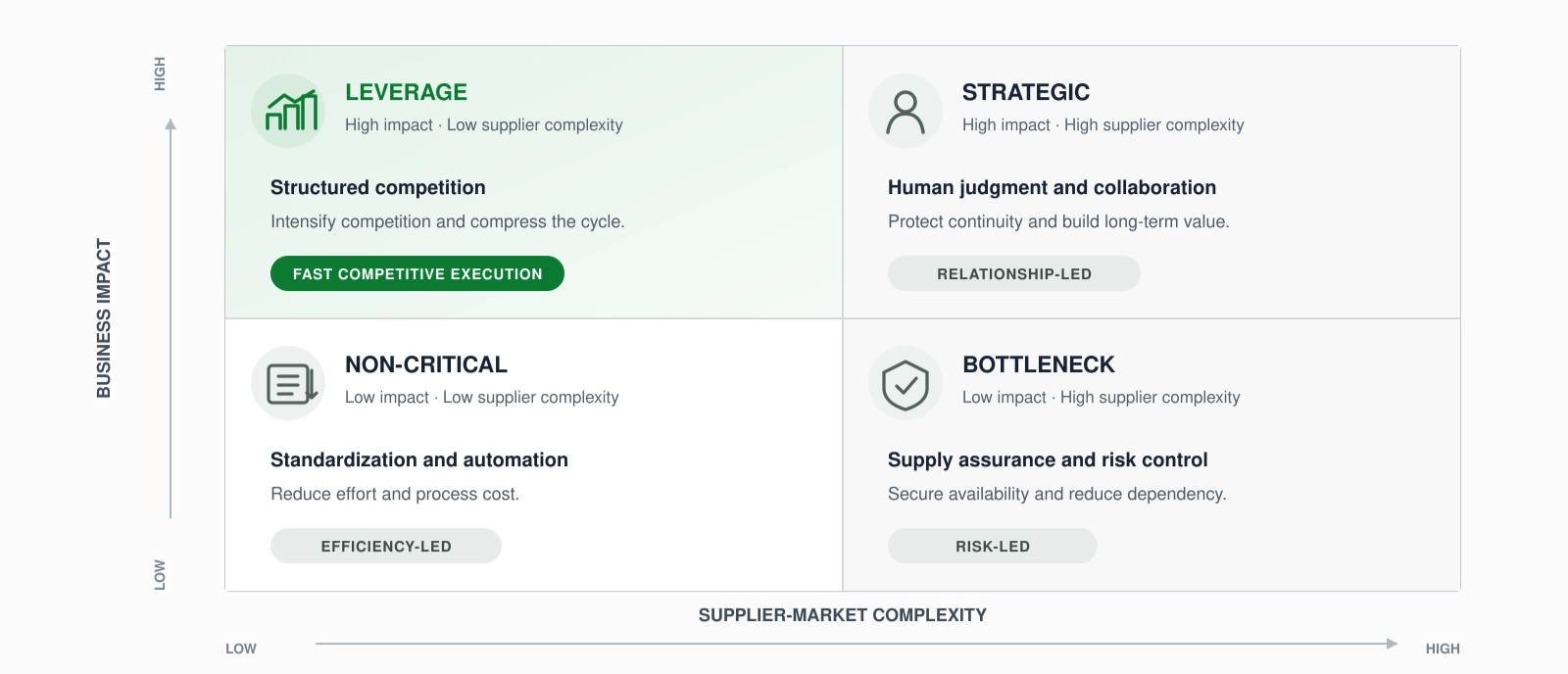
Category management is the pivotal capability here, because it introduces the idea that different categories demand different behavior. This is the stage where the Kraljic logic starts to earn its keep. Leverage categories, high spend and many available suppliers, reward competitive intensity and speed. Strategic categories, high value and few viable suppliers, reward relationship continuity and human judgment. A Stage 3 function that has understood this stops running every category the same way. The ones that stall here do so because they adopt the vocabulary of category management without changing the execution: they draw the matrix, then negotiate every quadrant with the same slow bilateral reflex. Recognizing that a category is a leverage play means little if the function cannot actually run a fast, multi-supplier event to exploit it.
Stage 4: Integrated Procurement Function
Procurement is now fully embedded in strategic planning, engaged early in product and service design and in client initiatives. KPIs expand beyond cost to include risk, sustainability, and innovation.
Research insight: cross-functional collaboration positions procurement as a business partner and innovation enabler.
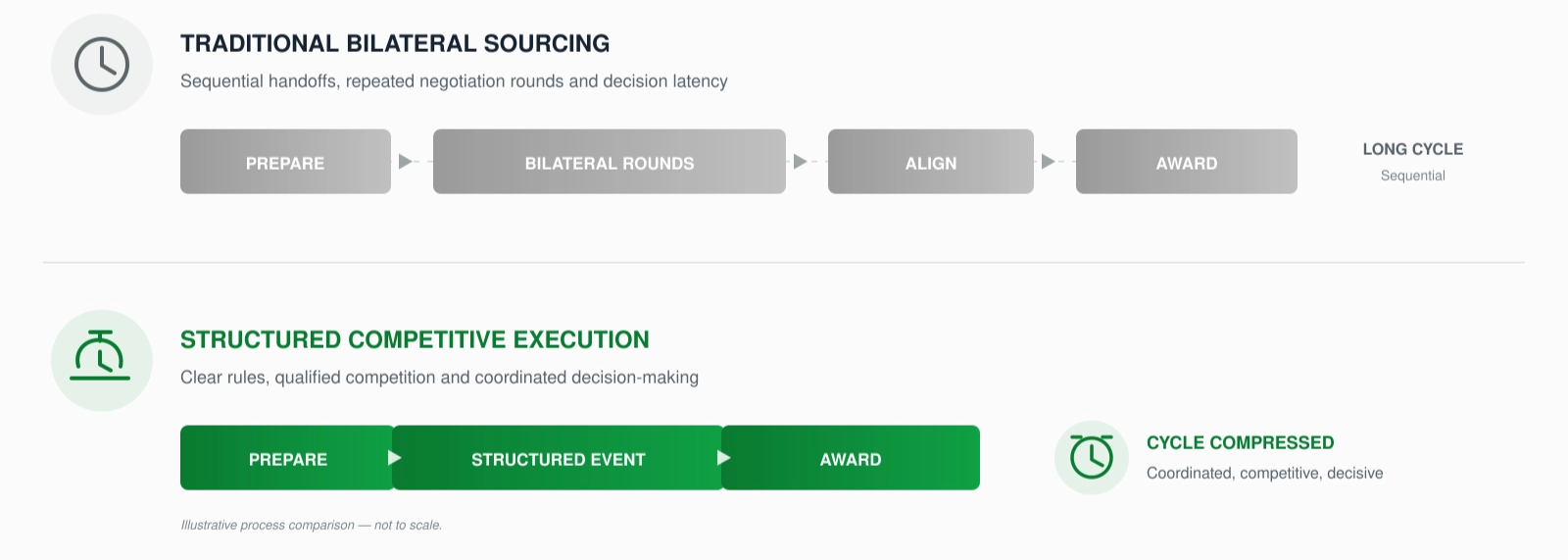
Stage 4 is where the maturity gap becomes most expensive, precisely because it looks like the summit. The function is embedded, cross-functional, measured on sophisticated KPIs. Scope has expanded in every direction. But scope expands faster than headcount, so the same team that now owns risk, sustainability, and design collaboration still has to run the sourcing that funds its credibility. The temptation at this stage is to treat every remaining problem as a strategic one, deserving of senior attention and deliberation. That instinct quietly destroys value on leverage categories, where deliberation is not sophistication, it is delay, and delay is margin lost while input costs drift. The mature Stage 4 move is the opposite of what the stage's self-image suggests: protect senior judgment for the strategic and bottleneck suppliers that genuinely threaten continuity, and push leverage categories toward fast, competitive execution that does not consume that judgment at all.
Stage 5: Strategic & Transformation Hub
At the final stage, procurement leads innovation and ESG initiatives, uses AI, forecasting, and market intelligence to shape strategy, and operates across all functions, from HR and Finance to R&D.
Research insight: at this stage, procurement becomes a source of competitive advantage and a driver of long-term transformation.
The risk at Stage 5 is reaching for transformation of the wrong kind. The stage description invokes AI and market intelligence, and the default reading is a multi-quarter enterprise project: a legacy suite module, a heavy integration, results deferred by several fiscal cycles and dependent on IT throughput. Those projects add structural sophistication while leaving the executional gap in day-to-day sourcing wide open. The functions that actually reach competitive advantage at this stage tend to do the opposite of a grand rebuild. They add a thin execution layer on top of the systems they already run, one that lets a mature strategy behave like one at the moment execution is worth the most. Advantage at Stage 5 is not measured by platform breadth. It is measured by whether the function can move at market speed when the market stops waiting.
Why Researching Procurement Maturity Matters
Studying your procurement maturity is not just about classification. It provides a framework for benchmarking against industry best practices, identifying capability gaps, prioritizing investments in people, process, and technology, and building a roadmap toward procurement excellence.
The value is in the honesty it forces, provided you measure the right thing. A maturity assessment that only inventories structure, reporting lines, KPIs, tooling, will flatter you. It records what the function is responsible for, not what it can execute under load. The more useful assessment measures the gap between the two, and it does so category by category rather than as a single organizational score. A function that runs leverage buys at strategic-negotiation speed is immature in exactly the place that costs the most, regardless of how advanced its org chart looks. Reading maturity this way changes what you do with the insight: instead of chasing the next stage by adding scope, you close the distance between claimed and executed capability where the money actually moves.
There is a second party this clarity serves, and it is easy to miss. A slow, opaque process is expensive for suppliers too. They wait weeks for decisions, respond to loosely specified requests, and price uncertainty into their quotes to protect against ambiguity they cannot resolve. A mature process, clear rules, visible evaluation criteria, a defined timeline, lets them price the work instead of the risk of dealing with a disorganized buyer. Better data and structured process raise the quality of responses on both sides. Maturity produces clarity, and clarity is not a weapon pointed at one party. It is the condition under which competition becomes fair enough to trust.
How to Benchmark Your Procurement Function
To accurately identify your stage, assess your procurement's role in the organization, evaluate supplier management practices and strategies, review your processes and level of standardization, measure alignment with business objectives, and examine your use of digital tools, analytics, and innovation levers.
Run each of those checks against reality rather than intention. It is one thing to say the function is engaged early in strategic planning, another to show a category where that engagement changed the outcome. The sharpest benchmarking question is not which stage you occupy but how much of your claimed maturity survives contact with the market. So add a test the standard checklist omits: take one genuinely contested category and run it at full speed, then watch what the function actually does. That single event will tell you more about your maturity than a page of self-scored dimensions, because it measures execution under the exact pressure, price volatility, supplier resistance, a compressed decision window, that the org chart never has to face.
The Procurement Maturity Model is a research-backed framework that lets organizations map their procurement journey and define what comes next. Whether you are just beginning with order execution or already building a strategic transformation hub, understanding your maturity helps you make informed decisions and build a function that delivers lasting value. The functions that pull ahead are the ones that stop treating maturity as an altitude to reach and start treating it as an executional capability to prove, category by category, event by event. What they need for that is rarely another layer of enterprise transformation. It is an execution layer sitting on top of the systems they already run, so that a mature strategy actually behaves like one when the market stops waiting.

.png)

.png)