
Top 5 human skills every procurement manager should have
Ask ten procurement leaders what makes a great category manager and most will describe someone analytical. Someone who knows their spend, reads a cost breakdown properly, spots the anomaly in a bid comparison. All true, and all insufficient, because the analytical part of the job is the part you can teach in six months.
What takes years is everything that happens once the analysis is done and someone has to act on it. Telling a supplier their proposal isn't competitive without wrecking a relationship you'll need next quarter. Convincing an engineering lead to reopen a specification they finalized before anyone called you. Holding a position under pressure from a business unit that wants the order placed today. Procurement is one of the few functions where almost all the value gets created inside a conversation, and no amount of data quality decides how that conversation goes.
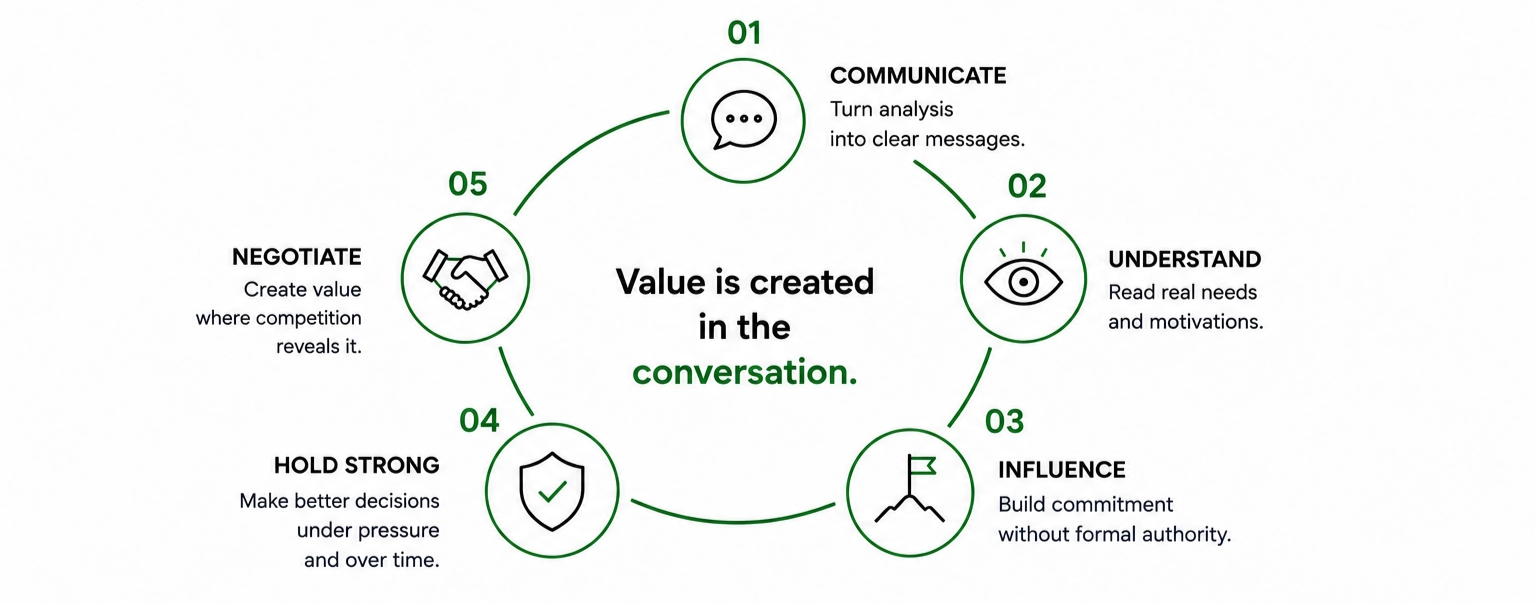
The teams that consistently outperform aren't the ones with the cleanest spend cube. They're the ones whose managers can sit through a difficult exchange without losing either the relationship or the position. Here are the five capabilities that determine whether that happens.
Why Human Skills Matter in Procurement
Before getting into the five, it's worth being clear about why this matters more here than in most functions.
Procurement sits permanently between interests that don't align. Suppliers are protecting margin while engineering protects performance, operations protects continuity and finance protects cash, and procurement is the only one required to hold all four at once and still produce a decision. That position generates friction by design. A manager who can't absorb friction drifts, month after month, toward whatever path resists least, which is nearly always the incumbent supplier, the existing specification and the automatic renewal. The savings don't disappear in a bad negotiation, they disappear in the negotiations that never happened.
Worth adding that this doesn't apply evenly. On non-critical spend, process discipline carries most of the load and interpersonal skill barely registers. On leverage categories, where the market is genuinely contestable, a well-structured competitive process does most of the work. It's on strategic and bottleneck categories, where alternatives are limited and switching costs are real, that individual capability becomes the thing that decides everything. One manager's credibility with a sole-source supplier can be worth more than the entire category strategy sitting behind it.
Communication Skills: Turning Analysis into Action
The word has been drained of meaning by competency frameworks, but in procurement it means something specific: getting a commercial position across to two audiences whose incentives point in opposite directions, without the message degrading somewhere in transit.
The internal failure is familiar to anyone who has lived it. Procurement talks in savings percentages and total cost of ownership, engineering hears budget interference, operations hears risk. The message is technically accurate and completely useless, because it was written in a language the recipient has no reason to decode.
The external failure is quieter and more expensive. Ambiguity in supplier communication isn't neutral, it's a transfer of value. Vague requirements get priced with a cushion for uncertainty. Unstated evaluation criteria push suppliers to optimize for whatever they assume you'll measure, usually price alone, which makes everything else in the proposal impossible to compare. Soft timelines get you quietly deprioritized inside their organization, and nobody tells you.
Managers who do this well share a habit that can look almost pedantic from outside: they state the decision rule before they ask for the input. They tell a supplier exactly how the proposal will be evaluated, on which dimensions and with what weight, before a line of it gets written. That isn't generosity, it's the only reliable way to get responses you can compare side by side. It also has an effect worth naming, which is that suppliers respond better to it. A transparent process with clear rules lowers their cost of bidding and lets a genuinely capable supplier compete where they're strong instead of guessing at what you want. When suppliers complain about procurement, it's rarely about the pressure. It's about the opacity.
Emotional Intelligence in Procurement: Understanding Stakeholders and Suppliers
Framing this as empathy misses what makes it useful. The competency isn't kindness, it's accurately working out what the other party actually needs, which is often not what they're saying they need.
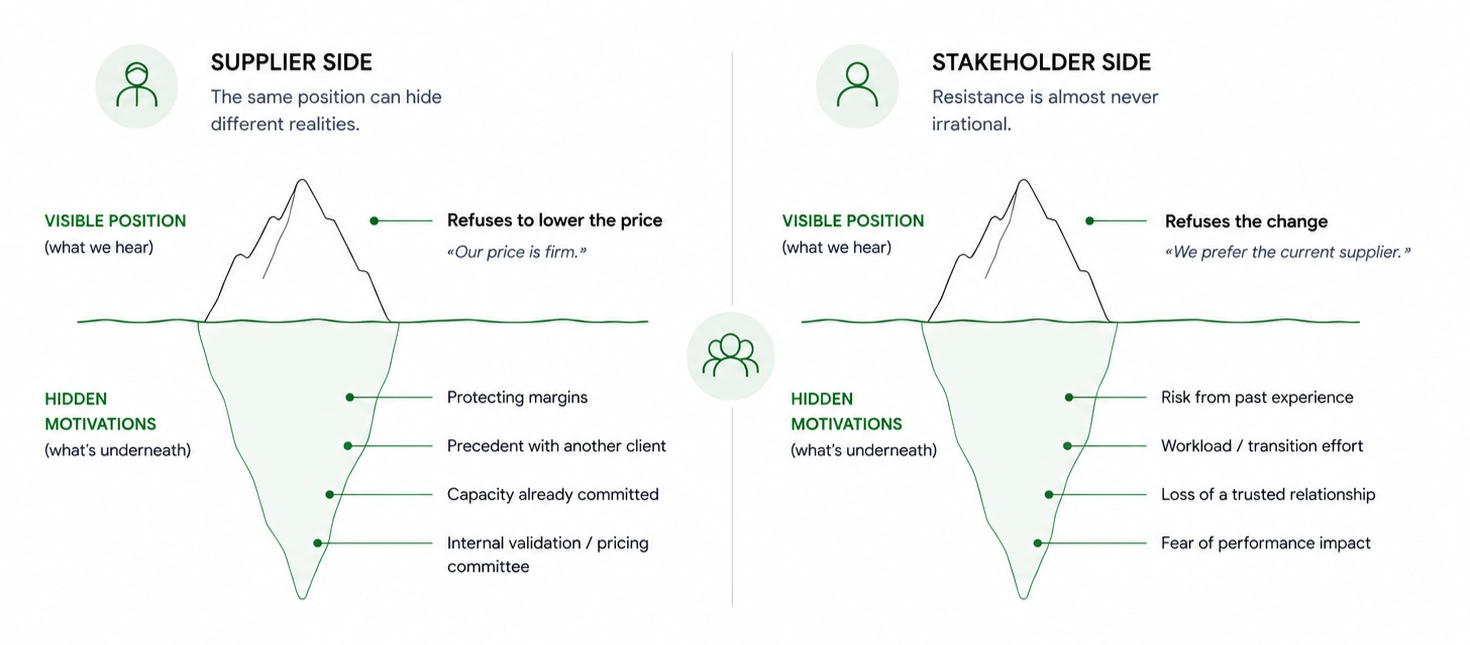
A supplier holding firm on price might be protecting margin, or a precedent they've set with another client, or their own standing with an internal pricing committee, or capacity they've already promised elsewhere and can't admit to. Four completely different situations that look identical from across the table, each calling for a different response. Read the wrong one and you spend an hour negotiating against a position that was never there.
Same logic inside your own building. A stakeholder resisting a supplier change is almost never being irrational, they're protecting themselves against a risk they absorbed personally the last time this went badly, or against the workload they'll carry during the transition, or against losing a relationship that makes their week manageable. Override that with a cost argument and you win the decision but lose the implementation. The specification quietly reappears, maverick spend resumes, and the savings evaporate somewhere between the contract and the invoice.
What separates the strong operators is a kind of diagnostic patience. Before responding to a stated position, they try to work out what interest is sitting underneath it, and they'll spend a whole conversation doing nothing else if that's what it takes. Slow, and also the difference between an agreement that gets signed and one that survives contact with the organization.
Leadership: Influencing Without Authority
Procurement leadership is a strange discipline, because the function's formal authority is narrow compared to what it gets held accountable for. A category manager is measured on outcomes that depend on decisions made elsewhere: the specification engineering wrote, the forecast planning produced, the payment terms finance accepted, the urgency created by a business unit that didn't involve procurement until the requirement was frozen solid.
So this is really the practice of influence without command, and two things separate the people who manage it from those who don't.
The first is showing up early. Influence exists while a requirement is still being formed and mostly disappears once it's been committed to. The managers who consistently deliver are the ones who made procurement present in the upstream conversation, before the specification existed, while the trade-off between performance and cost was still open. That isn't a process fix you implement in a quarter, it's a relationship built over years by being useful in rooms where procurement had no formal business being.
The second is holding a line internally. Category teams run with high autonomy and little daily supervision, which means priorities drift toward whatever produces the least resistance. The job is to decide where attention goes and then defend that decision, protecting the categories where effort compounds against the constant pull of the categories where effort is merely visible. Saying no to a low-value fire drill is a leadership act, and most teams underperform because nobody ever performs it.
Resilience: Making Better Decisions Under Pressure
Resilience usually gets described as staying calm under pressure, which is nearly useless as a definition. Calm is a demeanor. The question that matters is whether the quality of your decisions holds when conditions deteriorate.
Disruption does something predictable to procurement behaviour. Under a supply shock, a tariff move or a critical delivery failure, the decision horizon collapses and teams stop optimizing for total cost, switching to optimizing for the immediate absence of pain. Single-sourcing decisions get made in an afternoon that then take four years to unwind, premium freight becomes structural rather than exceptional, and carefully negotiated terms get waived to secure allocation and somehow never get renegotiated afterwards.
The resilient manager isn't the one who feels less pressure, it's the one who can still tell an urgent decision from an important one while both are landing at the same time. In practice that comes down to a few preserved habits: refusing structural commitments inside a crisis window, documenting which concessions were emergency measures so they can be reversed when things settle, and keeping at least one qualified alternative warm on any category where a single failure would be existential.
There's a second dimension people discuss less. Procurement managers absorb a lot of conflict as a basic condition of the job, and that absorption accumulates. Teams with high turnover in category management rarely have a compensation problem, they have an attrition-by-friction problem, and it destroys institutional knowledge faster than any reorganization.
Negotiation: where the other four skills either compound or expose each other
Negotiation is the visible surface of everything above, and the area where the amateur and professional versions look most alike from outside while producing entirely different results.
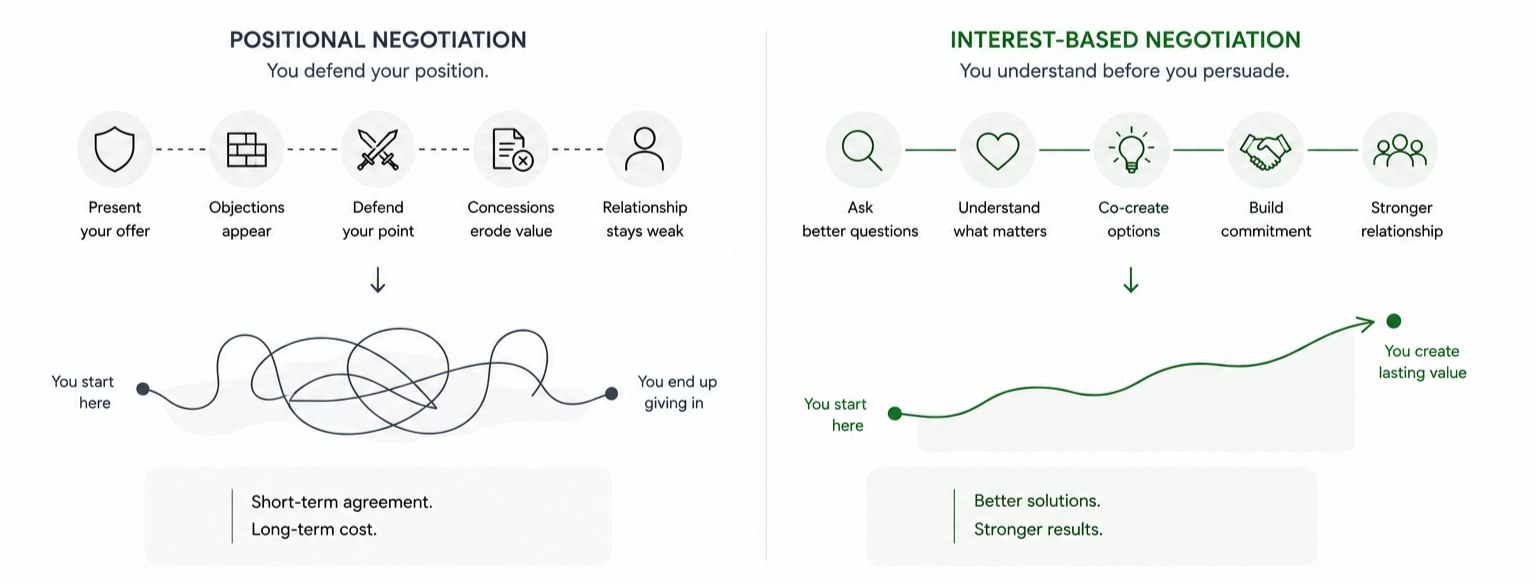
The amateur version treats negotiation as a conversation, and therefore treats skill as verbal agility. The professional version treats it as the last few hours of a preparation process where the outcome was largely decided before anyone opened their mouth. What actually determines the result is how well the requirement is defined, how many credible alternatives exist, how accurately you understand the supplier's cost structure and capacity situation, and how much time pressure each side is genuinely under. All four are set in advance.
Which is why the four preceding skills matter here rather than in the abstract. Communication is what made the requirement unambiguous. Emotional intelligence is what tells you whether the supplier's firmness is real or performed. Leadership is what got you into the conversation early enough to still have options. Resilience is what stops you conceding structure because the plant is calling every hour.
The mechanism worth understanding is what competitive tension does to price formation. In a bilateral discussion, the supplier's price is a function of what they believe you'll accept. In a genuinely contested process it becomes a function of what they believe the market will accept, which is a different and usually lower number. That isn't a psychological trick, it's a change in the information the supplier has when they set their price. Sequential bilateral negotiations, however skilfully run, can't reproduce it, because each supplier is still pricing against their estimate of your patience rather than a live signal of where the market sits.
That's where structured competitive mechanisms, eAuctions among them, earn their place: not as a replacement for negotiation skill but as a way of getting real price discovery where the market is contestable and the requirement clearly specified. The condition matters. Applied to leverage categories with several qualified suppliers, the mechanism does something no amount of individual skill achieves alone. Applied to a strategic single-source relationship, it damages something that took years to build and returns very little. Knowing where it applies is itself a judgment call, and it's the one that separates teams running competitive processes well from those running them everywhere and wondering why the supply base turned adversarial.
The strongest negotiators are also clear about what they're optimizing. Cost, quality, lead time and relationship durability aren't independent, and every concession on one is a purchase of another. Squeezing the last two percent from a supplier already at marginal cost hasn't created value, it's bought a fragile supply line at a discount, and the invoice for that arrives later, in quality escapes or in the supplier's unavailability when capacity gets tight.
The Future Procurement Skills Every Team Needs
None of these five are personality traits you either have or don't. They're practices, and they're trainable, which is why it's worth being precise about what you're actually developing.
There's also a shift underway that makes them more valuable, not less. The analytical work that used to fill most of a category manager's week, spend classification, benchmarking, normalizing responses, scanning the market, is steadily becoming something the process handles rather than something a person does. That doesn't shrink the human contribution, it concentrates it. Once the mechanical layer is handled, what's left is exactly the work that can't be systematized: reading a supplier's real constraint, holding an internal position that's unpopular and correct, deciding which relationships to protect and which to test.
Which reframes what a procurement leader should actually be measuring. Not whether the team is analytically strong, that's table stakes now, but whether the analytical load is leaving them enough room to be present in the conversations where the outcome is decided. A category manager spending three days normalizing bids is a category manager not spending three days with the supplier who could have restructured the requirement.
The teams that pull ahead over the next decade won't be the ones that automated the most. They'll be the ones that worked out which parts of the job were never automatable, and built everything else around protecting them.

.png)

.png)