
Five ERPs, three tiers: why most manufacturers buy a system for the company they wish they were
The most expensive ERP failures in manufacturing rarely come from bad software. They come from tier mismatch: a 200-person Tier 3 supplier implementing a system designed for a multinational, or a Tier 1 OEM (Original Equipment Manufacturer) stretching a mid-market platform far beyond its structural limits. In both cases, the company bought an ERP for the organization it imagined itself to be, not the one it actually operates.
This matters more than it used to, supply chains have become less forgiving. OEMs push data requirements, traceability demands and cost transparency down the chain. Tier 2 and Tier 3 suppliers are asked to behave, digitally, like companies ten times their size. The instinctive answer is to buy a bigger system but it’s often the wrong answer.
Here is how to think about ERP selection based on where you actually sit in the supply chain, which five platforms dominate each segment, and the one thing your ERP should never be asked to do.
Tier 1, Tier 2, Tier 3: your position in the supply chain defines your ERP requirements
Before comparing platforms, the tiers themselves need to be clear, because vendors deliberately blur them.
What the manufacturing tiers actually mean, beyond company size
The tier structure describes your distance from the final product, and by extension, the complexity you are forced to absorb.

Tier 1 suppliers sell directly to OEMs. They integrate complex assemblies, manage their own multi-level supplier base, and operate under contractual obligations on quality, traceability and delivery that leave no room for improvisation. Think of a systems integrator delivering complete modules to an automotive or aerospace firm. Revenue typically exceeds one billion dollars, operations span multiple plants and countries, and the supplier base is deep and fragmented.
Tier 2 suppliers sell components and sub-assemblies to Tier 1s. They are the mid-market backbone of industrial supply chains: typically 100 million to 1 billion in revenue, one to a handful of plants, real engineering capability, but leaner support functions. They inherit the compliance requirements of their Tier 1 customers without inheriting their resources.
Tier 3 suppliers provide raw materials, standard parts and basic processing: machining, casting, surface treatment, fasteners. Often family-owned, often under 100 million in revenue, frequently under 50. Their complexity is operational, not organizational.

When Does a Manufacturing Company Actually Need an ERP?
An ERP does one thing that nothing else does at scale: it creates a single version of operational truth. Inventory, orders, costing, capacity, invoicing, all reconciled in one system of record. For Tier 1 and Tier 2 manufacturers, this is not optional. When an OEM audit asks you to trace a batch across three plants, or when a customer demands landed-cost transparency per part number, spreadsheets collapse.
The honest caveat, and the one most ERP content avoids: a Tier 3 manufacturer does not always need an ERP. A 30-person machining shop with two production cells and forty active customers can run on a good MES or a lightweight MRP tool, disciplined spreadsheets, and clean accounting software. The trigger points that justify the jump are concrete: multi-site operations, customer-mandated traceability, inventory value that makes stock errors materially expensive, or growth past roughly 100 employees where tribal knowledge stops scaling. Below those thresholds, a full ERP implementation consumes 18 months of management attention to digitize processes that were not the constraint.
The strategic error is symmetric at the top and bottom of the chain: Tier 3s over-buy to look credible to their customers, Tier 1s under-invest in the discipline the system requires and end up with an expensive database nobody trusts.
Best ERP Software for Tier 1, Tier 2 and Tier 3 Manufacturers
The market offers dozens of platforms. Five of them cover the realistic decision space for most manufacturers, provided each is matched to its natural tier.
SAP S/4HANA: the Tier 1 default ERP, and a Tier 2 trap
For Tier 1 manufacturers, S/4HANA remains the reference. Its strength is exactly what makes it heavy: it models organizational complexity that genuinely exists at that scale. Multi-country legal entities, intercompany flows, deep variant configuration, plant-level costing consolidated globally. If your OEM customers run SAP, which in automotive and aerospace they almost certainly do, data exchange and audit alignment become simpler.
The trap is downstream: Tier 2 companies regularly buy S/4HANA to signal maturity to their customers, then discover that the implementation assumes internal IT capacity, process governance and change-management bandwidth they do not have. A mid-market manufacturer running a half-configured SAP instance has the costs of Tier 1 infrastructure with the data quality of spreadsheets.
Oracle Fusion Cloud ERP: the Tier 1 alternative with a data-first bias
Oracle Fusion competes for the same large-enterprise segment with a different center of gravity: financials, analytics and supply chain planning are its strongest surfaces. It suits Tier 1 organizations where the CFO agenda drives the ERP decision, or groups consolidating acquisitions that arrive with heterogeneous systems. Manufacturing execution depth is real but historically less granular than SAP's in discrete, high-mix environments. The selection question at this level is rarely about features. It is about which ecosystem your organization can actually govern for the next fifteen years.
Microsoft Dynamics 365: the upper Tier 2 pragmatist
Dynamics 365 Finance and Supply Chain Management has become the rational choice for Tier 2 manufacturers between roughly 150 million and a billion in revenue. Its argument is architectural: native integration with the Microsoft stack your teams already live in, a large partner ecosystem that keeps implementation costs negotiable, and enough manufacturing depth for most discrete and process environments. Its weakness is the flip side: quality varies enormously by implementation partner, and manufacturers with highly specific shop-floor logic often end up customizing more than planned. For a Tier 2 with standard-to-moderate process complexity, it is usually the best effort-to-value ratio available.
Epicor Kinetic: the manufacturing-native Tier 2 specialist
Where Dynamics is a generalist adapted to manufacturing, Epicor Kinetic was built from the shop floor up. Job costing, scheduling, engineer-to-order and configure-to-order flows are native, not bolted on. It fits Tier 2 discrete manufacturers, particularly in metal fabrication, industrial equipment and aerospace sub-tiers, where production logic is the business. The trade-off is a smaller ecosystem and less corporate-function polish than the megasuites. Infor CloudSuite Industrial plays in the same segment with similar logic; the choice between them usually comes down to regional partner strength and vertical fit.
Oracle NetSuite: the Tier 3 entry point that scales into Tier 2
For Tier 3 manufacturers that have crossed the thresholds described above, NetSuite is the most defensible starting point. Cloud-native from origin, fast to deploy relative to the category, strong financial core, adequate manufacturing functionality for standard discrete production. It will not run a complex multi-plant scheduling problem, and it is not meant to. Its role is to give a growing supplier a clean system of record without a transformation program. Companies that outgrow it tend to graduate toward Dynamics or Epicor, and that migration path is a feature, not a failure.
What your ERP should do, and what it should never be asked to do
This is where most ERP strategies quietly go wrong, at every tier.
Your ERP should be the system of record: master data, orders, inventory, costing, invoicing, compliance trails. Everything that requires one reconciled truth. Judged on data integrity and process discipline, not on ambition.
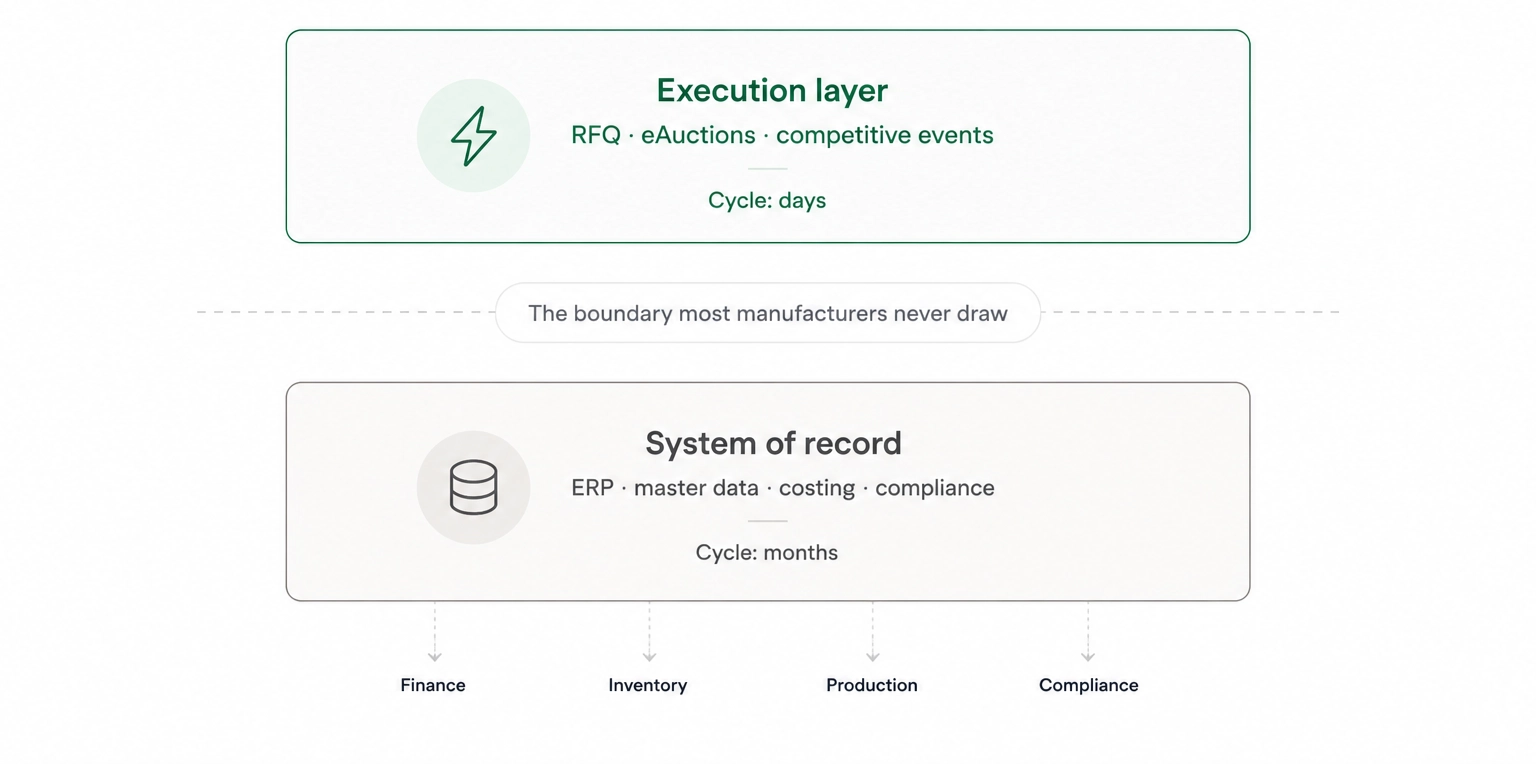
What it should never be asked to do is execute your negotiations. The sourcing modules bundled into large suites, and the AI roadmaps attached to them, promise end-to-end coverage. In practice, procurement teams inside legacy procure-to-pay environments know the pattern: long deployments, IT dependency for every workflow change, supplier portals that vendors tolerate rather than engage with, and negotiation events that take weeks to configure. The system of record becomes an anchor on the function that most needs speed.
The distinction follows Kraljic logic. For leverage categories, where competition between capable suppliers is the value driver, what creates savings is structured competitive pressure executed quickly: clean RFQ templates, comparable offers, well-designed eAuction events. That is an execution problem, not a record-keeping problem, and execution layers move at a different clock speed than ERPs. For strategic categories, where the relationship dominates, the human factor leads and no system should pretend otherwise. Non-critical spend calls for standardization and automation. Bottleneck items call for risk management first. An ERP supports all four quadrants with data. It wins in none of them on its own.
There is a supplier-side dimension to this that ERP-centric thinking misses entirely. Suppliers respond better, with sharper pricing and fewer defensive buffers, when the process facing them is clear: neutral specifications, visible evaluation criteria, explicit rules. A well-run competitive event is not pressure applied to suppliers; it is clarity offered to both sides. Heavy supplier portals, designed around the buyer's internal workflow, tend to produce the opposite: friction, low-quality responses, and quiet disengagement from exactly the suppliers you most want competing. Demanding industrial buyers, including first-rank aerospace and multi-site manufacturing organizations operating under intense supplier-market pressure, have learned this distinction the hard way: the ERP holds the truth, but the negotiation happens somewhere faster.
The system of record is not the system of leverage
Choose your ERP by tier, honestly assessed. Tier 1: S/4HANA or Oracle Fusion, with the governance to match. Tier 2: Dynamics 365 for breadth, Epicor Kinetic for manufacturing depth. Tier 3: NetSuite when the thresholds are crossed, and disciplined simplicity when they are not.
Then draw the boundary clearly. The deeper shift in manufacturing procurement is not that systems are getting bigger. It is that the functions creating margin, negotiation above all, are separating from the systems keeping score. Companies that recognize this run a stable, well-governed ERP as their foundation, and a fast execution layer on top of it for sourcing and negotiation, where cycle time and competitive pressure decide outcomes. Companies that do not keep asking their system of record to win negotiations it was never designed to enter.
Your ERP tells you what you spend. It will not change what you pay. If your negotiation phase still moves at ERP speed, that is the constraint worth removing first. CROWN operates the negotiation layer: structured RFQs, expert-run eAuctions, measurable incremental savings, live within weeks, without an IT project. Talk to us about your next sourcing wave.

.png)

.png)