


An L1 bidder is the bidder with the lowest evaluated price among the offers that meet the tender's requirements, and it usually, but not always, wins the contract.
The term comes from Indian public procurement. Bids that pass the technical check are ranked by price: L1 (lowest 1) first, then L2 and L3. India's General Financial Rules (GFR) 2017 say a contract should ordinarily go to the lowest evaluated bidder whose bid is responsive and who is qualified to perform it.
"Ordinarily" matters. Preference rules, quality-based selection, ties and withdrawals can all move the contract away from L1, so the tender should state them upfront.
General information, not legal advice. Last reviewed: 24 November 2026.
Key takeaways
- L1 is a rank, not a price tag: it is the lowest evaluated price among qualified bids.
- Evaluated price means total cost: taxes, freight and other stated costs count, not only the quoted figure.
- L1 is the default winner: the GFR 2017 make it the normal award rule.
- Preference rules can share the order: small and local suppliers may be invited to match the L1 price.
- Published rules protect the award: state the method in the tender, then award by it.
What do L1, L2 and L3 mean in a tender?
L1, L2 and L3 rank the qualified bids by evaluated price: lowest, second lowest and third lowest. Only bids that pass the technical and commercial check are ranked.
H1 is the highest-priced bid. In a buying tender, H1 ranks last. In a government sale, such as a scrap auction, the H1 bidder wins.
How is the L1 bidder decided?
The L1 bidder is decided on evaluated price, the total cost to the buyer, not the number on the quote. The Department of Expenditure's Manual for Procurement of Goods 2024 (para 7.5) compares financial bids on total outgo, including goods and services tax (GST), freight, insurance and duties, unless the tender says otherwise.
Three rules shape the ranking:
- Only responsive bids count. A bid must meet the tender's technical and commercial conditions first.
- Loadings must be announced. Prices can be adjusted for deviations, or for features such as low running costs, only if the tender says how.
- Conditional discounts are ignored. Only unconditional discounts change the ranking.
Where the tender says so, life-cycle cost can count too: the manual shows the highest quote becoming L1.
Worked example (illustrative)
Illustrative example, not a real tender. Three bidders quote for the same supply. One lakh is 100,000 rupees.
- Bidder A: quotes ₹10 lakh, delivered, GST included. Evaluated price: ₹10 lakh (about €9,400). Rank: L1.
- Bidder C: quotes ₹10.1 lakh, delivered, GST included. Evaluated price: ₹10.1 lakh (about €9,500). Rank: L2.
- Bidder B: quotes ₹9.6 lakh (about €9,000) ex-works. Freight and insurance add ₹0.6 lakh (about €600). Evaluated price: ₹10.2 lakh (about €9,600). Rank: L3.
Euro amounts are approximate, converted at the ECB reference rate of 30 October 2026 (€1 = ₹106.08) and rounded to the nearest €100.
Bidder B quoted the lowest number but ranks L3 once delivery is added.

Does the L1 bidder always win the contract?
Not always. L1 is the default winner, and GFR Rule 173(xvi) makes it the ordinary rule rather than an absolute one. Three set-ups can move part or all of the contract to another bidder, and the tender must state them in advance.
Purchase preference for micro and small enterprises (MSEs)
Under the Public Procurement Policy for MSEs Order 2012, central ministries and public sector undertakings must buy at least 25% of their annual procurement from MSEs, a target raised from 20% in 2018. When L1 is not an MSE, MSEs quoting within L1+15% may supply up to 25% of the tender value by matching the L1 price, according to the Ministry of MSME's policy FAQs (2022).
In the example, Bidder C is within 15% of L1. If C were an MSE and matched ₹10 lakh, it could supply a quarter of the order.
Purchase preference for local suppliers (Make in India)
The Public Procurement (Preference to Make in India) Order 2017, as revised on 19 July 2024 by the Department for Promotion of Industry and Internal Trade (DPIIT), sets a 20% margin of purchase preference. A Class-I local supplier has at least 50% local content, unless a higher figure is notified.
If L1 is not Class-I and the goods are divisible, L1 gets half the quantity. The lowest Class-I bidder within L1+20% may match the L1 price for the other half. This applies only to price-only evaluations.
Quality and cost based selection (QCBS)
In QCBS, the highest combined score wins, not L1. Under GFR Rule 192, used for consultancy, technical and financial scores are weighted, for example 70:30, and the technical weight cannot exceed 80%.
What happens if two bidders tie, or L1 backs out?
Ties follow a fixed order, and an L1 that withdraws during evaluation usually means a re-tender, according to the manual.
- Tie at L1 (para 7.5): after ruling out a cartel, the order goes to a tied MSE, with priority for MSEs owned by Scheduled Caste or Scheduled Tribe or women entrepreneurs. Otherwise, the tied bidder with the higher turnover last year wins. On GeM, the portal's own tie-breaker applies.
- L1 withdraws during evaluation (para 7.6.2): the tender must be re-tendered, and the withdrawn price is not used as a benchmark.
- Withdrawing has a cost: bid security is forfeited if a bidder withdraws within the validity period, or if the winner fails to sign the contract.
- L1 cannot supply it all: for ad hoc needs, GFR Rule 173(xvi) lets the buyer order the rest from the next bidder at L1's rates.
Can a buyer negotiate with the L1 bidder?
Only in exceptional cases, and only with L1. GFR Rule 173(xiv) says negotiation after bid opening must be severely discouraged. Where it is unavoidable, it is held only with the lowest evaluated responsive bidder.
The manual (para 7.6.9) lists the cases: L1's price is unreasonable and the purchase is by nomination, from limited sources or urgent, or a cartel is suspected. Reasons must be recorded, which matters because vigilance officers, who report to the Central Vigilance Commission (CVC), audit procurement decisions.
Negotiation does not move the preference bands. MSE and Make in India margins are still measured from the original L1 price.
How does a reverse auction change who is L1?
A reverse auction re-ranks bidders live. Under GFR Rule 167, bidders submit successively better bids during a set period, bids are evaluated automatically, and the best bid at the close becomes L1.
On GeM (the Government e-Marketplace), purchases above ₹10 lakh need bids through online bidding or a reverse auction (GFR Rule 149). When a tender is followed by a reverse auction, the manual (para 4.5) keeps the highest bidders out and ranks each bidder on the lower of its auction bid and its tender price. Preference holders can still match the final L1 price, and there is no negotiation after the close. In CROWN, each supplier also sees its own live rank. Our guide to how a reverse auction works on GeM walks through each step.
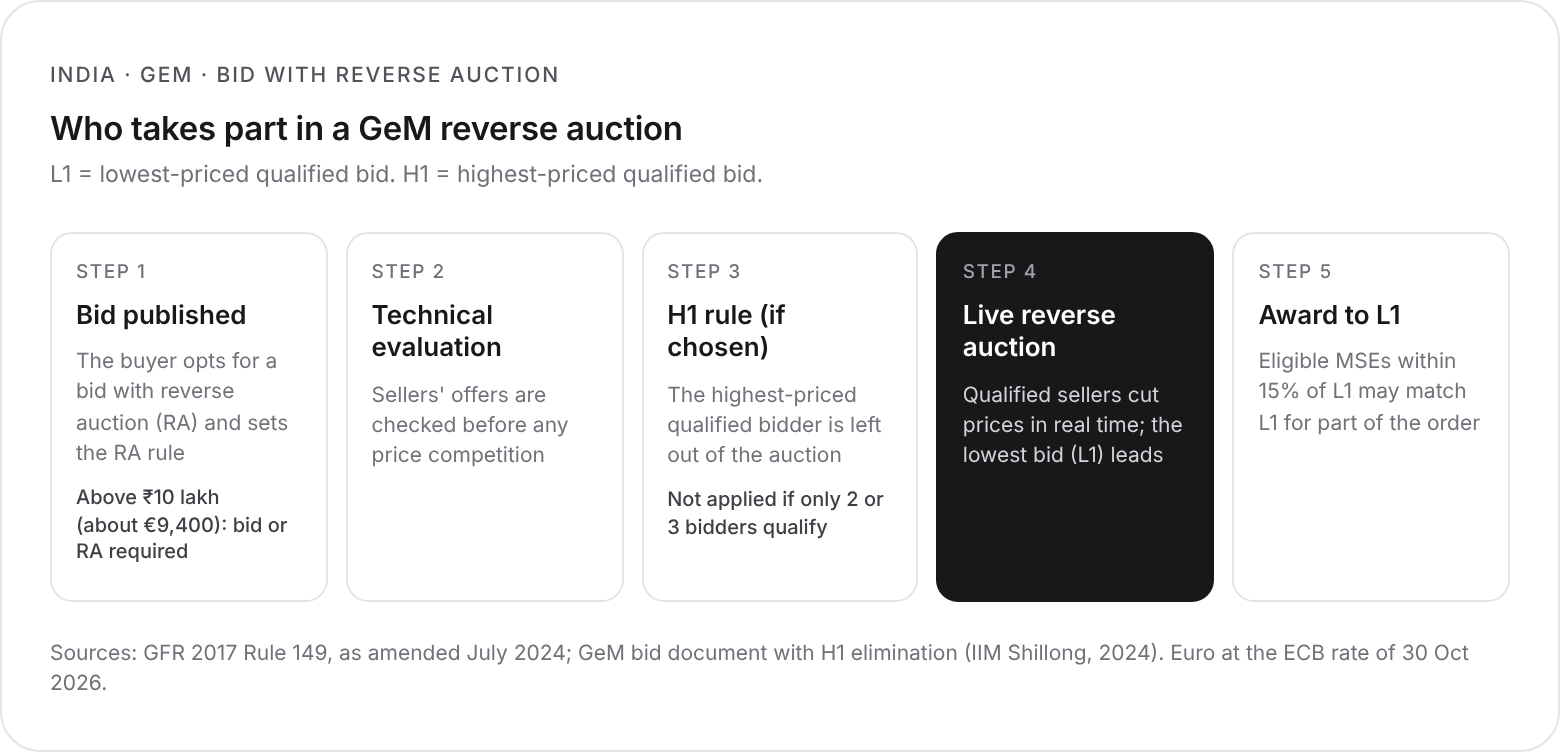
The manual names the conditions for success: a detailed specification, a competitive market (say more than five qualified bidders) and criteria expressed in money. Outside government, the lowest bidder after an eAuction wins only if the rules say so.
The bottom line
An L1 bidder is the lowest evaluated qualified bidder, and in Indian public tenders it usually wins. Preference rules, QCBS and the tie and withdrawal rules decide when it does not. Publish the method in the tender, then award by it.
The CROWN eAuction platform ranks suppliers live on the award rule you publish and keeps a record of every bid. Book a demo to see how it works.
FAQ
What is an L1 bidder?
The L1 bidder is the qualified bidder with the lowest evaluated price in a tender. "L1" stands for "lowest 1".
What is L1, L2 and L3 in purchase?
The ranks of qualified quotations, from the lowest evaluated price upwards. L2 and L3 matter when L1 cannot supply everything.
What happens if an L1 bidder backs out?
It usually loses its bid security. If it withdraws during evaluation, the Manual for Procurement of Goods 2024 says the tender must be re-tendered.
What is an H1 bidder?
The bidder with the highest price. In a buying tender it ranks last; in a government sale, such as a scrap auction, H1 wins.
Can we negotiate with an L1 bidder?
Only in exceptional cases, and only with L1, under GFR Rule 173(xiv). The reasons must be recorded.
What are the four types of bids?
There is no official list of four. The GFR 2017 name advertised, limited and single tender enquiries and the electronic reverse auction, and bids can be sent in one packet or as separate technical and financial bids.