

On India's Government e-Marketplace (GeM), a reverse auction is a live online event where technically qualified sellers cut their prices, and the lowest bid, called L1, wins.
The stakes are large. GeM handled over ₹5 lakh crore (about €47 billion) of orders in 2025–26, and more than ₹20 lakh crore (about €189 billion) since it started operating in August 2016.
Euro amounts are approximate, converted at the ECB rate of 30 October 2026.
Key takeaways
- L1 is the lowest-priced qualified bid; H1 is the highest. L1 wins the reverse auction.
- Above ₹10 lakh (about €9,400), a bid or a reverse auction is required on GeM.
- Technical evaluation comes first. Only qualified sellers enter the auction.
- The H1 rule is optional. When the bid uses it, the highest bidder is left out, unless only two or three qualify.
- Savings are real. Official figures cover the whole platform, so measure each auction on its own.
What do L1 and H1 mean on GeM?

They are price ranks among the technically qualified bids.
- L1 (lowest 1): the lowest-priced qualified bid. L2 is the second lowest, and so on. L1 wins.
- H1 (highest 1): the highest-priced qualified bid. Some bids exclude H1 from the reverse auction.
When must a GeM buyer run a bid or reverse auction?
Rule 149 of the General Financial Rules (GFR) 2017 makes it mandatory for ministries and departments to buy goods and services available on GeM. A July 2024 amendment (Department of Expenditure OM No. F.1/3/2024-PPD of 10 July 2024), relayed in this office order, sets three bands:
Up to ₹50,000 (about €470)
- Buy from any available supplier that meets the requirement.
₹50,000 to ₹10 lakh (about €470 to €9,400)
- Buy from the L1 seller, comparing at least three different manufacturers.
Above ₹10 lakh (about €9,400)
- Obtain bids through GeM's online bidding or reverse auction tool.
So the reverse auction is one of two options at the top band. The buyer decides which, and states the choice in the bid document.
How does a reverse auction work on GeM?
GeM uses a two-step process. Sellers are evaluated technically first. Then all qualified sellers are invited to the reverse auction, subject to the rule set in the bid.
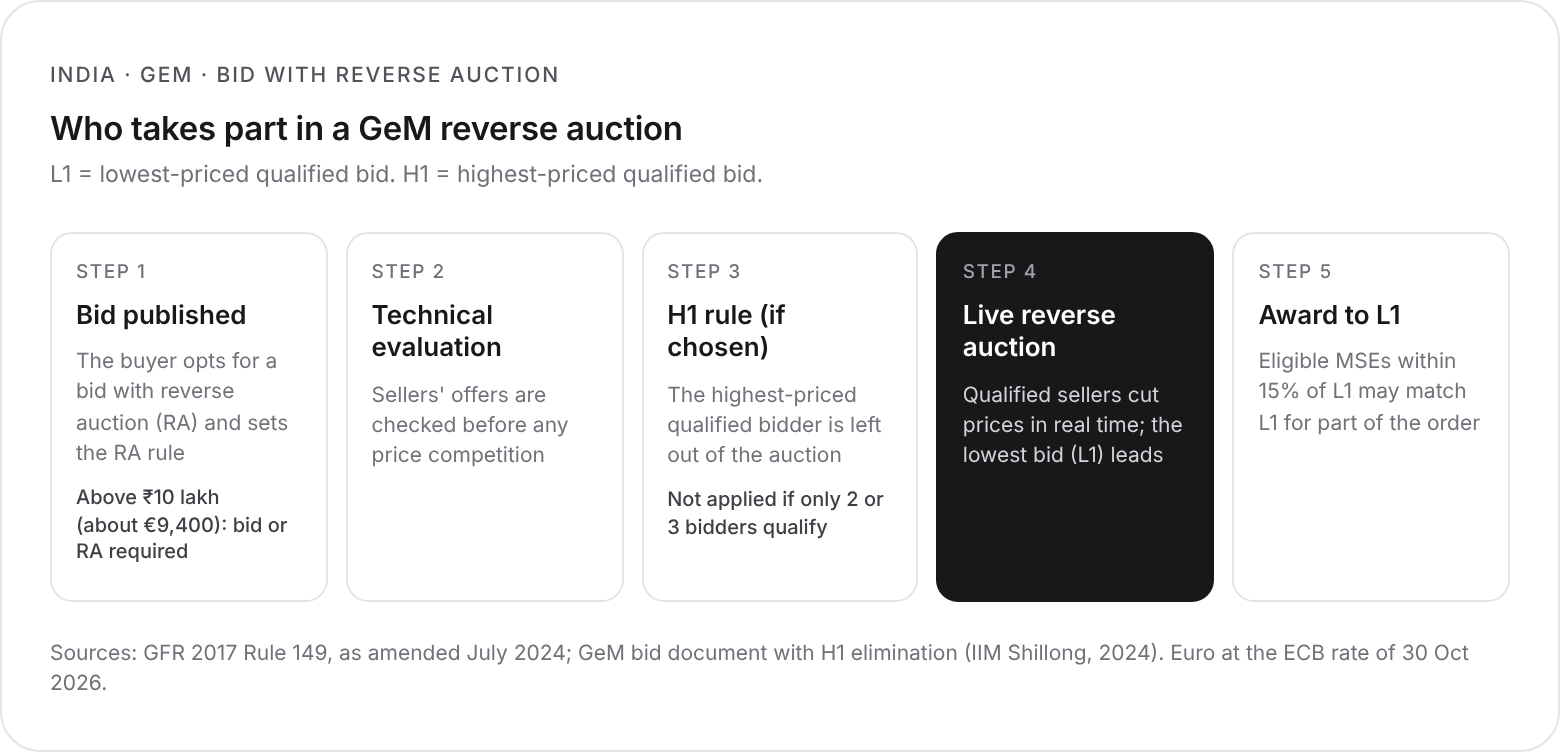
- The buyer publishes a bid with reverse auction (RA). The bid document sets the RA rule, such as H1 elimination.
- Technical evaluation. Offers that fail the requirements are rejected before any price competition.
- The RA rule is applied. If the bid uses H1 elimination, the highest-priced qualified bidder drops out.
- Live bidding. Qualified sellers cut their prices in real time. The current lowest bid is L1.
- Award. The contract goes to L1, subject to India's purchase preferences for small firms.
What is the H1 rule, and when does it not apply?
The H1 rule removes the highest-priced qualified bidder before the auction. It pushes the others to bid hard, since the top price cannot win anyway.
It applies only when the bid document says so. In one 2024 GeM bid, H1 stays in the auction when:
- only two or three bidders qualify technically;
- the order is split among several sellers, and H1 falls within that number;
- removing H1 would leave products from a single manufacturer;
- H1 is a small or micro enterprise (MSE) within 15% of a non-MSE L1;
- H1 is a "Make in India" bidder within 20% of a non-local L1.
After the auction, the same bid lets an eligible MSE within 15% of L1 match the L1 price and win part of the order.
Do GeM reverse auctions lower prices?
The platform does, and the auction is one of its tools.
Platform savings. The Government of India cites a World Bank assessment of 9.75% average savings on median prices between February 2019 and January 2020. That covers all GeM buying, not reverse auctions alone.
A newer IIT Delhi comparison cited by the government in August 2026 found GeM cheaper than other e-marketplaces for 74.3% of 101 items, with a spend-weighted saving of 13.6%.
Auctions outside GeM. India also uses reverse auctions for energy. In a May 2020 auction for round-the-clock renewable power, the lowest tariff fell by 69 paise (about 0.65 euro cents) over almost three hours of bidding, to ₹2.90/kWh (about 2.7 euro cents) in the first year.
What makes it work. A reverse auction delivers most with enough qualified sellers. That is why the H1 rule switches off when only two or three qualify: every bidder is kept in the competition.
What can other buyers learn from GeM?
- Qualify first, then auction. GeM checks every offer before price competition, so L1 can be awarded without surprises. CROWN works the same way: suppliers qualify, and submit an opening bid, before the live event.
- Publish the rule upfront. GeM states the RA rule, such as H1 elimination, in the bid. Suppliers know who will compete before they price.
- L1 is not the only option. GeM ranks on price. Where quality matters, a weighted event decides the winner on more than price. See whether the lowest bidder must win.
- Measure the auction, not just the platform. Compare the opening and closing prices of each event, as in a post-eAuction analysis.
The bottom line
On GeM, a reverse auction is a live price contest among technically qualified sellers, and L1 wins. It becomes an option above ₹10 lakh, where the buyer must run a bid or an auction. The H1 rule can sharpen competition, but only when there are enough bidders to spare one.
The CROWN eAuction platform runs both price-only reverse auctions and weighted events, with qualification before bidding and every bid recorded. Book a demo to see how it works.
FAQ
What is the reverse auction process on GeM?
Bids are evaluated technically first. Qualified sellers then cut their prices live, and the lowest (L1) bid wins. Some bid documents exclude the highest bidder (H1).
What is the difference between bidding and reverse auction on GeM portal?
In a bid, each seller's submitted price is final. In a bid with reverse auction, qualified sellers can improve their prices in a live event after technical evaluation.
What is L1 in GeM?
The lowest-priced technically qualified bid. In a reverse auction, L1 at the close wins the contract, subject to purchase preferences for small firms.
What is H1 elimination in a GeM reverse auction?
An optional rule that removes the highest-priced qualified bidder from the auction. It does not apply when only two or three bidders qualify.
What are the GFR rules for reverse auction?
Under GFR Rule 149, as amended in July 2024, purchases above ₹10 lakh (about €9,400) on GeM must use online bidding or the reverse auction tool.
Is a reverse auction mandatory on GeM?
Not on its own. Above ₹10 lakh, the buyer must run a bid or a reverse auction, and chooses which.