
Yes. Electronic auctions are allowed under the UK Procurement Act 2023, even though the Act has no dedicated section on them.
The tender notice must say whether one will be used, and the contract still goes to the most advantageous tender under the published award criteria. The Act has governed most UK public procurement since 24 February 2025. And eAuctions are on the rise: in September 2026, law firm Burges Salmon reported the growing use of electronic auctions in NHS procurement.
Still, the missing rulebook leaves many contracting authorities unsure what is allowed, and suppliers unsure what to expect.
General information, not legal advice. Last reviewed: 30 October 2026.
Key takeaways
- Allowed under the Procurement Act 2023, even though the Act has no dedicated section on them.
- Announce it in the tender notice (Procurement Regulations 2024, regulation 18).
- It fits the open procedure, the competitive flexible procedure, frameworks and dynamic markets.
- Award to the most advantageous tender, after checking very low bids.
- The old PCR 2015 safeguards remain good practice.
What does the Procurement Act 2023 say about electronic auctions?
The Act sets principles and two competitive procedures. The auction detail sits in secondary legislation and guidance.
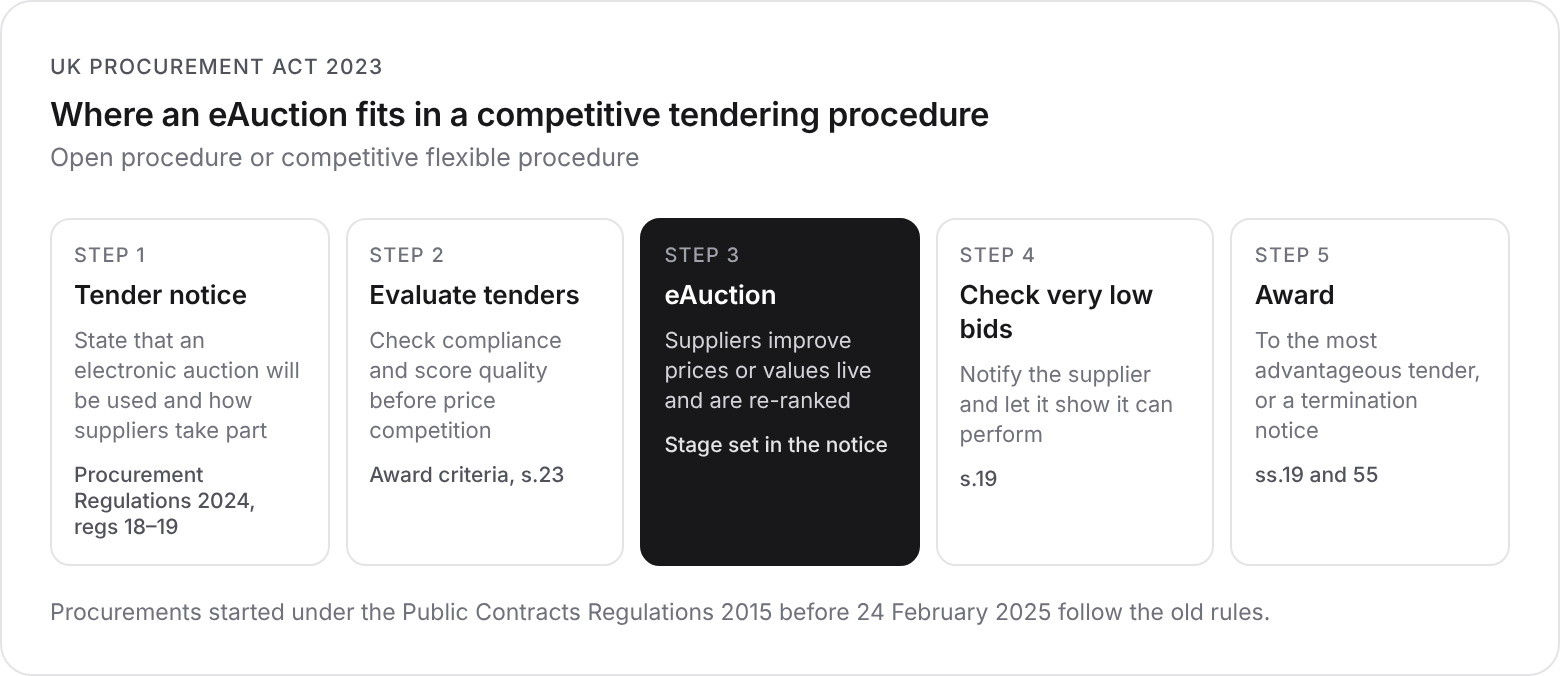
- The Procurement Regulations 2024. Regulation 18 requires an open procedure tender notice to state whether an electronic auction will be used, and how suppliers can take part. Regulation 19 applies the same requirement to the competitive flexible procedure.
- A working definition. Regulation 18 describes an electronic auction as an iterative electronic process. Suppliers submit new prices, or new values for quantifiable non-price elements, and tenders are ranked again.
- Government guidance. The guidance on competitive tendering procedures confirms the tender notice must describe any planned auction. The official e-learning lists e-auctions as a process used to reach the lowest price, with a reverse auction for standardised ICT equipment as its example.
Where do e-auctions fit in the new procedures?
- Open procedure: a single stage, open to all. State the auction in the tender notice.
- Competitive flexible procedure: you design the stages. An auction can follow the evaluation of initial tenders.
- Frameworks: call-offs follow the competitive selection process set out in the framework (ss.45–46). Describe any auction in the framework terms.
- Dynamic markets: contracts are awarded by competition among members (ss.34–40). Set out any auction stage in the procurement documents.
How is the winner chosen?
Under section 19, a contracting authority may award the contract to the supplier that submits the most advantageous tender. That is the tender that meets the requirements and best satisfies the award criteria.
Price can be the only criterion. That is where a price-only reverse auction fits best. If quality also counts, the auction should rank on a weighted score.
Section 19 also covers very low bids. Before disregarding an abnormally low tender, the authority must notify the supplier and give it a reasonable chance to show it can perform. Prices can fall fast in an auction, so build this step into your timetable.
What changed from the Public Contracts Regulations 2015?
Under PCR 2015, regulation 35 set out a detailed rulebook for electronic auctions. The Procurement Act 2023 removes most of that detail.
- Auction rules: a full regulation under PCR 2015. The Act has no dedicated section; tender notice content sits in the 2024 Regulations.
- Precise specification: a legal condition under PCR 2015. Not stated in the Act, but still essential.
- Formula: stated in the invitation under PCR 2015. Under the Act, award criteria are published; the formula is good practice.
- Minimum timing: two working days after invitations under PCR 2015. Not stated in the Act.
- Bidder anonymity: required under PCR 2015. Not stated in the Act, but still good practice.
- Award: on the auction results under PCR 2015. Most advantageous tender under the Act (s.19).
Less detail does not mean less risk. The Act still requires a contracting authority to treat suppliers the same unless a difference justifies it. When the rulebook is your own, a badly designed e-auction is easier to challenge.
Who does the Act apply to?
- Most UK contracting authorities, for procurements started on or after 24 February 2025.
- Not older procurements. Those started under the 2015 rules continue under them.
- Not devolved Scottish authorities, in most cases, which follow Scotland's own rules.
How do you run a compliant e-auction under the Act?
- Choose the route. Open procedure for simple, well-defined needs. Competitive flexible procedure if you need a qualification or negotiation stage first.
- Announce it. State the auction and how it works in the tender notice.
- Fix the specification. Every supplier must price the same thing. Check there is enough competition first.
- Publish the award criteria and formula. Suppliers should know how price and quality combine into their rank. In CROWN, weighted decision logic builds quality, ESG or risk scores into the eAuction rules.
- Evaluate first. Only compliant tenders should compete on price.
- Commit to the result. Say upfront how the ranking leads to the award, and stick to it. Suppliers who doubt the outcome hold back their best price.
- Close the loop. Check very low bids, issue the required notices, and review the results. See our guide to post-eAuction analysis.
The bottom line
Electronic auctions are allowed under the Procurement Act 2023. The Act no longer tells you how to run them, so the discipline is yours: a precise specification, an announced auction, a published formula and an award that follows the criteria.
The CROWN eAuction platform lets you design the auction stage that fits your procedure, from price-only reverse auctions to weighted events. Book a demo to see how it works.
FAQ
What is an e-auction in procurement?
An online event where pre-qualified suppliers improve their prices, or other measurable values, in real time and are ranked automatically. Under the Procurement Act 2023, its use is announced in the tender notice.
What are the key changes in the Procurement Act 2023?
Two main competitive procedures (open and competitive flexible), award to the "most advantageous tender", a central digital platform for notices, a debarment list and more transparency notices across the contract life.
Are electronic auctions allowed under the Procurement Act 2023?
Yes. The Procurement Regulations 2024 require tender notices to say whether one will be used, and government guidance gives a reverse auction as an example.
Can I use a reverse auction in the competitive flexible procedure?
Yes. You design the stages of the procedure, and an auction can be one of them. Describe it in the tender notice.
Does the lowest bid win an electronic auction under the Act?
Not automatically. The contract goes to the most advantageous tender. If price is the only criterion, the lowest compliant bid will usually win.
Does the Procurement Act 2023 apply in Scotland?
Largely not. Devolved Scottish authorities are excluded, with narrow exceptions, and follow Scotland's own procurement rules.