
Yes. Public buyers in the EU and UK can legally run reverse auctions, also called eAuctions or electronic auctions, as long as they meet strict conditions.
In the EU, Article 35 of Directive 2014/24/EU allows them when the specification is precise, the auction is announced in advance and the award follows the published criteria. In the UK, they can be used under the Procurement Act 2023. Some countries are stricter: France allows them for supply contracts only.
The rules are not new. Electronic auctions have been part of EU public procurement law since Directive 2004/18. Yet legality is still the first question many public sector teams ask before their first event.
General information, not legal advice. Last reviewed: 9 October 2026.
Key takeaways
- Legal in the EU and UK, under strict conditions.
- EU: Article 35 of Directive 2014/24/EU allows eAuctions when the specification can be set precisely.
- Excluded: intellectual work, such as the design of works.
- UK: allowed under the Procurement Act 2023. The tender notice must say whether one is used.
- France is stricter: public eAuctions are allowed for supply contracts only.
What is a reverse auction in public procurement?
In public procurement law, a reverse auction is called an electronic auction. The UK's Procurement Regulations 2024 define it as an iterative electronic process. Suppliers submit new prices, or new values for quantifiable non-price elements, and the tenders are ranked again.
In practice, it is a live event. Suppliers see their rank and can improve their offer until the auction closes. A typical example: a reverse auction for high-volume, standardised IT equipment. For other formats, see our guide to digital negotiation formats.
When is an electronic auction legal under EU law?
Article 35 of Directive 2014/24/EU sets the conditions for every member state. A proposed EU regulation, published in September 2026, would replace the directive, but it is not yet law.
Where it can be used. In open procedures, restricted procedures and competitive procedures with negotiation. Also when reopening competition within a framework agreement, and for contracts under a dynamic purchasing system.
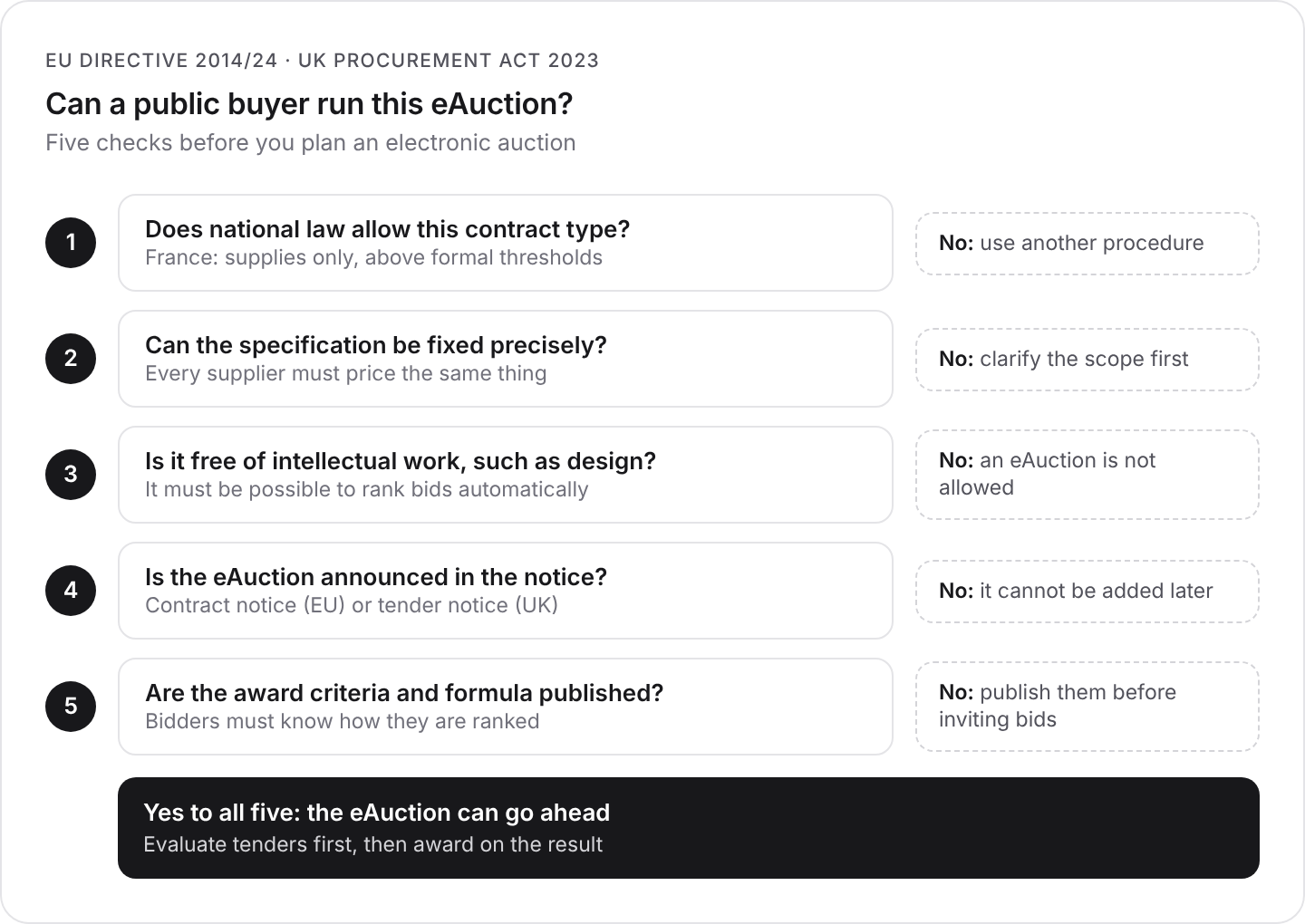
The key condition. The contracting authority's procurement documents, including the specification, must be "established with precision".
What is excluded. Contracts involving intellectual performances, such as the design of works, cannot be auctioned. They cannot be ranked automatically.
How it must be run.
- Before: announce the auction in the contract notice (or invitation to confirm interest), and evaluate all tenders in full first.
- Invitation: state the mathematical formula used for the ranking.
- Timing: start no sooner than two working days after invitations.
- During: bidders see their rank at any time; identities are never disclosed.
- After: award on the auction results, under the award criteria.
Are eAuctions legal in the UK?
Yes. After Brexit, the UK kept the EU model in regulation 35 of the Public Contracts Regulations 2015. Regulation 35 copied Article 35 almost word for word.
Since 24 February 2025, the Procurement Act 2023 has replaced those rules for most contracting authorities. The Act has no dedicated section on electronic auctions. But the Procurement Regulations 2024 require an open procedure tender notice to say whether one will be used. Government training material gives a reverse auction for standardised ICT equipment as an example.
Two exceptions apply. Procurements started under the 2015 rules continue under regulation 35. And devolved Scottish authorities largely fall outside the Act.
How do the EU, UK and France compare?
The Directive sets the outer limits. Member states can be stricter. France is the clearest case: article L2125-1 of its public procurement code allows electronic auctions only for supply contracts above the formal procedure thresholds.
EU: Directive 2014/24
- Legal? Yes.
- Contract types: supplies, services and works, if the specification is precise.
- Excluded: intellectual work, such as design.
- Detailed rules: Article 35.
UK: Procurement Act 2023
- Legal? Yes.
- Contract types: not limited by the Act.
- Excluded: not specified.
- Detailed rules: tender notice content (2024 Regulations).
France
- Legal? Yes.
- Contract types: supplies only.
- Excluded: services and works.
- Detailed rules: code articles R2162-57 to R2162-66.
Buying across borders? Always check the national code before planning an e-auction for services or works.
What are the downsides of using reverse auctions?
Most legal risks come from preparation, not from the format itself.
- A vague specification. If suppliers price different things, the ranking means nothing, and the auction may not be lawful. See when not to run an eAuction.
- A late announcement. The contracting authority must announce the auction from the start.
- A hidden formula. Bidders must know how they are ranked before the event.
- Unqualified bidders. Inviting suppliers you would never award to, just to push prices down, breaks trust and fair treatment. CROWN asks suppliers for an opening bid during qualification, so only committed suppliers enter the live event.
- Too few bidders. With one or two suppliers, a reverse auction adds little pressure.
The bottom line
eAuctions are legal for public buyers in the EU and UK. What makes one lawful is the preparation: a precise specification, an announced auction, a published formula and an award that follows the result. Check national rules first.
The CROWN eAuction platform supports price-only and weighted, multi-criteria events, with rules shared before bidding and every bid recorded. Book a demo to see how it works.
FAQ
What is a reverse auction in procurement?
A live online event where suppliers compete by lowering their prices, or improving other measurable values, and are ranked automatically. In public procurement law, it is called an electronic auction.
What is an e-auction in procurement?
The same thing as an electronic auction. It usually follows a full evaluation of tenders, and only compliant bidders take part.
What are the downsides of using reverse auctions?
They do not suit complex or creative work, they need a precise specification and enough bidders, and they can damage supplier relationships if run unfairly.
What is an example of a reverse auction?
A public body buying high-volume, standardised IT equipment. Pre-qualified suppliers bid down live, and the contract goes to the best-ranked bid.
Can public buyers auction services or works?
Under the EU Directive, yes, if the specification is precise and the work is not intellectual, such as design. France allows public electronic auctions for supplies only.
Do bidders know who they are bidding against?
No. Bidders see their rank, but the identities of other bidders are never disclosed during the auction.