
For many procurement leaders, the word “eAuction” still triggers mixed reactions.
Some see it as a powerful lever to unlock incremental savings and accelerate negotiation. Others associate it with aggressive price squeezing or supplier pushback. The truth, as always, sits somewhere in between.
eAuctions are not a tactic. They are a mechanism.
When properly designed and governed, they transform negotiation from a subjective, buyer-driven conversation into a structured, market-driven process. And like any mechanism, their impact depends entirely on how and when they are used.
In this article, we will clarify what eAuctions really are, how they fit into the procurement process, and provide an overview of the five main formats used in modern sourcing:
- Reverse English
- Reverse Dutch
- Reverse Japanese
- Reverse English with Transformation
- Hybrid format (English Top 3 + Dutch)
What Is an eAuction?
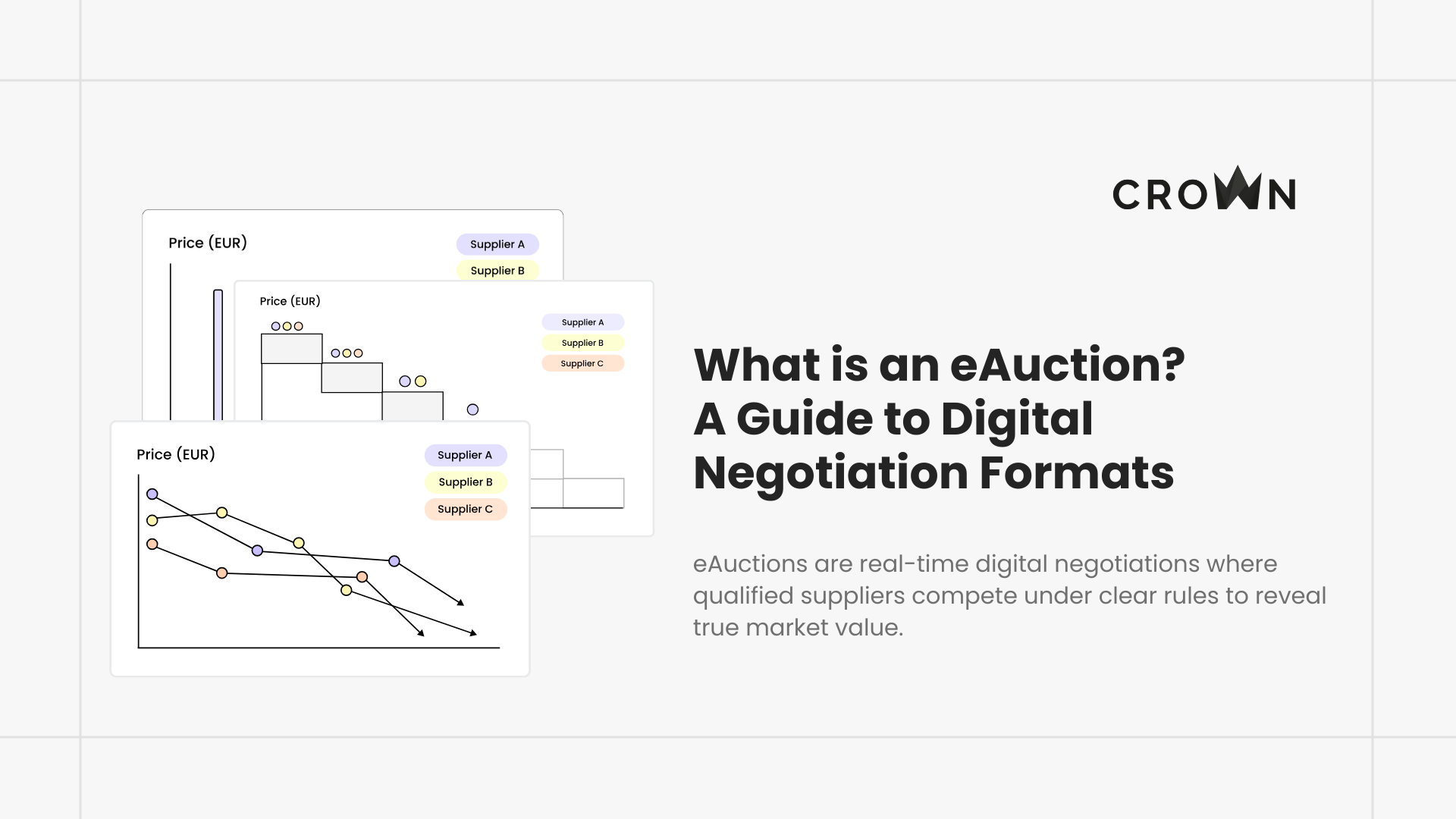
An eAuction is a real-time, digital negotiation process in which pre-qualified suppliers compete under predefined rules to offer their best commercial proposal.
It does not replace the RFP.
It does not replace supplier qualification.
It enhances only the traditional negotiation phase.
The sequence typically looks like this (picture of the process):
.png)
The critical elements of a professional eAuction are:
- Real competition (at least two credible suppliers)
- Clear and neutral specifications
- Transparent rules
- Commitment to award
- Pre-defined evaluation logic
When these conditions are met, the eAuction becomes a structured method of discovering the true market price or total value.
Now let’s look at the five main formats.
1. Reverse English eAuction
.svg)
The Reverse English auction is the most widely used and most intuitive format.
How It Works
- Suppliers submit an initial bid.
- During the live event, they see their rank (but not competitors’ prices).
- They can submit increasingly lower bids in real time.
- The event runs for a fixed duration, with possible automatic extensions if bids are placed near closing time.
- The lowest compliant bid wins, or ranking determines allocation logic.
When to Use It
Reverse English eAuctions are ideal when:
- Prices are close between suppliers.
- There are at least three qualified bidders.
- The category is relatively standardized.
- The objective is transparent price discovery.
Typical categories include packaging, freight, IT hardware, raw materials, and standardized services.
Why It Works
The power of the Reverse English format lies in competitive intensity. Suppliers react to their ranking position and adjust accordingly. The buyer does not need to “push.” The market dynamics drive the movement.
It shifts pressure from buyer tactics to peer competition.
2. Reverse Dutch eAuction
.svg)
The Reverse Dutch eAuction operates differently. Instead of suppliers lowering prices step by step, the buyer progressively increases the price until a supplier accepts.
How It Works
- The eAuction starts at a low initial price.
- The price increases in predefined increments over time.
- The first supplier to accept the displayed price wins immediately.
- The event stops as soon as a bid is accepted.
When to Use It
Reverse Dutch eAuctions are particularly effective when:
- There are few suppliers (two or three).
- The price gap between suppliers is large.
- The buyer wants to introduce urgency.
- There is dependency on a preferred supplier.
This format creates controlled pressure in less competitive environments.
Why It Works
The Dutch format leverages timing and urgency. Instead of reactive bidding, suppliers must decide when the price reaches their acceptable threshold.
It reveals true walk-away levels quickly and can generate surprisingly strong results even in limited competition scenarios.
3. Reverse Japanese Auction
.svg)
The Reverse Japanese eAuction introduces a disciplined, sequential dynamic.
How It Works
- The price starts high.
- The price decreases in predefined steps.
- At each round, suppliers must actively confirm their participation.
- If they refuse or fail to accept the current price, they exit permanently.
- The last remaining supplier wins.
When to Use It
Reverse Japanese eAuctions are useful when:
- The buyer wants to limit strategic signaling.
- The market has few suppliers.
- Confidentiality is important.
- The buyer wants to encourage truthful bidding.
Why It Works
This format reduces passive behaviors. Suppliers must decide on each price level. There is no ability to “wait and see” at the last second.
It encourages disciplined bidding and often prevents artificial price anchoring.
The Japanese format is particularly appreciated in sensitive industries where transparency must be balanced with discretion.
4. Reverse English with Transformation
One of the most persistent myths about eAuctions is that they are “price-only.”
Adding transformation to a Reverse English addresses this directly.
How It Works
- The base format is identical to a standard Reverse English eAuction.
- However, a value model is applied.
- Non-price parameters are weighted in advance (e.g., ESG score, quality rating, switching cost).
- Handicaps or scoring adjustments are integrated.
- Suppliers are ranked based on total value, not only raw price.
For example:
- Supplier A offers the lowest price.
- Supplier B has a stronger sustainability score.
- A predefined 3% handicap is applied to reflect ESG value.
- The ranking adjusts dynamically during bidding.
When to Use It
This format is appropriate when:
- Suppliers offer different service levels.
- Historical relationships matter.
- Quality variations exist.
- ESG or risk factors must be integrated.
Why It Works
Transformation models allow buyers to remain competitive without sacrificing strategic priorities.
It professionalizes evaluation logic and removes subjective post-negotiation adjustments.
Instead of saying “we prefer them because they feel safer,” the value is quantified.
5. Hybrid Format: English Top 3 + Dutch
.png)
Hybrid formats combine the strengths of multiple mechanisms.
One of the most effective models is a two-phase approach:
Phase 1: Reverse English
Phase 2: Reverse Dutch among Top 3 Suppliers
How It Works
- A standard Reverse English eAuction is conducted.
- The top three ranked suppliers are selected.
- A Reverse Dutch event is launched with these finalists.
- The first supplier to accept the increasing price wins.
When to Use It
Hybrid formats are useful when:
- The buyer wants broad competitive discovery.
- The final decision requires intensified pressure.
- High-value or sensitive categories are involved.
Why It Works
The English phase maximizes competitive compression.
The Dutch phase forces decisive commitment.
This combination often generates strong final price movement while maintaining perceived fairness.
When eAuctions Do Not Make Sense
.svg)
eAuctions are powerful but not universal.
They are not suitable when:
- There is only one supplier.
- The spend is too low to justify competition.
- The internal stakeholder has already selected a supplier.
- The category is entirely innovation-driven and non-comparable.
- Government-regulated pricing applies.
Appropriateness matters more than enthusiasm.
Beyond Price: What eAuctions Actually Deliver
%20(1).svg)
While savings are the most visible outcome, the real benefits go further:
- Faster negotiation cycles
- Increased transparency
- Reduced bias
- Digital audit trail
- Measurable incremental savings
- Standardized governance
In many organizations, negotiation remains the least structured phase of procurement. eAuctions introduce discipline without removing strategic judgment.
The Strategic Perspective
The real question is not “Should we use eAuctions?”
It is: “Which mechanism fits this category?”
- Competitive, standardized markets respond well to Reverse English formats.
- Limited competition may require Dutch or Japanese structures.
- Complex value environments benefit from transformation models.
- High-stakes decisions may justify hybrid formats.
Procurement maturity lies in understanding this menu of mechanisms and selecting the right one based on market conditions.

.png)