
.png)
A savings target is not a plan. It is a number, usually agreed in December, that says nothing about where the money will come from. A procurement savings roadmap is what turns that number into work: which categories, which lever, how much, and when.
Without one, effort goes where it is comfortable and procurement cost savings bunch up in Q4. Even signed deals lose value on the way: World Commerce & Contracting found that procurement contracts lose around 11% of their value after signature.
This guide covers the five steps to build a roadmap your team can run and your CFO will sign off.
Key Takeaways
- Data before deals. Build a spend baseline and agree with finance what counts as a saving.
- Score, don't guess. Rank every category on impact and ease to act.
- One category, one lever. Renegotiation, consolidation and competitive events each fit a different market.
- Contract dates set the pace. Plan in waves over 12 months.
- Count it at the invoice. A saving is real when it shows up in what you pay.
What Is a Procurement Savings Roadmap?
A procurement savings roadmap is a ranked, dated plan that shows which spend categories procurement will work on, which lever it will use for each, how much it expects to save, and when the savings will land. It turns an annual target into a sequence of projects.
It is the part of your procurement strategy roadmap that is measured in money: the bridge between your spend analysis and your negotiation calendar.
Why Savings Targets Get Missed?
Most missed targets have little to do with negotiation skill. They come from the plan, or the lack of one.
Effort goes where it is easy. Teams start with low-risk tail spend. The savings are real but too small to move the target, while the next 5% is hiding in larger categories.
Contract dates are ignored. A great category is no help this year if its contract runs until 2028.
Finance never agreed the baseline. At year end, procurement reports one number and finance accepts another.
How to Build a Procurement Savings Roadmap in 5 Steps?
Each step builds on the one before. Skip the first two and the rest becomes guesswork.
1. Build your spend baseline
Every roadmap rests on this step. Pull 12 to 24 months of purchase order and accounts payable data, then group it by category and supplier. A focused spend analysis does not need to be perfect. It needs to be good enough to rank categories.
Capture four facts per category. Annual spend and number of suppliers, the contract end date and notice period, when it was last put to competition, and who owns the relationship in the business.
Look at total cost, not unit price. Freight, payment terms, quality issues and rework all belong in the picture. A price-only view hides a large part of your procurement cost savings potential.
Agree the rules with finance. This conversation is short, and it saves weeks of debate in December. The key is hard savings vs soft savings, and cost avoidance vs cost savings:
- Hard savings: a lower price than the baseline, visible in the P&L. Counts towards the target.
- Cost avoidance: a price increase you prevented. Agree with finance, and report it separately.
- Soft savings: time or process gains, such as fewer negotiation rounds. Usually not counted, but worth reporting.
Agree the baseline too: last price paid, current contract price or budget. Pick one, write it down, and use it everywhere.
2. Score every category
A roadmap built on opinions gets rebuilt every time someone senior disagrees. Scores settle the argument.
Use two scores, from 1 to 5. The idea borrows from the Kraljic matrix, but asks a sharper question: where can we save money this year?
Impact is the size of the prize. Annual spend, time since the last competitive event, the number of qualified suppliers, and whether your volume is attractive enough for them to compete hard.
Ease to act is how fast you can move. A clear and stable specification, a contract that ends or can be reviewed in the next 12 months, and a budget holder who supports the change.
The highest scores go first. High impact with low ease means preparation first. If a large category shows a clear lack of competition, it usually belongs near the top of the list.
One warning: "this category is strategic" is a claim to test, not a reason to skip it. Large, strategic categories often hold the biggest savings, so give them a plan rather than a pass.
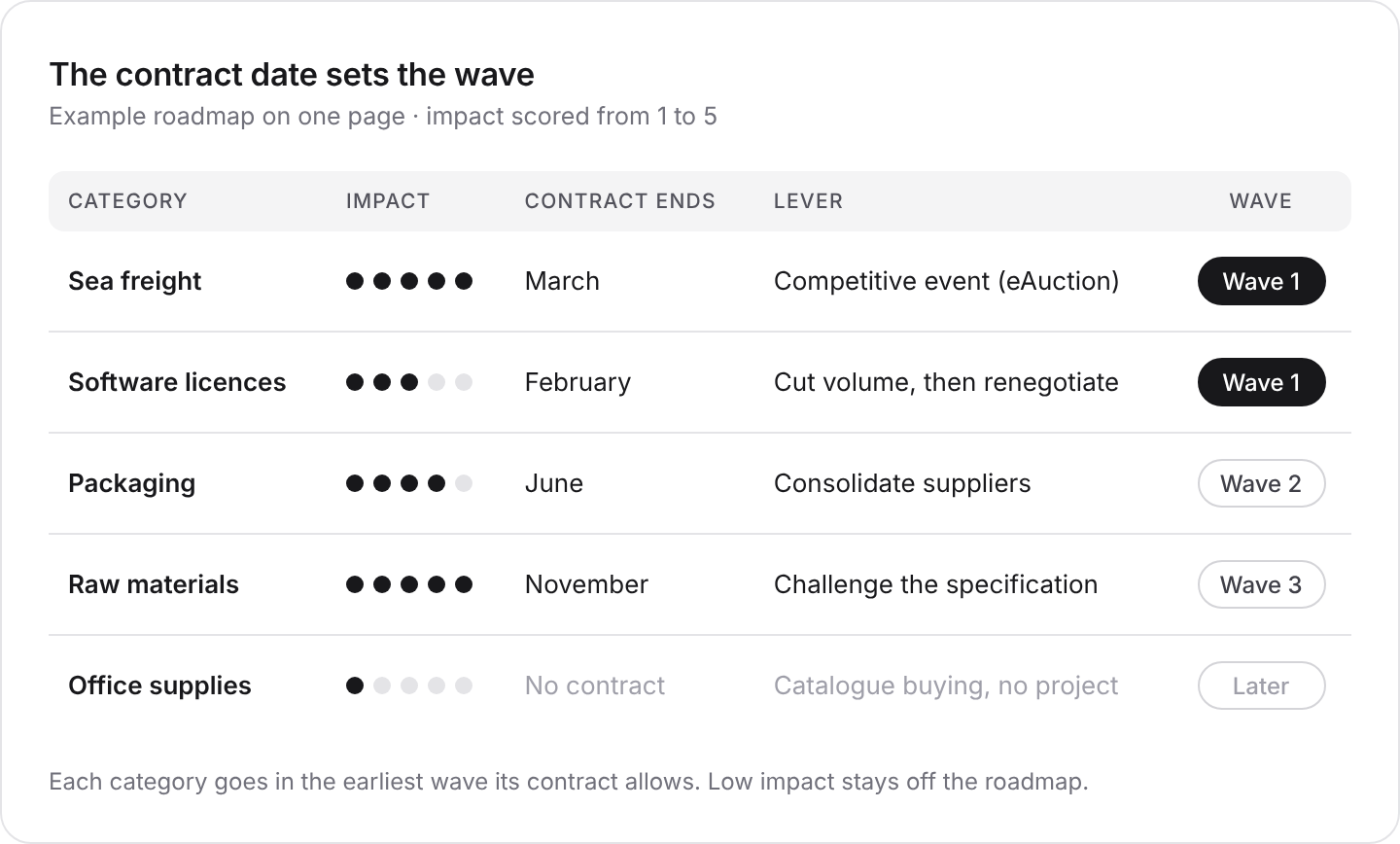
By the end of step 4, every scored category also has a lever and a wave: the block of months when you work on it. On one page, it looks like this:
3. Choose the right lever for each category
A score tells you where to work. The lever tells you how.
Savings come from one of two sources of pressure: your negotiating position with a single supplier, or competition between several. Most procurement cost reduction strategies use one or both, through five levers:
- Renegotiate with the incumbent (1–3 months to a signed result): few real alternatives, good relationship, contract up for renewal.
- Run a competitive event, RFx and eAuction (2–4 months): clear specification, at least two or three qualified suppliers, volume suppliers want.
- Consolidate suppliers (3–6 months): the same need bought from many suppliers across sites.
- Challenge the specification (3–9 months): over-engineered requirements that lock in one supplier.
- Manage demand (ongoing): volume can fall without hurting the business.
Choose on evidence, not habit. Renegotiating every contract leaves money on the table, and not every category suits an eAuction either.
Picture three categories from the same spend file.
Sea freight. Six qualified carriers, a clear list of lanes and a contract ending in March. There is real competition for volume carriers want, so a competitive event fits. Run as an eAuction, carriers improve their offers live instead of over weeks of back-and-forth.
Raw materials. One qualified supplier, and a specification written around its product. Challenge the specification first, so a second supplier can be qualified in time for wave 3.
Software licences. One vendor, a renewal in February, and usage data showing unused licences. Cut the unused volume, then renegotiate with the incumbent.
Whatever the lever, commit to the result. If suppliers suspect the outcome will not be honoured, they hold back their best offer. Agree award criteria and sign-off internally before you go to market.
4. Sequence it over 12 months
A roadmap without dates is a wish list. The rule is simple: each category goes in the earliest wave its contract allows.
Start from contract dates. Work back from each expiry date. Most competitive events need two to four months of preparation, so a contract ending in June means starting preparation in February or March, in the wave before.
Plan in waves. A wave is a group of categories you work on in the same period, usually a quarter. Wave 1 covers months 1 to 3, wave 2 months 4 to 6, and wave 3 the rest of the year, so results land steadily instead of all in Q4.
Respect team capacity. Count how many projects each buyer can run per month, and keep some room for surprises such as a supplier failure or a sudden price rise.
.png)
- Wave 1 (months 1–3): categories you can act on straight away, such as contracts ending or renewing this quarter.
- Wave 2 (months 4–6): the next contracts to come up, prepared during wave 1.
- Wave 3 (months 7–12): later contracts, plus big categories that need preparation first, such as a new specification.
Wave 1 matters most for credibility. Early, visible results make it far easier to win support for the harder categories in waves 2 and 3.
Treat it as a rolling procurement savings plan, not a one-off project. A project ends when the last contract is signed. A programme renews its targets every year.
5. Track savings from target to realised
A saving nobody can trace is a saving nobody believes. Follow every category through a simple savings pipeline:
- Identified. The opportunity and its estimated value are on the roadmap.
- Approved. Finance has agreed the baseline and the method.
- Contracted. The new price or terms are signed.
- Realised. The saving shows up in what you actually pay.
Give each category one owner, and review the pipeline with finance every month. Report realised savings, not only identified ones. The gap between the two is where credibility is won or lost. Procurement savings tracking does not need special software at first: a shared sheet with these four stages is enough.
Build a case library. One page per completed project: the situation, the lever used and the result. Hard numbers win support far faster than anecdotes, and over a year they become your best argument for the next target.
Refresh every quarter. New contracts, market shifts and supplier changes will move some categories up and others down. That is a sign the roadmap is working, not that it was wrong.
Common Mistakes to Avoid
Starting with tail spend. It feels safe, but small savings on small categories convince nobody, and the programme never moves past the pilot stage.
Building it in procurement alone. Budget holders who were not consulted slow down every wave, and finance will not trust numbers it never agreed.
Using one lever everywhere. The lever should follow the category, not the team's habits.
How CROWN Fits Into Your Savings Roadmap
CROWN's Spend Audit turns your spend data into a scored, prioritised roadmap, with a savings forecast for each category and the ones ready for a competitive event flagged. Where an eAuction is the right lever, the CROWN platform runs it, and our procurement consultants can design the first events alongside your team. Book a demo to see what your first wave could look like.
A Target Is a Number. A Roadmap Is a Plan.
Build the baseline. Score every category. Match the lever to the market. Let contract dates set the pace. Track every saving to the invoice.
The teams that hit their targets do not negotiate harder in Q4. They decide in January what they will negotiate, and when.
FAQ
What is a procurement savings roadmap?
A ranked, dated plan showing which spend categories procurement will work on, which lever it will use for each, the expected saving and when it will land. It turns an annual savings target into a sequence of projects.
What are the different types of procurement savings?
The main types are hard savings (a lower price than the baseline, visible in the P&L), cost avoidance (a price increase you prevented) and soft savings (time or process gains). Agree with finance which ones count towards your target.
What is the difference between cost avoidance and cost savings?
A cost saving lowers what you pay compared with the baseline. Cost avoidance stops a price from rising, so spend stays flat instead of going up. Both have value, but report them separately.
How do you calculate procurement savings?
Take the baseline price minus the new price, multiplied by the expected volume over the contract period. Use the same baseline method for every category, agreed with finance in advance.
What is the 80/20 rule in procurement?
It is the observation that roughly 80% of spend usually sits with about 20% of suppliers or categories. In a savings roadmap, it tells you to focus the first waves on that 20%.
How long does it take to build a procurement savings roadmap?
With reasonably clean spend data, a first version usually takes a few weeks: the baseline, the category scoring and a 12-month plan. It then needs a review every quarter.