

eAuctions have earned their reputation as one of the most effective negotiation tools in modern procurement. When applied correctly, they compress timelines, drive genuine competition, and consistently deliver savings that traditional face-to-face negotiations struggle to match. Yet the very power that makes them attractive is what makes them dangerous when deployed without strategic discipline. Not every sourcing event belongs in an auction, and forcing one into the wrong context can damage supplier relationships, erode internal credibility, and ultimately cost the organisation more than it saves.
Understanding when to step away from the auction button is, paradoxically, one of the most important capabilities an eAuction-savvy procurement team can develop. The mistakes that follow are not hypothetical. They are patterns that repeat across industries, company sizes, and maturity levels, and they tend to share a common root: treating the eAuction as a default rather than a deliberate, strategic choice. These mistakes fall broadly into three categories: getting the market conditions wrong, failing on the internal front, and undermining the long-term credibility of the programme itself.
Market Conditions That Should Stop You From Launching an eAuction

No Competition, No Auction
The most fundamental prerequisite for any eAuction is the presence of real, meaningful competition. If your supply base has been narrowed to a single viable provider, whether through technical lock-in, proprietary specifications, or years of unchallenged incumbency, launching an auction is not just pointless, it is counterproductive. In his book A Practical Guide to e-Auctions for Procurement, Jacob Gorm Larsen is unequivocal on this point: a monopoly market, whether genuine or self-made through internal barriers, simply does not meet the conditions required for an eAuction to function. Competition is not a nice-to-have; it is the mechanism through which value is created.
This extends beyond outright monopolies. Some organisations run auctions where one supplier is so far ahead on price or capability that the remaining bidders are effectively there to provide theatre. Suppliers recognise this dynamic instantly, and their response is predictable. They either decline to participate in future events, or they pad their bids with risk premiums because they sense the process is not being conducted in good faith. The damage to your credibility as a buyer compounds over time and across categories.
Undefined Scope, Unreliable Bids
Equally problematic is the attempt to force a price-based competition when the scope of what you are buying has not been clearly defined. Complex maintenance contracts, large-scale system implementations, bespoke consulting engagements: these are all situations where the full picture only emerges as the work progresses. Forcing suppliers to bid against one another on loosely defined requirements invites proposals that are either unrealistically low, setting you up for costly change orders down the line, or defensively inflated to cover the unknown.
When Price Is the Wrong Lever
To give you a concrete example: it is like taking your car to the garage for a service, where the mechanic will only know what truly needs fixing once they get under the bonnet. In those situations, the value lies in strong contractual terms, access to the best talent from your partner, and a governance framework that manages scope evolution, not in squeezing a headline price through competitive bidding. Running an auction here does not just fail to add value; it actively misdirects attention from the levers that actually matter.
Internal Failures That Sabotage the Process
When Internal Politics Kill the Auction
Even when the external market conditions are perfectly suited for an eAuction, internal dysfunction can sabotage the process before a single bid is placed. Stakeholder alignment is one of those requirements that procurement teams often underestimate until it derails an event in real time. Larsen highlights this as a critical precondition: if stakeholders are not genuinely on board with the auction process and its potential outcomes, suppliers will pick up on mixed messages almost immediately. A category manager who openly favours the incumbent, a plant director who has privately assured a supplier that the auction is just a formality, or an executive who has not committed to honouring the results, any of these scenarios can undermine the entire exercise.
The Trap of Overriding Reluctant Stakeholders
The temptation to push ahead with management support alone, overriding reluctant stakeholders, is a trap. Even if the auction runs to completion, the internal fallout can poison future adoption. The better path, as Larsen recommends, is to invest the time in another round of internal alignment before proceeding, even if it means delaying the event. An eAuction that lands in a politically hostile environment will deliver a number on a screen that nobody intends to implement.
Declaring Victory Too Soon
There is also a subtler internal failure that tends to emerge after the initial success phase: assuming the job is done. Larsen references John P. Kotter's classic change management framework and identifies "declaring victory too soon" as one of the most common reasons eAuction programmes lose momentum and eventually collapse. Once the initial targets are hit and executive attention moves on, adoption drops, institutional knowledge fades, and within a few years the organisation finds itself reintroducing eAuctions from scratch, often triggered by the next economic downturn. This is not a failure of the tool; it is a failure of organisational commitment. Sustainable eAuction programmes require ongoing investment in capability building, change management, and continuous refinement. They need to be embedded in the procurement DNA rather than treated as a project with a start and end date.
Practices That Destroy Long-Term Programme Credibility
Short-Term Wins That Destroy Long-Term Trust
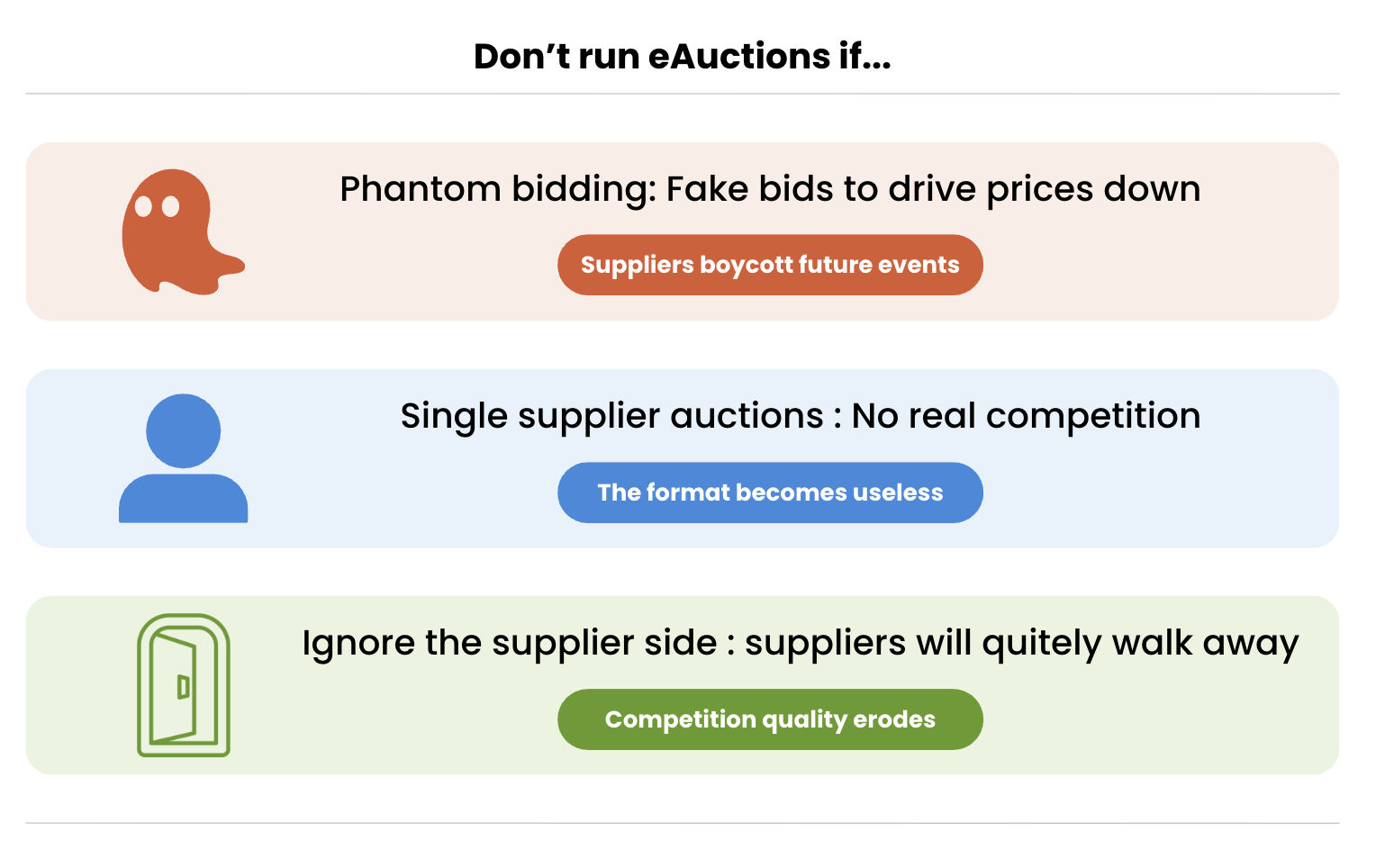
Perhaps the most destructive category of mistakes is the one that sacrifices long-term programme sustainability for short-term savings. The history of eAuction adoption is littered with cautionary tales of organisations that engaged in phantom bidding, placing fake bids to drive prices down, or that ran single-supplier auctions using formats that technically allowed it. These practices might deliver a one-off result, but they corrode the trust that makes future auctions viable.
Larsen documents a particularly instructive case from the European retail sector, where a group of retailers systematically ran reverse Dutch auctions with only one supplier participating. While this produced initial savings, it eventually led to an outright supplier boycott of the format. Suppliers refused to participate even in legitimately competitive events, driving prices higher than a credible, sustainable process would have achieved. The irony is sharp: the very tool designed to harness market forces was rendered useless because the market no longer believed in the fairness of the process.
The Supplier's Side of the Table
Sitting beneath many of these tactical errors is a broader strategic blind spot: failing to consider how the auction experience feels from the supplier's side of the table. Suppliers who feel that an auction is being used to bully them into unsustainable pricing, who suspect the process is rigged, or who are asked to invest significant preparation time for a contract that is not commercially attractive will eventually vote with their feet. And when good suppliers stop showing up, the quality of competition declines, which erodes the very foundation the eAuction depends on.
Your Reputation Is the Programme
The best procurement teams treat each auction as a moment that either builds or diminishes their reputation in the supply market. They ensure that the contract is genuinely worth competing for, that the rules are transparent and honored, and that the outcome reflects a fair market price rather than an artificially suppressed one. A well-run eAuction programme is an asset that appreciates over time, but only if the market trusts the auctioneer.
The Bottom Line
Knowing when not to run an eAuction is not a sign of weakness or a lack of ambition. It is a mark of strategic maturity. The procurement teams that generate the most consistent, long-term value from their eAuction programmes are those that apply rigorous criteria before every event, that invest in stakeholder alignment, and that treat the credibility of the process as a non-negotiable asset. An eAuction is a powerful instrument, but like any powerful instrument, it demands respect for the conditions under which it works best and the discipline to set it aside when those conditions are not met.

.png)