
There is a question that tends to make procurement leaders pause when it comes up in conversation: how many categories in the last sourcing cycle were genuinely contested, with real competitive pressure, and respected a structured process? The answer is rarely comfortable. A handful, perhaps. The big contracts, the ones where the renewal deadline was visible on the CFO's dashboard. The rest were renewed with the incumbent, adjusted for inflation, or handled through a few rounds of emails whose outcomes everyone already knew before they were sent.
This is not a talent problem. Procurement professionals are commercially aware, experienced, and often deeply knowledgeable about their categories. The issue is structural, rooted in how teams are measured, how processes are designed, and how the cultural default gradually shifts from competitive discipline toward administrative continuity. Building a negotiation-first culture is about reversing that drift, making structured, prepared, and genuinely competitive negotiation the reflex rather than the exception.
Why the Default Drifts Away from Negotiation
The relationship preservation reflex
One of the most persistent dynamics in procurement organizations is what might be called the relationship preservation reflex. When a renewal approaches with an established supplier, buyers naturally weigh the commercial objective against the risk of disrupting something that functions. The logic is not irrational. Continuity has genuine value, and a supplier who understands specifications, processes, and organizational context is not easily replaced overnight.
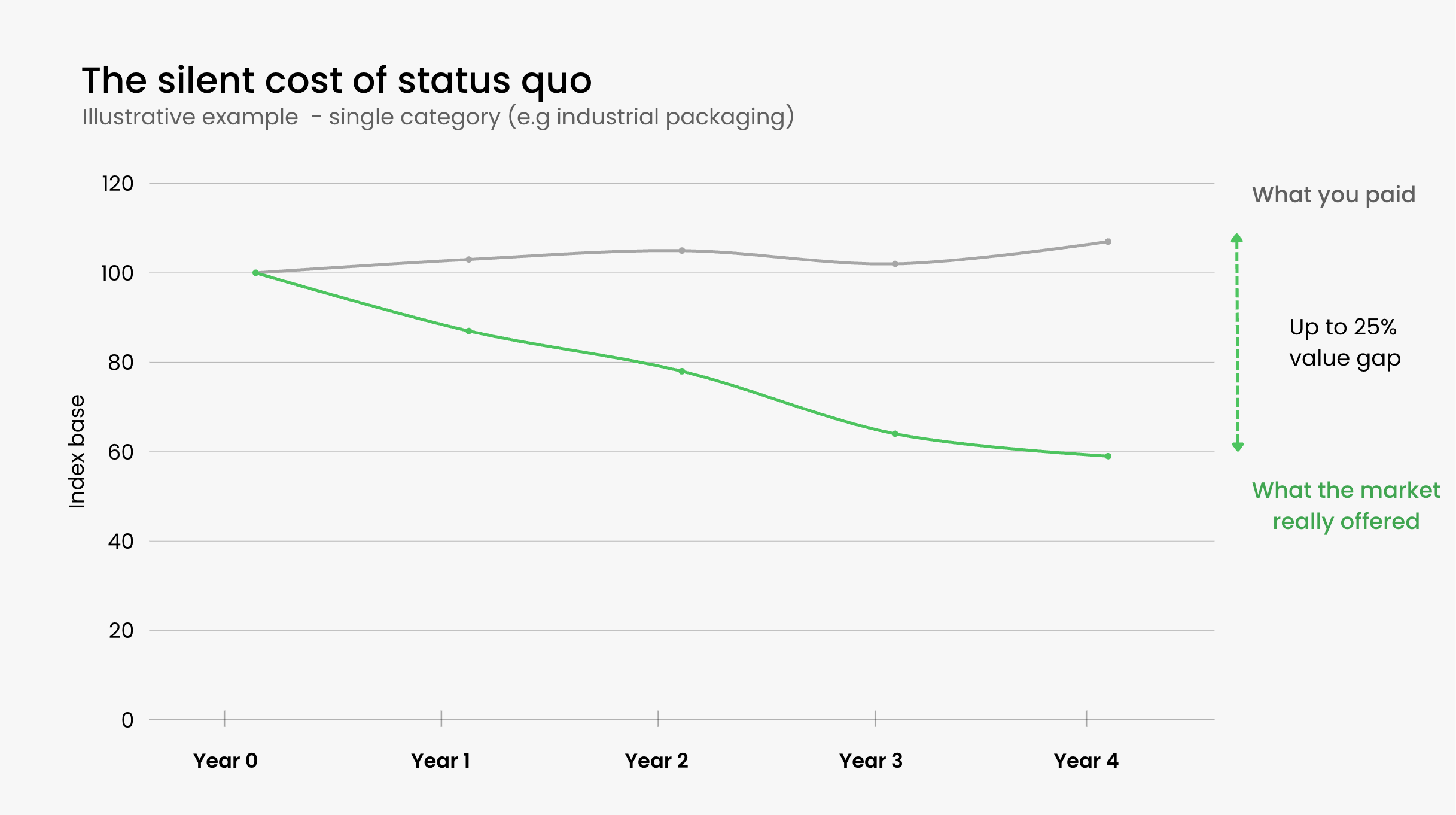
But when left unchecked, this logic tends to gradually crowd out commercial ambition. The negotiation becomes a formality designed to preserve the relationship rather than test the market. The buyer anchors on the previous contract price, adjusts for inflation, frames the outcome as a success, and moves on. Meanwhile, the supplier, having operated without real competitive pressure for several cycles, has had little structural incentive to sharpen their offer. The result is a quiet, steady erosion of value, not dramatic enough to trigger alarm, but significant enough to compound into a material performance gap over time.
What makes this dynamic difficult to address is that it rarely looks like a failure. On paper, savings are delivered, contracts are renewed, relationships are maintained. The invisible cost is the delta between what was achieved and what a properly competitive process would have generated.
The measurement gap that sustains the status quo
The second structural issue is how negotiation performance is measured, or more precisely, how imprecisely it tends to be measured. Savings are typically tracked against the previous contract price or an internal budget target. These are useful reference points, but they reveal almost nothing about what the market would actually offer if properly solicited. A buyer who achieves a 3% reduction on a category where a structured competitive process would have delivered 9% will appear successful in the reporting, with no visibility into the gap.
This measurement gap creates a subtle but powerful distortion. When teams are evaluated on savings against budget, the rational path is to find gains that are achievable without exposing the category to genuine competitive tension. There is no external benchmark to compare against, so there is no honest feedback loop, and without a feedback loop, there is no cultural incentive to raise the standard.
A third factor compounds both: time and process friction. Running a proper competitive process with traditional tools means:
- Tracking multiple supplier responses across endless email threads
- Consolidating bids in Excel files that were never designed to be compared
- Managing versioning errors and communication delays
- Coordinating follow-through across a team already stretched thin
Three Levers That Actually Build the Culture
Preparation as a non-negotiable standard
The single most consistent differentiator between procurement teams that negotiate well and those that do not is preparation quality, not negotiation technique. Technique matters at the margin, but it matters far less than entering a negotiation with a credible alternative, a documented understanding of supplier economics, and a clear internal alignment on what a realistic best outcome looks like versus a satisfactory fallback.
The gap is usually visible in how buyers enter the conversation. A team that has mapped supplier cost structures, understood the competitive landscape, and agreed internally on its BATNA before the first meeting starts from a fundamentally different position than one that opens with a target in mind and adapts reactively. The former shapes the negotiation. The latter responds to it.
Building preparation as a cultural standard means institutionalizing it at the process level, through category-specific negotiation playbooks, structured team reviews before any major sourcing wave is launched, systematic collection of market intelligence, and clear internal alignment on acceptable outcomes. This is less about methodology than about discipline: the willingness to invest time upstream so that the negotiation itself is not where the strategy gets invented.
Technology as a friction-remover, not a replacement for judgment
This is where the transition from aspiration to execution tends to break down. Most procurement teams have lived through at least one generation of heavy sourcing suites that promised to digitize the negotiation process and delivered something more complex than the email threads they were meant to replace. Configuration burdens, rigid workflows, modules that required weeks of setup before running a single event, and an overall user experience that pushed buyers back toward Excel. That legacy is real, and it explains a significant part of why structured competition remains the exception rather than the rule.
The generation of tools that followed has taken a different approach. Modern competitive sourcing platforms, including eAuction formats, are designed to remove logistical friction from a process that was never the problem. The strategic judgment, the supplier selection, the specification design, the award rationale, all of this remains the buyer's domain. What the platform handles is the coordination layer: managing bid submissions, maintaining transparency across participants, running competitive rounds without the back-and-forth that consumes weeks in traditional processes, and surfacing real market positioning in real time.
The time saved is not a minor efficiency gain. For a team managing a broad category portfolio, compressing the competitive phase from weeks of email exchanges to a structured few-hour process means the preparation quality described above becomes genuinely achievable across more categories, not just the flagship ones. The technology does not replace the buyer. It gives the buyer back the bandwidth to do what only a buyer can do.
It is worth being direct about the distance between this and the reverse auction model that gave eAuctions a difficult reputation in the early 2000s. Poorly governed price-only auctions, run without supplier context, without clear rules, and with no commitment to honoring the outcome, caused lasting damage to trust on both sides. What has changed is not just the technology but the design philosophy. A well-run modern eAuction is transparent to suppliers: clear rules communicated in advance, a defined timeline, visibility into market positioning, and a process where the best offer, across price and value criteria, determines the outcome.
For a supplier's commercial team, that is a more honest process than weeks of opaque bilateral discussions where they never know whether they are genuinely competing or being used as leverage against an incumbent they were never going to displace. One concrete example: at Safran, a structured eAuction process on aerospace components delivered 8.2% in additional savings beyond the best negotiated offer, not by squeezing suppliers, but by making the competitive market visible to everyone in the room simultaneously.

Targeting the right spend: leverage categories and the mid-tier gap
A negotiation-first culture does not mean applying competitive processes uniformly across every category. The Kraljic logic still holds: strategic categories with a single qualified supplier and high switching costs require a different approach, centered on collaboration and long-term value management rather than price competition. The risk of misapplying structured competition to genuinely strategic relationships is real and worth taking seriously.
The opportunity, and it is a substantial one, lies in the mid-tier spend that sits between the flagship categories that already receive structured attention and the long tail that is too fragmented to manage actively. These are the leverage categories in the classic procurement sense: competitive supplier markets, significant spend concentration, meaningful volume to offer, but historically managed through annual renewals or informal negotiations because no one had the time or the process infrastructure to do more.
This is where a negotiation-first culture, supported by the right tools, generates the most consistent and durable value. The market is competitive but under-exploited. Suppliers in these categories are often well-positioned to sharpen their offers when given a structured opportunity to do so, and the absence of that structure is what leaves the gap open year after year.
Making negotiation a learning system, not a recurring event
The third lever is the most underrated and the most neglected. Most procurement organizations treat negotiation as a series of discrete episodes: a contract renewal triggers a sourcing event, a result is recorded, and the team moves on. There is rarely a structured process for capturing what was learned, identifying what preparation gaps limited the outcome, or understanding how supplier behavior during the process should inform strategy in the next cycle.
The procurement teams that build genuine negotiation capability over time treat every major negotiation as a source of intelligence. Post-event debriefs are not administrative formality; they are analytical exercises: what did the supplier's opening position reveal about their cost structure, where did competitive pressure shift their behavior, what would better upstream preparation have changed, and what does this imply for how the category should be managed between now and the next renewal? This kind of structured reflection is what transforms individual events into organizational capability, and it compounds.
When outcomes are reviewed seriously and learning is extracted consistently, negotiation stops being something that happens to the team and starts being something the team actively designs. That shift in ownership, from reactive administration to deliberate strategy, is what a genuine negotiation-first culture looks like in practice. And it is, ultimately, what separates procurement organizations that improve year on year from those that simply repeat the same process with slightly different numbers.
Building this kind of culture requires no single dramatic intervention. It is the cumulative result of choices made consistently: what gets measured, what preparation standards are enforced, what process formats are used to create genuine competitive tension, and how the organization extracts and applies learning from every major negotiation. The tools available today make those choices easier to execute than they have ever been. The harder work, as it has always been, is the organizational will to hold the standard.

.png)

.png)