

Procurement Suite vs Best-of-Breed: Where Does CROWN Fit in Your Procurement Stack?
Ask ten category managers whether they run a "suite" or a "best-of-breed" stack, and nine will shrug and say a bit of both, stitched together over ten years of budget cycles and vendor consolidations nobody really planned. The suite-versus-best-of-breed debate has produced more conference panels than better sourcing outcomes. That alone is a signal it's probably the wrong question.
The real question isn't architectural. It's operational: does the stack shorten the time between "we need this sourced" and "we have a signed, competitive deal," or does it just add one more interface between the buyer and the negotiation. Everything else, including which logo sits on the login screen, follows from that one question.
Why the Procurement Suite vs Best-of-Breed Debate Misses the Real Sourcing Problem
The Promise of Procurement Suites, and Why They Slow Down Sourcing
On paper, the logic behind procure-to-pay suites made sense: one data model, one approval chain, one vendor to manage instead of a dozen. What that logic didn't account for was the reality of rolling one out. A traditional procure-to-pay suite is built to cover everything before it's built to move fast. Getting one live usually means several quarters of implementation, an IT team involved in every configuration change, and a total cost that only becomes clear well after go-live. By the time the suite is fully running, the market conditions it was built for have often already shifted. Price volatility, supplier consolidation, and category-level swings don't wait for a phased rollout to finish.
The Promise of Best-of-Breed Procurement Software and Its Historical Integration Challenge
Best-of-breed tools solved the opposite problem: a sourcing team could pick up a sharp, purpose-built tool for eAuctions or spend analysis without waiting on a platform roadmap. The cost was integration. Every specialized tool meant one more data silo, one more login, one more manual reconciliation for the category manager just trying to see total cost exposure across suppliers. For years, that cost was steep enough to keep suites in the lead, not because they were better, but because the alternative was expensive to hold together.
Why Modern Procurement Teams Are Moving Toward AI-Powered Execution Layers
That cost has largely gone away. API-first architecture has made modular adoption much cheaper to run, and the market data backs this up: Gartner's own tracking of the source-to-pay space shows a category that's fragmenting and specializing rather than consolidating, with newer intake-and-orchestration-first vendors entering specifically because buyers want tools that fit into the workflow they already have, not systems that force them to rebuild around a new one.
The teams moving fastest haven't picked a side in the suite debate. They're the ones building an AI-native execution layer on top of the ERP and category tools they already run, instead of waiting for a legacy suite to retrofit AI onto infrastructure that was never designed for it in the first place.
The most demanding buyers don't take that logic on faith. They test it against a simple standard: does the tool hold up under real negotiation pressure, with real suppliers, on categories where a pricing mistake actually costs money. That test, run before any level of automation is trusted, is what separates a real infrastructure decision from a software purchase driven by a feature checklist.
Where CROWN Fits: An AI-Powered Procurement Execution Layer
CROWN wasn't built to replace your ERP, your P2P suite, or your category-specific sourcing tools. It was built to sit on top of them, right at the point where negotiation actually happens faster: compressed RFQ and RFP cycles, structured eAuction dynamics, and supplier engagement that runs on clear criteria instead of email threads. The "suite or best-of-breed" question doesn't really apply to an execution layer, because it isn't competing for the same shelf space. It's shortening the distance between the system you already have and the signed outcome.
Choosing Procurement Technology Based on Category Risk, Not Software Architecture

Not every purchasing category benefits from the same tooling logic, and pretending otherwise is the fastest way to make a procurement transformation project lose credibility. The Kraljic framework is still a useful filter, even if imperfect:
For leverage categories, where several qualified suppliers compete on price and volume, AI-assisted execution and CROWN's infrastructure produce the clearest result: faster eAuction cycles, sharper competitive pressure, measurable cost savings.
For non-critical categories, standardization and automation pay off more than negotiation sophistication. CROWN's role there is efficiency, not strategy.
For strategic categories, defined by long-term supplier relationships and mutual dependency, human judgment still comes first. CROWN feeds that judgment with cleaner data and faster analysis, but it doesn't replace the relationship-level negotiation that stays with the category manager.
For bottleneck categories, the real issue is supply risk, not price. Infrastructure plays a secondary, monitoring role there, not a leading one.
A framework that claims to deliver the same value across all four quadrants is a marketing framework, not a procurement one. The credibility comes from being honest about where the logic doesn't fully apply.
How AI-Powered eAuctions Improve Procurement Negotiation Performance
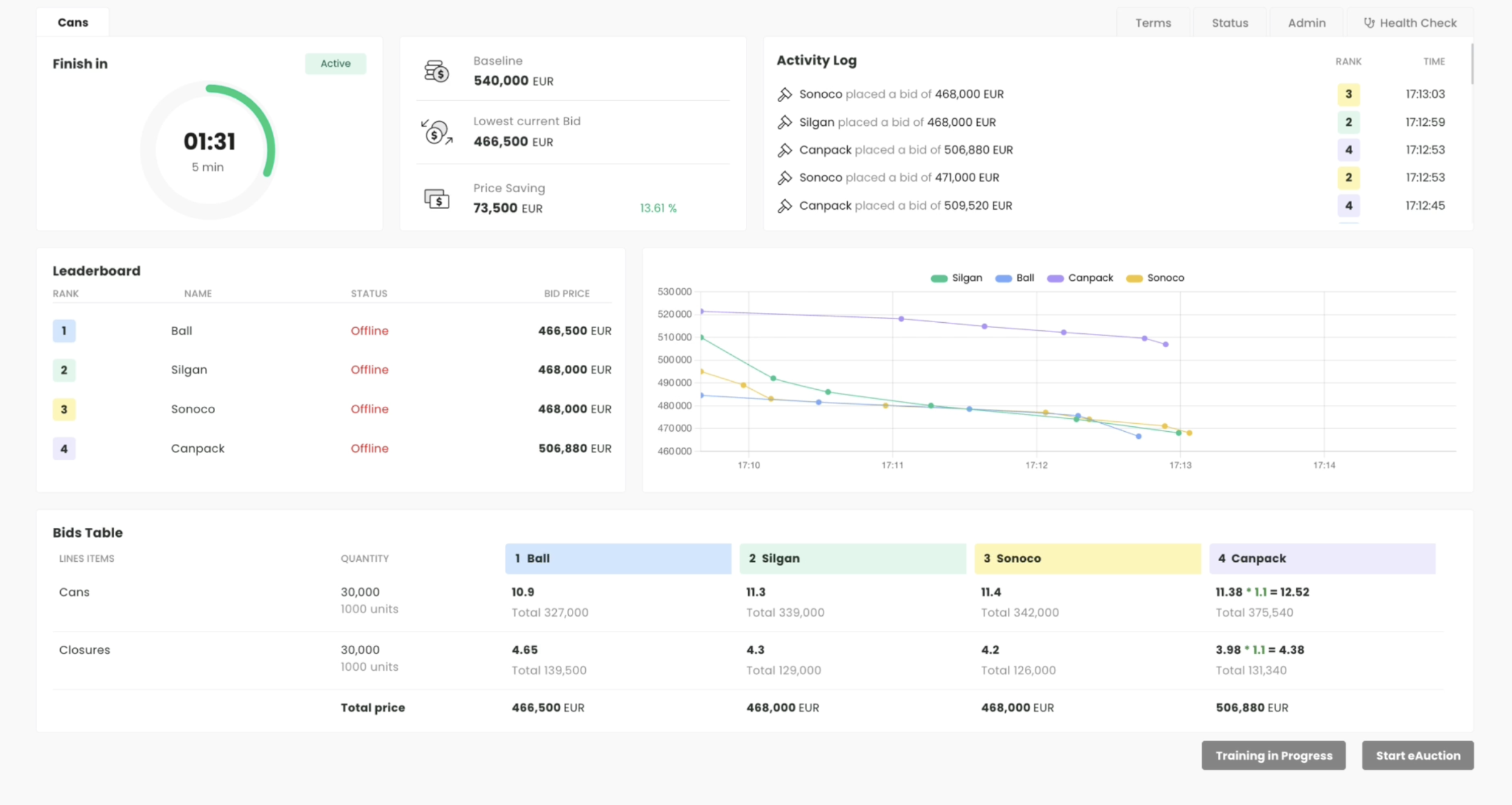
A bilateral negotiation, even run by a very good buyer, tops out at the persuasive power of one conversation at a time. A structured eAuction changes that entirely: suppliers can see, in real time, that they're competing against a defined field under defined rules, and that visibility moves prices in a way a one-on-one call almost never does. The same logic applies to RFQ and RFP cycles that today lose weeks to formatting inconsistencies, incomplete supplier responses, and manual reconciliation across bids. Shortening that cycle isn't just a convenience. It's directly tied to how much negotiating leverage a buyer still has while market prices keep moving underneath the process.
How Transparent Procurement Software Benefits Suppliers
A sourcing process built on clear rules and visible evaluation criteria isn't only an efficiency win for the buyer. It's a win for the supplier too. When a supplier knows exactly how their bid will be evaluated, against what criteria, and against how many qualified competitors, they stop wasting time guessing at the process and start putting that time into the response itself: a more complete bid, submitted faster, priced with more confidence. That's the actual promise CROWN makes to the supplier side of the table: clarity on the rules, fairness in how they're applied, and time given back to both sides that would otherwise be lost to vague, back-and-forth RFx exchanges. A negotiation infrastructure earns supplier trust by being transparent about how it works, not by hiding it.
Why Procurement Teams Adopt Execution Layers Faster Than Traditional Suites
In Europe, resistance to procurement technology is rarely resistance to AI itself. It's a defensive reflex built from experience: multi-quarter suite rollouts that reshaped job descriptions and reporting lines before delivering a single faster negotiation. An execution layer that plugs directly into the tools a team already uses removes that fear at the source, instead of trying to argue it away. A category manager can run their first structured negotiation inside CROWN within days of onboarding: no parallel change management program, no duplicate logins, no retraining built around a new system of record. That speed isn't a nice detail. It's what lets adoption happen team by team, category by category, instead of waiting on the top-down transformation mandate that European procurement functions have learned, often the hard way, to be wary of.
Why AI Execution Layers Deliver Faster Value Than Legacy Procurement Suites
The legacy procure-to-pay path to that same outcome runs through a multi-quarter deployment, an IT roadmap it depends on, and a business case that has to justify the entire suite before anyone sees a shorter sourcing cycle. An execution infrastructure built for immediate deployment flips that order: the sourcing team gets faster negotiation cycles first, inside the stack it already runs, without waiting for a platform-wide transformation to land.
The organizations negotiating from a position of strength over the next decade won't be the ones that finally picked a side in the suite debate. They'll be the ones that stopped treating procurement software as a category choice and started treating it as execution infrastructure, judged the way any infrastructure should be: by what it does to cycle time and negotiating power when the market is actually moving, not by which logo sits on the homepage.
If your sourcing cycles are still set by the speed of your platform rather than the speed of your market, that's the conversation worth having next.

.png)