

The Top 5 spend analysis platforms in 2026 and why spend visibility is no longer enough
Most procurement teams already have a spend analysis tool: dashboards are built, categories are tagged, and someone can tell the CFO in a few clicks what the company spent on logistics last quarter. What hasn't moved, despite all that, is the outcome of the negotiations themselves.
Seeing your spend clearly and having power in a negotiation are two different things, and the gap between them is where most procurement transformations quietly stall. A team can have clean data, a 98% categorization rate, and a well-built Kraljic matrix, and still renew with the same three suppliers, on the same terms, for the same price as three years ago, because the data was never the problem, getting something done with it was.
This matters more in 2026 than it did five years ago, because spend analysis tools have gotten really good at the one thing procurement used to struggle with most, making sense of messy spend data, and what's left once that problem disappears isn't a data gap anymore. It's an action gap, and it's big enough to eat most of the savings a good analytics program finds but never actually captures.
Why Seeing Your Spend Clearly Isn't Enough Anymore
The data problem is basically solved
For years, the standard complaint in procurement was the same: messy ERP data, suppliers named five different ways across systems, spend hidden in cost centers nobody checks, and someone sorting it all by hand in a spreadsheet. AI has mostly closed that gap. SpendHQ combines AI categorization with expert review and gets to 98% accuracy. Sievo classifies spend down to the most detailed level of a company's taxonomy, at 94% accuracy and 98% coverage, using a database built from over 100 million mapped suppliers. Zycus says its AutoClass engine hits 99% accuracy. This used to take a data team and months of work. Now it mostly happens out of the box, with a bit of human correction.
The uncomfortable part for procurement leaders who justified their tool purchase on visibility alone: clean, benchmarked spend data isn't a competitive edge anymore. It's the baseline, and every serious platform on this list can deliver it.
What the best teams do differently
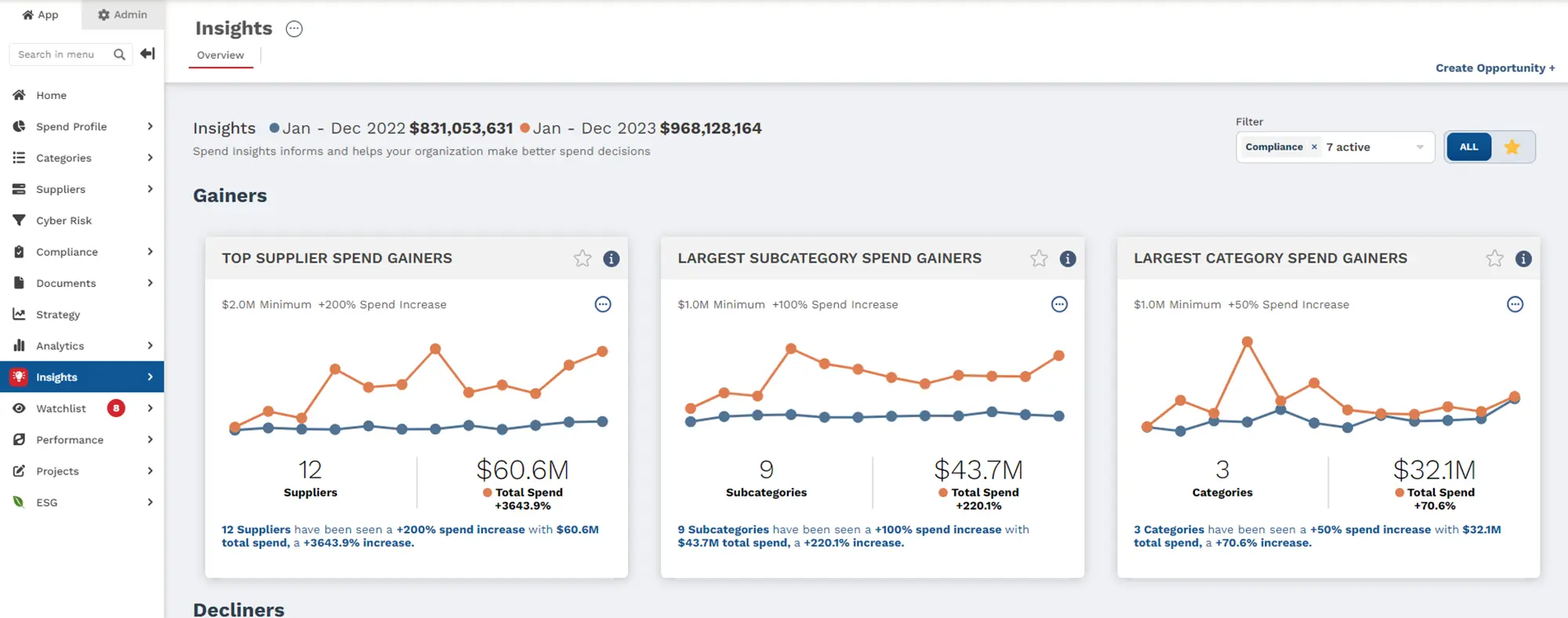
The procurement teams pulling ahead aren't the ones with the nicest dashboard. They treat spend analysis as a starting point, not an endpoint. Knowing where the money goes, how much, and with which suppliers, doesn't create pressure between suppliers on its own. It doesn't shorten a negotiation. It doesn't force a fair, time-limited comparison of offers. Those are execution problems, and they get solved by running a structured negotiation, not by a better report. A category manager who knows exactly how much they spend with an incumbent supplier isn't automatically in a stronger position to negotiate with them. The leverage comes from what happens after the insight, not from the insight itself.
Where this gets tested in the real world
This isn't theoretical for large industrial groups. One global manufacturer we work with, in a technical, engineering-heavy category, ran structured digital negotiations across two year-end sourcing projects, with more volume planned. The spend was already mapped. The categories were already clear. What actually changed the outcome was the negotiation setup layered on top of that data: an approach agreed with procurement leadership, supplier training so the process didn't fall apart from confusion, and a live, time-limited process that forced real competition instead of a slow back-and-forth by email stretched over weeks. The result: roughly 10% in extra savings, and a real drop in the time buyers spent negotiating. We've seen the same pattern with other clients in retail and consumer goods: the analytics found where the money was. A structured negotiation is what actually moved it.
Good spend analysis is a requirement for a good negotiation. It has never been a replacement for one.
The Top 5 Spend Analysis Tools, and What Each One Doesn't Solve
Five platforms come up again and again when procurement and finance leaders shortlist spend analysis software in 2026. Each solves the data problem in a different way, with a different bet on where AI helps most, and a different type of buyer in mind. Worth knowing the differences before picking one.
SpendHQ: clean data without needing a data team
SpendHQ is built for procurement and sourcing teams who want reliable spend data without building an internal analytics team to get there. Over 500 companies use the platform, including well-known names like PepsiCo and Best Buy, for visibility, workflow, and ready-made reporting. It connects to more than 40 other systems out of the box, more than most competitors, which matters if a company runs several ERPs at once, common after a merger. Reviewers describe its main strength in simple terms: it takes messy, multi-million-row spend data from different sources and turns it into one clean, trustworthy view. Beyond classification, its Performance Management module lets teams assign ownership of savings projects and automate reporting to stakeholders, which makes it feel closer to a light performance-tracking tool than a pure analytics product. The cost shows up early: several reviewers say mistakes made during initial setup carry through the whole system, and that scheduled data refreshes can lag what a fast-moving team needs.

Execution gap: SpendHQ tells you where your spend sits, clearly, without needing a data scientist. But it has no way to turn that clarity into pressure on a supplier. Someone still has to take the savings plan it produces and actually run with it.
Sievo: the biggest benchmark database in the category
Sievo has been ranked the top procurement technology by Spend Matters three times in a row, out of 27 competitors, with its models built on 1.4 trillion dollars of analyzed spend. That scale is really the product: category managers can compare their own payment terms, pricing, and supplier performance against anonymized data from other companies, across more than 130 detailed categories, something a smaller, single-company tool simply can't match. Sievo IQ lets buyers ask plain questions instead of building reports by hand, and its Action Hub goes a step further, suggesting concrete next steps like flagging a contract for renegotiation. On results, Sievo claims $20M in extra savings per $1B of spend analyzed, and a 63x return. One client, MediaMarktSaturn, said work that used to take an hour now takes five minutes. The trade-off, mentioned often in reviews, is a steeper learning curve than lighter tools, and it fits best with teams that already have some analytics maturity.

Execution gap: Sievo can tell you, very precisely, that your payment terms are behind the market, or that a category is ready to be consolidated. It can't run the negotiation that actually closes that gap. The insight stops exactly where the conversation with the supplier would need to start.
Zycus: the most AI inside a full sourcing suite
Zycus takes a different approach: spend analysis, called iAnalyze, is one module inside a much bigger AI-driven sourcing platform, not a standalone tool. The company has built a strong reputation on the depth of its AI, and its AutoClass engine classifies spend across four levels of detail while learning from corrections over time, claiming 99% accuracy. What sets Zycus apart isn't the classification engine on its own, it's everything built around it: Merlin, its AI layer, extends into negotiation agents, supplier risk summaries, and contract analysis, all sharing the same underlying data. It's a good fit for large, complex organizations ready to commit to one full platform rather than a smaller point solution.

Execution gap: Zycus automates a lot of the process around a negotiation: intake, approvals, supplier scoring. It doesn't replace the live, competitive event that actually moves the price. Automating the steps around a negotiation isn't the same as creating pressure inside one.
GEP SMART: built like a consulting project, not a plug-in tool
GEP SMART is one platform built on a single codebase, connected natively to Microsoft Azure, and covers the whole sourcing process under the GEP Quantum AI brand. Unlike suites built by buying up smaller companies, everything, spend analysis, savings tracking, supplier performance, pulls from the same data, so nothing gets lost translating between separate modules. That matters for large, multi-region companies tired of numbers not matching between tools. GEP's roots as a consulting firm show in how it's sold: it comes with heavy support and hands-on implementation help, and it's positioned less as software you buy and more as a project you run together, with the real value showing up once the whole process runs through GEP.

Execution gap: GEP SMART's analytics work best once the surrounding project is fully in place, and that usually takes quarters, sometimes years. Most procurement teams have a negotiation coming up long before that timeline is done, and the tool offers no way to speed that up.
Suplari: built for messy data spread across several systems
Suplari starts from a different assumption than the rest: that spend analysis shouldn't need clean, unified data to be useful. It's built to work with imperfect data and improve it over time, without a big upfront project to build a taxonomy, and it promises deployment in 90 days, using AI agents and more than 175 ready-made insights, connecting to existing ERP, sourcing, and contract systems, SAP, Oracle, Coupa, and Ariba included, without asking companies to replace anything. Its Assistant answers plain-language questions using the company's real data, and its Worker agents watch spend continuously and run defined tasks with or without approval. One client, BT, described it simply: the ERP and sourcing systems are the data lake, and Suplari is the layer of intelligence on top, delivering insight in what one executive called two clicks.

Execution gap: Suplari gets a company to insight fast, even with messy data spread across several systems. But speed to insight isn't speed to a signed, better-priced contract. The agents flag the opportunity, then hand the actual negotiation back to a human, unassisted, right at the point where the value is won or lost.
Using the Kraljic matrix to know when the data alone is enough
The Kraljic matrix is a useful way to apply these tools correctly instead of just going with whichever vendor gave the best demo. For leverage categories, where several suppliers compete for real volume, strong analytics combined with a structured, competitive negotiation is close to the ideal setup: the data finds the opportunity, the process captures it. For low-risk, non-critical spend, the priority is automation and keeping spend under control, not running a full negotiation event. For genuinely strategic categories, spend analysis and AI can inform the conversation, but the negotiation itself should stay human and long-term; no platform should run that conversation on its own. For bottleneck categories, where switching supplier is hard or risky, the priority is managing risk, not pushing for a lower price. The mistake procurement teams make is applying the same approach, usually more automation, everywhere, to every category. The data doesn't care about the category, but the strategy has to.

What suppliers actually want from a better process
A clear process, with visible rules and criteria stated upfront, reduces frustration on the supplier side and leads to better offers, because suppliers who understand exactly what they're being judged on stop padding their prices to cover uncertainty. A badly run sourcing process does the opposite: inconsistent bids, unrealistic prices from suppliers misjudging the risk, no real basis for comparison, and a loss of trust that shows up as worse offers next time.
Marc, who handles supplier onboarding on CROWN's negotiation projects, puts it simply: suppliers tell him again and again that they'd rather spend forty minutes inside a clear, time-limited digital negotiation than three weeks of vague back-and-forth emails that wear down their sales teams for no clear outcome and no sense of where they stand against competitors. A clean, well-benchmarked spend base is what makes that kind of process possible in the first place. It's the raw material, but on its own, it doesn't make the process happen.
"But my sourcing suite already has an eAuction tool"
This comes up in almost every conversation with a procurement leader already using GEP, Zycus, or something similar, and it deserves a straight answer. Yes, most of these platforms include a reverse-auction or eAuction feature. Almost none of it gets used past the first pilot, and the reason has nothing to do with the technology.
An eAuction tool bundled into a bigger suite is sold, set up, and supported as a feature. Nobody on the vendor's side is responsible for how any single event actually goes. The buyer gets a generic template and has to decide, alone, which format actually fits the category in front of them, a sealed-bid format for a fragmented supplier base is not the same tool as a Dutch reverse auction meant to pressure one incumbent supplier, and picking the wrong one gives a worse result than running no auction at all. Then there's the supplier side, where most of these tools quietly fail: suppliers log into an interface they've never seen, with no training and no context on the rules, and they react the way anyone would to an unexplained process, carefully, defensively, or not at all. This is exactly what gave eAuctions a bad name in procurement fifteen years ago: badly explained, run once, then abandoned.
CROWN closes that gap on both sides. On the buyer side, the negotiation format is chosen by people who have run this before, not configured by a buyer reading a help page for the first time, using a library of more than ten proven formats built from over a thousand past events, not one generic template. On the supplier side, every participant gets proper onboarding and training before the event instead of a cold login, which is the single biggest reason a competitive auction works instead of a one-sided one. The technology behind an eAuction was never the hard part. Getting a buyer and a room of unfamiliar suppliers to run a fair, high-pressure process well, on the first try, is.
What actually changes for the people involved
Strip away the platform language and two groups are directly affected by how well this is run: the buyer running the negotiation, and the supplier on the other side of it.
For the buyer, the relief is practical. Instead of owning every step alone, preparation, chasing suppliers, watching the event live, following up, on top of an already full workload, the heavy lifting, format design, supplier onboarding, running the event, moves off their desk. Buyers report saving up to 80% of the time they'd normally spend on the negotiation itself, and teams working with CROWN describe roughly 30% less workload overall on running a negotiation from start to finish. That's not a number for a slide. It's the difference between a category manager dreading their next renewal and one who can actually prepare for it properly instead of rushing through it.
For the supplier, the relief is different but just as real: knowing where they stand. A clear process, with visible rules, a live ranking, and a fixed end time, replaces the doubt of not knowing if they're actually being considered fairly, or if the deal was already decided before the conversation started. Suppliers in a CROWN-run event see their position in real time and understand exactly why the outcome landed where it did, which is why participation on well-run digital negotiations tends to sit close to 100%: suppliers show up and engage once they trust the process is actually fair, something a cold, unexplained tool inside a legacy suite has rarely earned.
CROWN doesn't sit on top of your stack, it picks up where the dashboard stops
Every procurement leader looking at SpendHQ, Sievo, Zycus, GEP SMART, or Suplari is really asking one question: where is my money going, and where's the opportunity. Any of these five will answer that well, each with a different trade-off in depth, speed, and how the product is built. None of them will negotiate on your behalf. That's not a knock on any of them, it's just outside what they were built to do.
To be clear about what that means: CROWN isn't another platform to connect to your ERP, another login for your buyers, or a long integration project competing for the same IT time as your analytics rollout. It plugs in after whichever tool already tells you where the opportunity is, and takes the operational weight of the negotiation itself, format, supplier onboarding, running the event, off your team's plate. Your data stack stays exactly as it is. What changes is how fast a known opportunity turns into a signed, better-priced contract, and how much of that work your category managers have to carry themselves.
That second part, going from insight to actual savings, in weeks instead of quarters, with suppliers who know exactly what's expected of them, is the part of the procurement stack that keeps getting the least investment relative to how much value it holds.
If your spend analysis tool can already tell you where your next negotiation should happen, the problem isn't visibility anymore. Talk to CROWN about running that negotiation.

.png)