

Spend analysis is one of procurement's most discussed disciplines and one of its most consistently underused levers. Most organizations run it annually, produce a well-structured report, and file it. The categories it identified as high-priority stay untouched for another 12 months. The cycle repeats.
This article is about why that happens, and what a spend analysis that actually triggers negotiations looks like in practice.
The Two Types of Spend Analysis: Compliance vs. Execution
There are two ways to run a spend analysis. The first produces an annual PowerPoint that circulates through leadership reviews, confirms that governance processes have been followed, and disappears into a shared folder until the next budget cycle. The second produces an operational negotiation pipeline, with prioritized categories identified, recommended auction formats, and estimated savings with target dates attached.
These two outputs share the same name, and they have nothing else in common.
Compliance spend analysis is the natural product of traditional procure-to-pay suites: well-structured dashboards, normalized ERP exports, carefully maintained taxonomies. And an implicit conclusion that nobody ever states out loud: the data triggers nothing. It documents the past without orienting future action. It answers the question "what happened?" when the only question that matters in procurement is "where are we going to negotiate in the next 90 days, and on what terms?"
Execution spend analysis is built the other way around. It starts with the decision, traces back to the data, and structures everything else from there. It asks one precise question: across the organization's total spend, which categories present the market conditions, the supplier substitutability, and the volume structure that would allow the procurement team to exercise a real, structured, and measurable negotiation lever? Every piece of analytical work serves that answer, and nothing else.

What spend analysis actually is: definition and scope
Spend analysis is the process of collecting, cleaning, classifying, and interpreting an organization's procurement expenditure data, with the goal of identifying savings opportunities, supplier rationalization levers, and improvements to purchasing practices.
That definition is accurate, and also insufficient on its own.
What spend analysis actually produces, when conducted with operational intent, is a map of the organization's competitive vulnerability. Every spending category carries a level of exposure to supplier price increases, a degree of portfolio concentration, a window for renegotiation, and a potential for competitive pressure. A well-built spend classification framework is the only tool that makes this complexity readable in a single view, and that allows procurement teams to decide where to concentrate negotiation effort.
The four dimensions of an operational spend classification framework
Raw visibility is the first layer: who spends what, with whom, under what contractual form, and how often. Without it, everything that follows rests on approximations that suppliers will exploit more effectively than buyers. This visibility covers direct spend, tied to the production chain, and indirect spend, covering services, maintenance, logistics, temporary labor, and consulting. These two perimeters have distinct market dynamics, different supplier structures, and non-overlapping negotiation levers. A spend analysis that merges them without distinction produces a dashboard, not a strategy.
Data normalization is where most procurement analytics projects lose their value in practice, and where the gap between the theory of spend management and the reality of ERP data quality becomes impossible to ignore. Procurement data in most organizations is not clean: it is fragmented, inconsistently labeled, and distributed across systems that were never designed to talk to each other. The same supplier gets invoiced under three different legal entity names across two ERP instances. The same service gets categorized differently depending on which business unit approved the purchase order. Normalization means making sure that "IBM Inc.", "IBM France" and "International Business Machines" all collapse into a single negotiation line, so that the real consolidated volume becomes visible and the real leverage becomes exercisable. Without this step, the analysis describes what the systems recorded, not what the organization actually bought.
Classification by spend family comes next. Once data has been normalized, it must be organized into homogeneous families, each corresponding to a coherent supplier market. The practical difficulty here is that most internal taxonomies are built around accounting logic rather than procurement logic. A category labeled "external services" in the general ledger may contain management consulting, IT development, industrial maintenance, and temporary staffing, each of which has a completely different market structure and a completely different negotiation approach. Reclassifying this spend toward procurement-relevant families is time-consuming work, and it is also the work that determines whether the analysis produces actionable output or a more organized version of the same confusion.
Dynamic reading over 24 to 36 months is what separates a descriptive spend report from a predictive procurement analytics tool. A single-year snapshot reveals what happened. A multi-year read reveals what has been allowed to happen: price drifts that accumulated silently without challenge, supplier concentration that worsened without an explicit procurement decision, and categories whose volume declined without a corresponding renegotiation of unit conditions. These temporal readings allow procurement to arrive at any renegotiation with documented evidence of drift rather than a general sense that "prices have probably gone up."
The Real Spend Analysis Challenges: What the Theory Does Not Tell You
Every experienced procurement leader knows that the gap between a spend analysis and a negotiation result is not primarily a technical problem. It is an organizational one. Three frictions dominate in practice, and ignoring them is what separates a credible strategic article from a consulting brochure.
Challenge 1: business unit resistance to spend consolidation
When procurement attempts to consolidate spend across business units, the pushback is immediate and predictable:
- Local teams have relationships with local suppliers they consider strategic
- Category managers hold implicit agreements that predate any centralization initiative
- Finance teams have allocated budgets that assume the current supplier base
Presenting a spend analysis that identifies €30 million in consolidation potential across three divisions does not produce three divisions ready to consolidate. It produces three divisions ready to defend their autonomy.
This resistance is not irrational. Business units are protecting operational continuity, supplier relationships they consider strategic, and local flexibility that genuinely matters to their day-to-day execution. The spend analysis does not resolve this tension, it surfaces it. And surfacing it without a change management approach aligned with procurement leadership is the most reliable way to produce a diagnostic that changes nothing.
The practical implication: a spend analysis without executive sponsorship is a research exercise. The categories it identifies as high-leverage cannot be actioned if the business units controlling the spend have not been brought into the logic of consolidation before the analysis is presented.
Challenge 2: procurement data quality is rarely what the ERP promised
The theoretical starting point of a spend analysis is a clean, complete, consistently coded dataset. The practical starting point looks more like this:
- Missing supplier identifiers across subsidiaries
- Purchase orders split across fiscal years for accounting reasons
- Invoices coded to the wrong cost center
- Procurement categories assigned by finance staff applying a chart of accounts, not a procurement taxonomy
This is not an exceptional situation. It is the normal state of enterprise procurement data in organizations that have not specifically invested in data governance for their sourcing function. The consequence is not that spend analysis is impossible, but that the first two to three weeks of any serious diagnostic are spent on data triage, not data analysis. Organizations that anticipate this and resource accordingly produce actionable results. Organizations that assume their ERP data is analysis-ready typically discover the real state of their data at the moment it costs the most: mid-project, after the timeline has been communicated to leadership.
Challenge 3: supplier panel depth invalidates the most promising categories
A category can look highly attractive on paper: significant volume, no long-term contract in place, incumbent supplier with no structural switching barrier. Then the team goes to market and discovers that the supplier market is thinner than the initial read suggested. Two qualified alternatives exist, not six. One of them already works with the organization in a different category, which makes their participation in a competitive bid awkward. The other has capacity constraints that exclude them from the full volume scope.
This is not an edge case. On any spend portfolio of meaningful size, a meaningful proportion of the categories initially flagged as high-leverage will reveal panel depth issues when the market mapping is done seriously. The diagnostic must integrate supplier market assessment alongside spend classification, rather than treating it as a downstream sourcing step. A category with an attractive spend profile but an insufficient competitive panel is not a negotiation opportunity. It is a supplier development project with a longer timeline.
Which categories to target, and which to leave alone
The categories that lend themselves to structured competitive negotiation share a common profile: three or more technically qualified suppliers with meaningful market share, specifications that can be standardized enough to allow direct offer comparison without destroying value, volume concentrated enough to represent a genuine commercial opportunity for competing suppliers, and no switching cost so high that a change of allocation would create operational disruption.
In practice, this points consistently toward:
- Logistics and transport, where lane-by-lane or mode-by-mode competition produces measurable results
- Facilities management and MRO, where service scope standardization unlocks volume leverage across sites
- Professional services where market rates are observable and deliverable definition is possible
- Packaging and industrial consumables where specifications are mature
- IT infrastructure and software resale where vendor consolidation creates commercial pressure
It explicitly excludes:
- Sole-sourced critical components where the qualification cost of a second supplier exceeds any realizable saving
- Categories where the supplier is co-developing intellectual property with the organization
- Relationships where the supplier's operational embeddedness is such that any competitive signal would be read as a relationship termination rather than a negotiation opening
How clean spend data eliminates the risk premium suppliers build into every unclear RFP
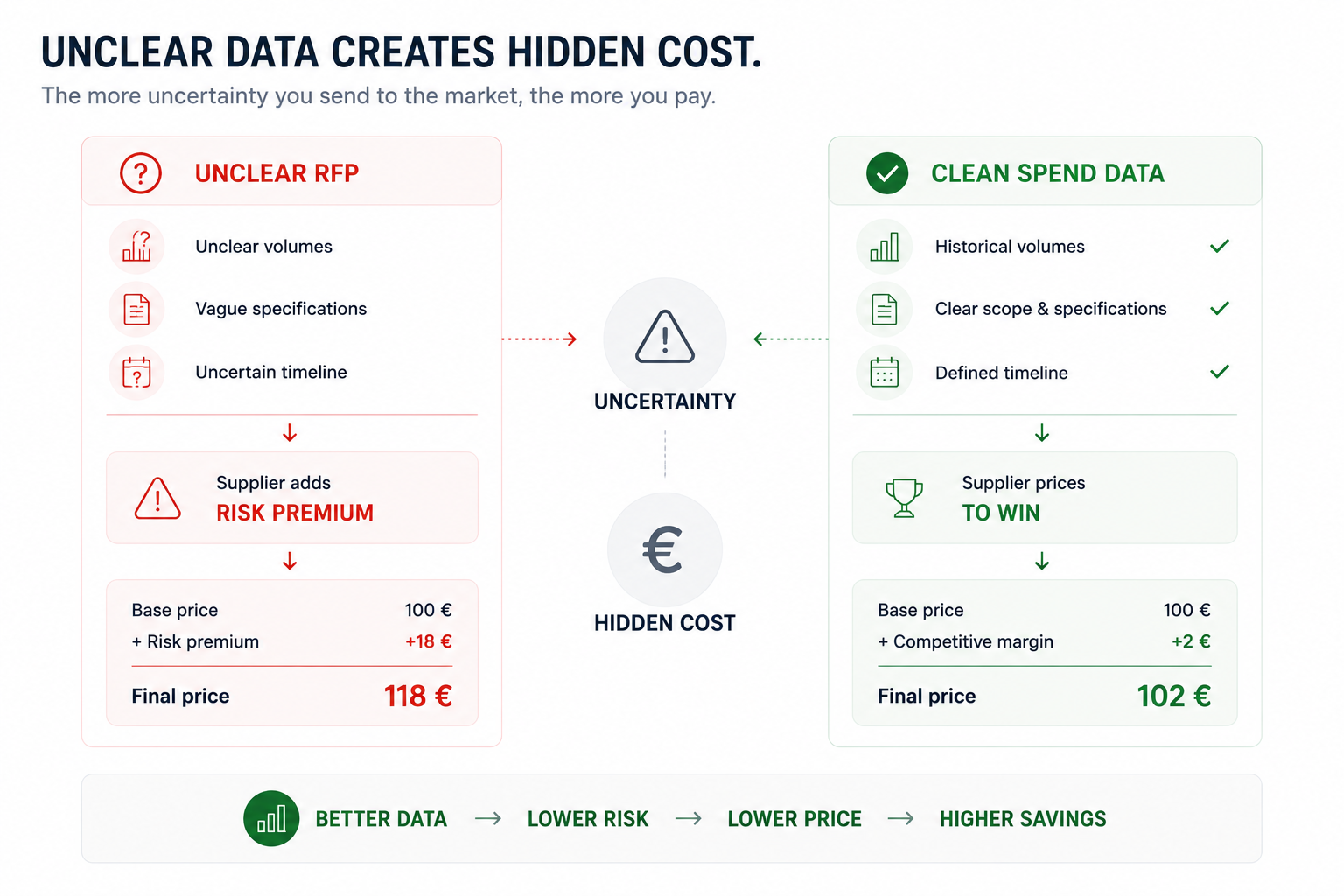
When a supplier receives an RFP built on vague volumes, unclear specifications, or ambiguous evaluation criteria, their response integrates a risk premium. This is not a deliberate act of bad faith, it is rational economic behavior: uncertainty has a cost, and that cost gets priced into the offer. A supplier who does not know whether the actual volume will land at €2 million or €5 million, or whether quality criteria will shift during execution, or how their offer will be compared to competitors, protects themselves by adding margin. That margin is invisible in the final price, and the buyer has no mechanism to identify it as a correctable cost line.
Clean spend data removes the conditions that generate this premium. A request for proposal built on precise consolidated volumes, consumption histories documented over two or three years, and stable evaluation criteria gives suppliers the economic visibility they need to calculate precisely. They can price to win rather than pricing to hedge.
The financial implication is direct and systematic: every point of ambiguity in a scope of work is a cost that the buyer absorbs in the final contract price. This cost does not appear on any savings tracker and is not attributed to any decision. It is simply the price paid for imprecision, embedded in contract after contract, quarter after quarter. A rigorous spend diagnostic, by producing the data quality that removes this ambiguity, is a savings mechanism that operates before the first negotiation session begins.
From Spend Diagnostic to Negotiation Pipeline: Measuring the ROI
The transition from spend analysis to negotiation execution is where most procurement teams experience their most significant value leakage. The analysis is completed, the categories are ranked, the potential savings are estimated, and then the organizational calendar reasserts itself: category managers are in the middle of other projects, eAuction formats require preparation time, business units need to be aligned, supplier shortlists need to be validated.
The result, in most organizations, is a diagnostic that is six months old before the first negotiation it was supposed to enable has been launched.
The structural solution is not to run the analysis faster. It is to connect the output of the analysis directly to a pre-qualified execution format, so that each identified category arrives with a negotiation method decision already attached: bilateral negotiation for categories where the competitive panel is thin or the relationship is sensitive, structured eAuction for categories where market conditions support genuine competition and the specification can carry the format.
What drives spend analysis ROI, and what compresses it
Savings projections from spend analysis deserve more transparency than they typically receive in procurement writing. The ranges cited in diagnostic exercises, often between 8% and 15% on competitive categories put through structured negotiation, are averages drawn from portfolios where the conditions were favorable, and they do not apply uniformly.
Factors that drive results toward the upper range:
- A supplier panel with three or more genuinely competitive participants
- A clean and standardized scope of work
- No incumbent with a technical or qualification lock-in
- A volume large enough to represent a meaningful commercial opportunity for competing suppliers
Factors that compress results toward the lower range:
- Thin panels where one supplier is clearly dominant
- Specifications that structurally favor the incumbent
- Volume too fragmented to motivate aggressive competition
- Categories where the last negotiation was recent enough that suppliers have limited room to move
A credible spend analysis does not produce a single savings estimate. It produces a range by category, with the assumptions made explicit and the panel depth assessed, because the aggregate potential is only as reliable as the weakest assumption in the category-level calculations beneath it.
The question worth asking before starting any spend analysis initiative
Before treating spend analysis as a project to be initiated, it is worth asking a sharper question: how many categories in your current portfolio have not been formally contested in the past 24 months, and what does your existing data tell you about whether the conditions for competition exist on them today?
In most organizations with active procurement functions, this question reveals a perimeter where inaction has been the default, where contracts have rolled over without market validation, and where the data needed to contest the market is already sitting in the systems, waiting to be read as a negotiation input rather than a financial record.
The obstacle is rarely the data itself. It is the absence of a method that treats the diagnostic and the execution as a single connected sequence rather than two separate projects with an organizational gap between them.

.png)