

For decades, procurement operated within a narrow mandate. The function existed to reduce costs, negotiate better prices, and report savings to the CFO. If you worked in procurement 10 or 15 years ago, you know the drill. Your success was measured in one dimension only, and everything else was someone else's problem.
That model served its purpose in a world where supplier markets were deep, switching costs were low, and the biggest risk was overpaying. But the environment shifted dramatically, and the old playbook stopped delivering what companies actually needed. Supply chains broke. Inflation surged. Geopolitical tensions reshuffled sourcing maps overnight. And "buying cheaper" was no longer enough to keep a company competitive.
Today, a recent study shows that more than half of organizations report their Chief Procurement Officer plays a substantially larger role in high-level decision-making than just two years ago. That is not a marginal shift, it is a structural repositioning of the function within the enterprise.
Procurement is no longer the department that says "no" to spend. It is becoming the function that shapes how a company creates, protects, and delivers value. The question is: what drove this evolution, and what does the "value architect" model actually look like in practice?
How procurement killed the cost-killer model
The cost-killer model was built for stability. It assumed supplier markets would remain competitive, that relationships didn't matter much beyond the next negotiation round, and that procurement's job was fundamentally transactional. The post-2020 era proved every one of those assumptions wrong.
A world of structural volatility
The disruptions that started with COVID and continued through geopolitical crises, energy shocks, and trade wars were not temporary anomalies. They revealed a new normal. Recent industry surveys indicate that nearly two-thirds of procurement leaders now cite inflation and rising costs as a top external concern, while almost 40% rank risk mitigation as their number one priority for the year ahead.
Consider what happened during the supply chain disruptions of 2021 and 2022. Procurement teams that had spent years squeezing suppliers on price suddenly found those same suppliers unable, or unwilling, to prioritize their orders. The relationships had been hollowed out, and there was no goodwill left to draw on when it mattered most.
The weight of external spend
A deeper structural issue also became impossible to ignore. External spend represents 50 to 80% of a company's total cost base depending on the industry. For large corporations, supplier costs can account for roughly 65 to 75% of total spending and a similar share of revenue. That is a staggering proportion of value flowing through procurement's hands, far too much to manage with a cost-cutting lens alone.
And here is the insight that really changed the conversation: it has been well documented that around 70% of a product's total cost is locked in during the design phase. If procurement is only called in after specifications are finalized, it can only optimize the remaining 30%. The biggest value lever is upstream, in decisions about what to buy and how to design, not in negotiating a few percentage points off the final price.
This forced a fundamental question that many CPOs started asking themselves. If procurement controls most of the company's external expenditure, and most of the cost is committed before procurement even gets involved, then isn't the function being systematically underused? For a growing number of organizations, the answer was clearly yes.
A widening gap in procurement performance
The cost-killer model didn't fail because cost reduction stopped mattering. It failed because cost reduction alone became insufficient. Companies needed procurement to do more: manage risk, enable innovation, protect margins in volatile markets, and contribute to strategic decisions that go far beyond supplier selection.
The organizations that recognized this earliest gained a measurable advantage. Research consistently shows that top-performing procurement organizations meet or exceed their savings plans at a rate significantly higher than their peers. But the difference goes beyond savings. These leaders also outperform on stakeholder satisfaction, supplier performance, and innovation enablement. They are not just buying better, they are building better.

What the value architect model looks like in practice
Talking about "strategic procurement" is easy. Every conference deck and consulting report has used the phrase for years. The harder part is making it real. In practice, the shift from cost-killer to value architect rests on a few concrete, observable changes.
Getting involved before decisions are locked in
The most impactful procurement organizations do not wait for a specification to land on their desk. They participate in product development discussions, capital expenditure planning, and make-or-buy decisions from the very beginning of a project lifecycle.
One situation we all encounter regularly: a company designs a new product or launches a CAPEX project, selects materials and specifications internally, and only then asks procurement to "find the best price." By that point, the most expensive decisions have already been made. The value architect model flips this entirely. Procurement is at the table during concept development, challenging specifications, suggesting alternatives, and connecting internal teams with supplier innovation capabilities. This is not about procurement overstepping its role, it is about bringing market intelligence and total cost of ownership thinking into decisions that shape the majority of the final cost.
Measuring what actually matters
Cost savings will always be a core KPI, and it should be. But leading procurement functions now track a broader set of metrics: cost avoidance, supply continuity, time-to-market contribution, supplier innovation pipeline, ESG compliance, and internal stakeholder satisfaction.
This shift in measurement is not cosmetic, it fundamentally changes what buyers prioritize in their daily work. When you measure a buyer only on savings, they will optimize for savings, sometimes at the expense of supplier relationships, quality, or long-term resilience. When you measure them on value delivered to the business, their behavior changes. They start thinking like business partners rather than transaction processors.
Using technology to free up strategic bandwidth
One of the biggest barriers to the value architect model has always been time. Procurement teams are buried in operational tasks: processing RFQs, chasing approvals, managing POs, and updating spreadsheets. There is simply no bandwidth left for strategic work.
This is where technology becomes a genuine enabler, not as a replacement for human judgment, but as a way to compress the time spent on repetitive processes. Tools like eAuction platforms, for instance, can reduce negotiation cycle times by 50 to 70%, giving buyers back hours they can reinvest in supplier development, market analysis, or cross-functional collaboration. Industry research consistently shows that digitally mature procurement organizations deliver significantly higher savings as a share of spend, precisely because technology frees their people to focus on higher-value activities.
Building supplier relationships that create mutual value
The cost-killer model treated suppliers as interchangeable. The value architect model treats the best suppliers as strategic assets. This does not mean being soft on pricing. It means being intentional about which relationships deserve investment, and then co-creating value through joint innovation, shared risk frameworks, and long-term planning.
World-class procurement organizations typically reduce purchasing costs by 8 to 12% on average and deliver additional annual savings of 2 to 3% on top of that. But the key finding across all the research on the topic is the same: these results come from collaborative partnerships between procurement and the business, not from procurement working in isolation.
Earning a seat at the leadership table
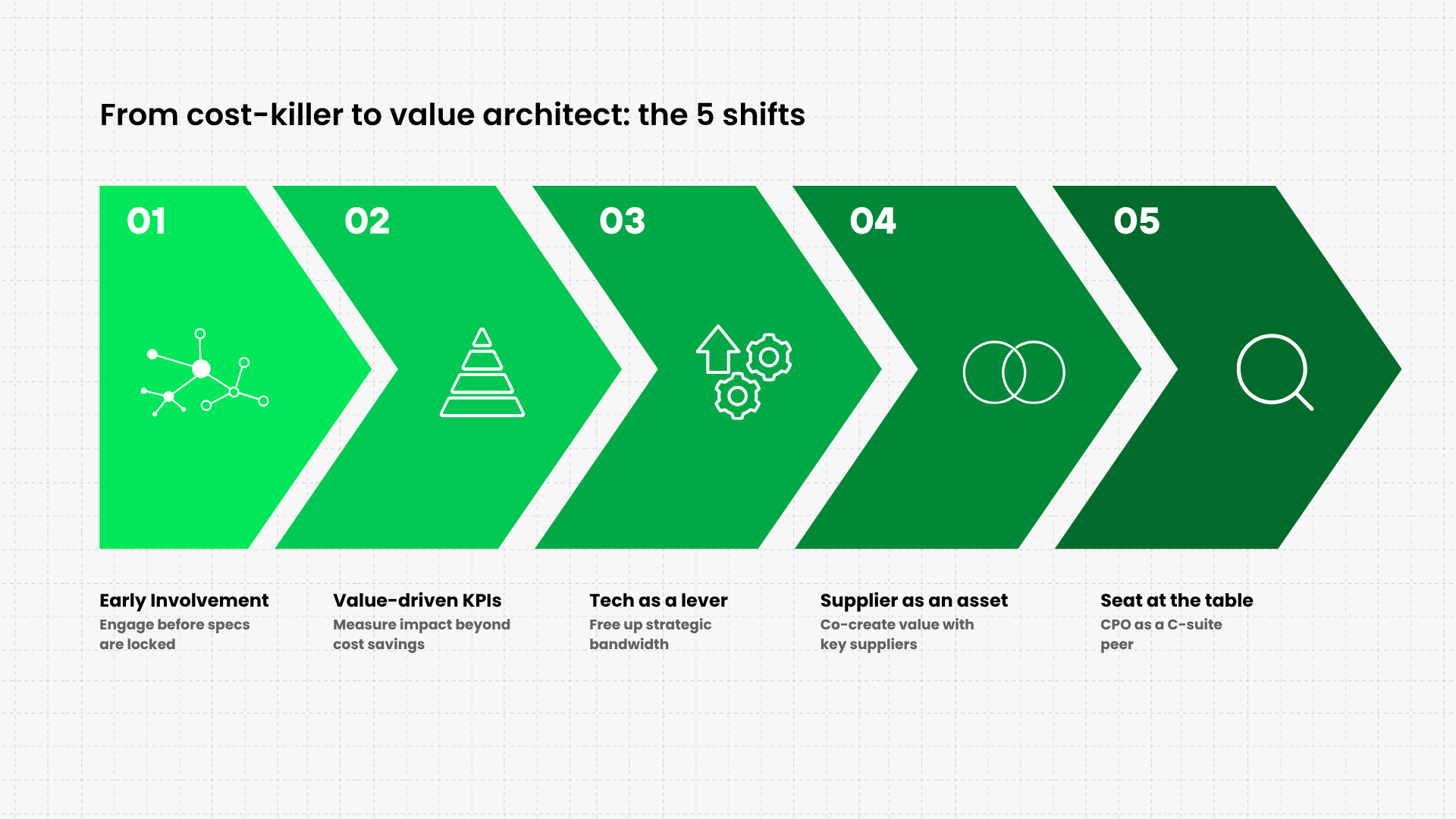
Perhaps the most visible marker of the evolution is where the CPO sits in the organizational chart and who they report to. In the cost-killer model, the head of procurement typically reported to the CFO or COO and was rarely involved in strategic discussions. In the value architect model, the CPO is a peer of the C-suite, contributing to decisions about growth strategy, M&A targets, sustainability commitments, and digital transformation roadmaps.
This trend is accelerating. CPOs are increasingly expected to be enterprise-wide strategists who lead collaboration across procurement, marketing, R&D, and operations. The title may still say "Chief Procurement Officer," but the mandate has expanded well beyond traditional procurement boundaries.
This evolution is not theoretical. It is happening in real organizations right now, creating a growing gap between companies where procurement operates as a strategic function and those where it remains confined to the old cost-killer playbook. The question for every procurement leader is straightforward: which side of that gap is your organization on?

.png)

.png)