
Every procurement conference in 2026 has the same opening slide. Something about AI transforming everything. The audience nods. Then most of them go back to the office and keep running negotiations the way they did in 2019.
I don't blame them. The AI conversation in procurement has become incredibly noisy. Vendors promise autonomous sourcing agents, consultants sell transformation roadmaps. And meanwhile, a category manager just needs to know if the tool will actually help them close a better deal on packaging by Friday.
So let's cut through the noise. Is AI in procurement a productivity gadget or a genuine competitive advantage? Honestly, it depends entirely on how you use it.
The Gadget Trap: Why Most Teams Get Stuck at the Surface
Most procurement teams that have adopted AI are using it for what I would call "level one" tasks. Drafting RFP templates, summarizing supplier responses, cleaning spend data. Generating first-draft emails to suppliers.
Useful stuff, It saves time. According to a recent procurement survey, 50% of organizations that adopted sourcing automation cite lack of expertise and data quality as their top challenges, not the technology itself. The tools work fine. The problem is that teams stop there.
When AI only speeds up administrative tasks, it stays a gadget. A nice one, sure, but a gadget. You save a few hours a week, you produce cleaner documents, you feel more productive.
You're just not changing your competitive position in any meaningful way.
And this is where teams get stuck. They adopt AI, report some efficiency gains, tick the "digital transformation" box, and move on. They never get to the stage where AI actually reshapes how they negotiate, how they read markets, or how they decide where to allocate their team's time.
The maturity gap is real, and it is widening
Here's the uncomfortable part. According to Gartner, through 2027, only 20% of procurement organizations will have sufficient data and process maturity to deploy multi-agent AI systems. Everyone else will still be wrestling with fragmented data, incomplete digitalization, and change fatigue.
The data tells a similar story. Among AI adopters, the top challenges are vendor selection difficulty (42%), data quality issues (39%), change resistance (39%), and difficulty measuring ROI (39%). High upfront costs? Only 13%. It's not a budget problem. It's a readiness problem.
And the gap between leaders and laggards is compounding fast. Teams that adopted AI and automation early are now planning advanced sourcing optimization at nearly 80% adoption rates for their next initiative. Teams with no adoption history? Only 30% are even considering AI projects.
The longer you wait, the wider that distance gets.

The real barrier is not budget, it is ambition
A big chunk of non-adoption comes down to factors that sit squarely within leadership control. Among organizations that haven't adopted AI, the most common blockers include perceptions that the technology is still immature (35 to 41%), that the timing isn't right (23 to 32%), and fears around losing control (16 to 29%).
None of these are structural barriers. They're judgment calls, often rooted in risk aversion or assumptions that haven't been pressure-tested in two years. And the data makes those reasons harder to defend by the quarter. Organizations that adopted AI or automation are measurably more resilient to geopolitical and tariff volatility, move faster, and plan more ambitious digital initiatives.
Waiting for the "right time" sounds prudent. In practice, it means falling further behind peers who started earlier and are now compounding their advantage.

Where AI Becomes a Competitive Weapon
The shift from gadget to real advantage happens when AI starts influencing decisions, not just documents.
Three areas where I see this playing out already.
Market timing and price forecasting
One of the most powerful, and least exploited, applications of AI in procurement is predictive analytics for market timing. An FMCG company documented in Jacob Gorm Larsen's research built algorithms that predict price movements across high-spend categories using internal spend data combined with external market signals. Their models outperformed human analysts by up to 50%.
Think about what that means in practice. Instead of going to market because a contract happens to expire in Q3, you go to market because the data tells you prices are about to move in your favor. Your competitor across the street, still negotiating on autopilot based on calendar dates, doesn't have that information. That's a structural edge, and it has nothing to do with drafting emails faster.
Negotiation strategy optimization
AI-powered negotiation guides are starting to recommend the optimal negotiation format based on historical data, category characteristics, and supplier behavior. Should you run a reverse auction? A multi-round sealed bid? A hybrid approach? These tools don't replace the buyer's judgment, but they challenge assumptions that often go unchallenged for years.
I see procurement teams default to the same approach for every category all the time. Face-to-face, three rounds, split the difference. Comfortable, yes. Also leaving money on the table. When AI recommends an eAuction for a category that was always negotiated bilaterally, and the result is 5 to 10% better than the best face-to-face offer, that's a different kind of impact altogether. No amount of faster email drafting gets you there.
Workload reallocation at scale
Gartner's 2026 predictions estimate that by 2030, AI will orchestrate procurement in 30% of organizations, routing tasks to humans or AI agents depending on the nature of the work. The companies moving in this direction today aren't just running leaner teams. They're building an operating model that can absorb market shocks without falling apart.
Organizations that adopted both AI and automation are 2 to 3 times better at protecting demand levels during market disruptions compared to those that haven't. Faster decision cycles, broader visibility, more scalable responses to volatility. That's the kind of benefit that compounds over years, not weeks.
What the leaders are doing differently
The procurement leaders I talk to who are getting real value from AI have a few things in common.
They start with a specific pain point, not a technology mandate. The question isn't "How do we use AI?" It's "Where are we losing money because we can't process information fast enough?"
They measure impact in business terms, not feature adoption. A 6% improvement in transport costs across Europe is a number the CFO cares about. "We deployed an AI tool" isn't.
They combine AI with process discipline. AI on top of a broken process just produces bad answers faster. The teams seeing the most value already had clean data, structured workflows, and clear sourcing strategies in place. AI made good processes better.
And they're honest about what AI can't do. It won't replace a skilled negotiator's read of the room in a complex supplier partnership. It won't navigate the politics of a cross-functional sourcing decision. But it will make sure that negotiator walks in with better data, sharper benchmarks, and more options than the person sitting across the table.
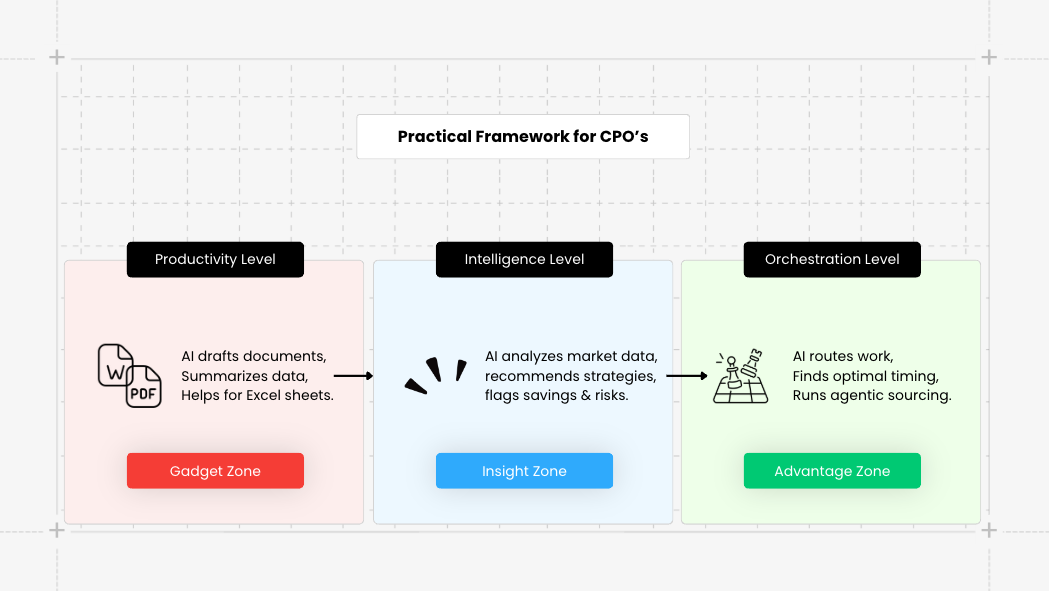
From gadget to advantage: a practical framework
If you're a CPO or Head of Procurement trying to figure out where AI fits in your strategy, here's a simple way to think about it.
Level 1: Productivity (the gadget zone). AI drafts documents, summarizes data, automates repetitive tasks. Useful, but not differentiating. Every competitor will have this within 12 months.
Level 2: Intelligence (the insight zone). AI analyzes market data, recommends sourcing strategies, flags risks, spots savings opportunities you would have missed. This is where competitive separation starts.
Level 3: Orchestration (the advantage zone). AI routes work, triggers negotiations at optimal market timing, runs automated sourcing events for tail spend, and frees your best people to focus on the 20% of categories that actually require human creativity and relationship skills. This is where procurement earns its seat at the strategy table.
Most teams are stuck at Level 1. The opportunity for those willing to push further is massive.
The bottom line
AI in procurement is whatever you decide to make of it.
Use it to write emails faster, and it stays a nice productivity boost. Use it to rethink how you go to market, when you negotiate, and how you allocate your team's finite time, and it becomes something your competitors will struggle to replicate.
The data points in one direction. Organizations that embed AI into their core sourcing and decision processes are more resilient, move faster, and deliver more savings. And the gap between them and everyone else keeps growing.
For procurement leaders in 2026, the question isn't whether AI matters. It's whether you'll use it to do the same things slightly faster, or to do fundamentally different things.

.png)

.png)