

Most procurement teams today share the same frustration. They have been optimizing for years, consolidating suppliers, renegotiating contracts, benchmarking prices, and running competitive tenders across their key categories, and yet, every year, the CFO asks for more while the pool of available savings keeps shrinking.
This is not a failure of competence, it is the natural consequence of doing the same things well for a long time. When you have already squeezed the obvious levers, the next percentage point of savings does not come from squeezing harder, it comes from looking somewhere else entirely.
Why the traditional savings playbook is running out of steam
The diminishing returns of bilateral negotiation
For most procurement teams, the default negotiation format has not changed in decades. A buyer sits across from a supplier, they exchange proposals, they go back and forth a few times, and they eventually land somewhere in the middle. It works reasonably well the first time around, but with each renewal cycle, the incremental gains become thinner and thinner.
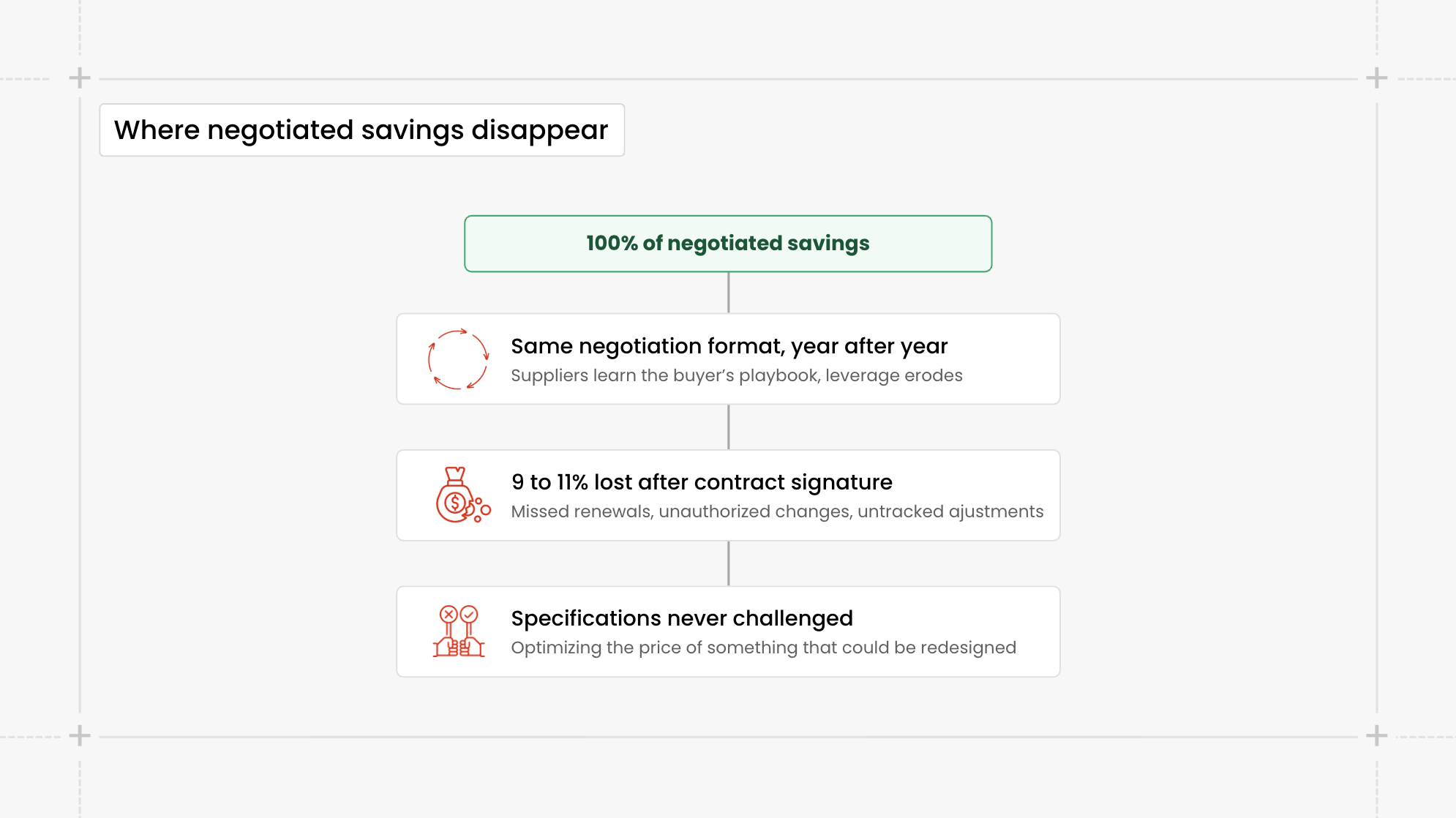
This is not surprising, because in a bilateral negotiation, the buyer's leverage erodes over time. The supplier learns the buyer's patterns, their pain points, and their switching costs, while the buyer has less and less room to push because the relationship carries weight, the specifications are locked in, and alternatives have not been properly developed. The format of the negotiation matters as much as the preparation, and if you always negotiate in the same way, you will always land in the same zone, because the supplier knows the game, and the game has a ceiling.
Savings leakage after signature
There is another reason why incremental savings feel harder to find: a significant portion of what procurement teams negotiate never actually materializes. Recent industry research suggests that organizations lose an average of 9 to 11% of contract value after the deal is signed. This leakage comes from multiple sources, including unauthorized contract changes, missed renewal deadlines, poor compliance monitoring, and overpayments from untracked price adjustments.
The implication is significant: if a team is spending months negotiating a 3% improvement on a major contract, but 8 to 10% of the previous contract's value leaked through poor post-signature management, then the real opportunity is not in the negotiation room at all, it is in the execution and compliance infrastructure that sits behind the contract.
In practice, most procurement teams focus the vast majority of their energy and talent on the pre-award phase, the sourcing strategy, the RFP, the supplier evaluation, the negotiation itself. But once the contract is signed, accountability shifts, attention moves to the next project, and the savings that were carefully negotiated begin to quietly erode. Closing this gap does not require a new technology platform or a transformation programme, it requires discipline, governance, and a clear process for tracking whether what was agreed is actually being delivered.
Specification inertia and the cost of "good enough"
One of the most overlooked sources of hidden savings sits in the specifications themselves. Over time, organizations develop technical specifications that become embedded in their processes and are rarely questioned. Materials, tolerances, packaging formats, service levels, all of these accumulate complexity that may have been justified at one point but no longer reflects actual needs.
It is very common to see procurement teams that negotiate aggressively on price but never challenge the underlying specification, which means they are optimizing the cost of something that could itself be redesigned, simplified, or substituted. In one concrete example, a manufacturer had been buying a specific grade of packaging material for years simply because it was what the original specification called for. When the specification was finally reviewed in collaboration with engineering and the supplier, a lower-grade alternative met all performance requirements and delivered a cost reduction that no amount of price negotiation could have matched.
This is where procurement needs to shift from negotiating the cost of what the business buys, to questioning whether the business should be buying it in that form at all.
Where the next 5% is actually hiding
Reintroducing real competitive tension into the negotiation process
One of the most effective ways to unlock additional savings is to change the negotiation format itself. When you move from a bilateral, sequential negotiation to a structured competitive event, the dynamics shift fundamentally, because suppliers are no longer negotiating against the buyer's expectations, they are competing against each other in real time.
This is the principle behind eAuctions, and it works because it restores a market dynamic that bilateral negotiation gradually erodes. When suppliers can see (or sense) that they are in direct competition, their pricing behaviour changes, they stop anchoring to the buyer's last price and start anchoring to the market, which consistently delivers an additional 5 to 15% of savings beyond the best offer obtained through traditional face-to-face negotiation.
But the value of structured competition goes beyond price, because it also compresses the negotiation timeline dramatically, freeing up buyer bandwidth for higher-value activities, and it introduces transparency and fairness into the process, which, when done correctly, actually strengthens supplier relationships rather than damaging them. The key is preparation: the competitive event itself is just the final step of a well-structured sourcing process, not a shortcut that replaces strategic thinking.
Expanding scope beyond the usual categories
Most procurement teams have a well-defined perimeter of categories they manage actively, typically the high-spend, high-visibility areas like raw materials, logistics, packaging, IT infrastructure, and major services contracts, and within those categories, the optimization has often been thorough.
But there is usually a significant portion of spend that sits outside this perimeter, sometimes called tail spend, sometimes simply indirect or unmanaged categories. This spend is fragmented, handled by operational teams without procurement involvement, and often contracted without any competitive process at all. Research consistently shows that indirect and unmanaged spend represent the largest untapped savings opportunity in most organizations, with potential reductions in the range of 10 to 20% when proper procurement discipline is applied for the first time.
The challenge is not that these savings do not exist, it is that capturing them requires a different operating model. You cannot assign a senior buyer to manage hundreds of small, fragmented suppliers across dozens of categories, which is why you need scalable tools and processes, whether that means digital sourcing platforms, group purchasing arrangements, or managed services that can apply competitive discipline to categories that were previously left on autopilot.
Leveraging data to negotiate at the right time
The third lever is timing. Most procurement teams negotiate on a calendar cycle, where contracts come up for renewal, a sourcing process is launched, and the negotiation happens within a predetermined window. But market conditions do not follow contract expiry dates, because commodity prices fluctuate, capacity constraints shift, and supplier cost structures evolve independently of the buyer's renewal schedule.
Organizations that use market intelligence and data analytics to inform their negotiation timing can capture savings that would be invisible under a calendar-driven approach, and this does not necessarily mean building a sophisticated AI-powered forecasting engine. It can start with something as simple as monitoring key commodity indices, tracking supplier financial health, and aligning major negotiations with periods of favorable market conditions rather than defaulting to "the contract expires in Q3, so we negotiate in Q2."
Shifting from cost reduction to total value management
Finally, the next 5% is often hiding not in what procurement pays, but in what the organization consumes and how it consumes it. Demand management, consumption optimization, and total cost of ownership analysis remain underused levers in most procurement organizations because they require cross-functional collaboration that is harder to orchestrate than a supplier negotiation.
But the impact can be substantial. Reducing unnecessary consumption, standardizing specifications across business units, consolidating demand before going to market, and factoring in lifecycle costs rather than unit price, all of these levers can deliver savings that traditional price negotiation simply cannot reach.
This is where procurement earns its seat at the strategic table, not by negotiating harder, but by helping the business spend smarter.


.png)

.png)