
Implementing a new procurement solution is not a software project. It is a change in how buyers, stakeholders and suppliers negotiate. The configuration and integrations are the easy part. What decides your return is whether people still use the tool, on spend that matters, a year after go-live.
That is where most rollouts fall short. In Ardent Partners' 2025 research, 30% of procurement leaders said poor user adoption limits the ROI of their technology. McKinsey puts the failure rate of corporate transformations at around 70%.
This guide covers the five best practices that separate lasting programmes from expensive shelfware.
Key Takeaways
- Ownership beats features. Name a programme owner and an executive sponsor before go-live.
- Define success first. Agree the baseline, KPIs and an ambitious target before you configure anything.
- Pilot where it shows. Start on high-impact categories, not tail spend.
- Suppliers are users too. Clear rules and a fair process decide whether they engage.
- Adoption never finishes. Usage falls the moment the pressure stops.
Why Procurement Implementations Stall After Go-Live
Sourcing and negotiation events are infrequent. Many categories go to market once a year, so a buyer may use the new tool only a handful of times before the next renewal comes round.
Habits never form, and the old way is always one phone call away. So usage peaks after launch, then drifts back to email and spreadsheets.
Every practice below is designed to stop that drift.
What are the Top 5 Best Practices for Implementing a New Procurement Solution
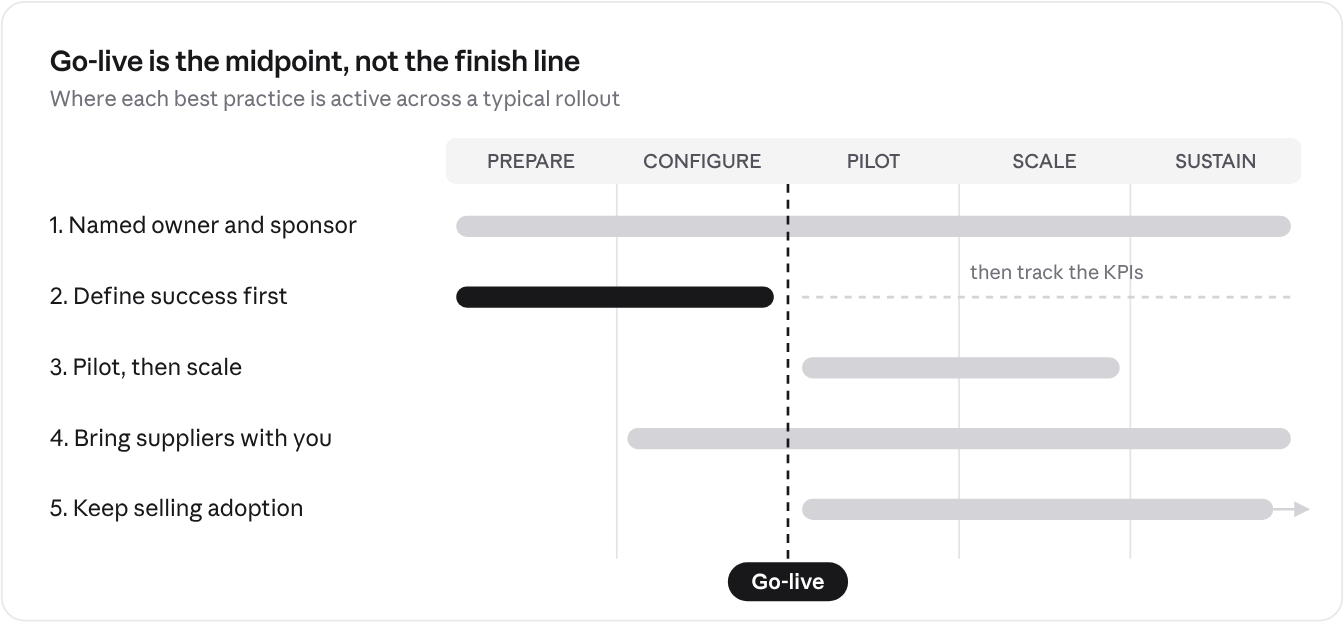
Only defining success is mostly finished before go-live; the other four practices keep running long after launch.
1. Run it as a Programme with a Named Owner, not an IT Project
Projects end at go-live. Programmes have targets that renew every year. If nobody owns adoption after launch, usage has no one to defend it.
Give adoption an owner. In larger teams, that is a small centre of excellence (CoE), often just two or three people. Most procurement teams don't have one, and they don't need to wait for it. A single internal champion can carry the programme: someone who believes in it and will push it, even though it sits outside their main role. What matters is that they have time set aside and visible backing. The owner takes care of:
- Training and day-to-day support for buyers
- Event set-up for occasional users
- Supplier onboarding and communication
- KPI tracking and the pipeline of upcoming events
- The written rules for how the tool is used
Champions rarely have spare capacity. CROWN's procurement consultants can design and run the first negotiations alongside yours, so the programme keeps moving when their own workload peaks.
Influence, don't mandate. A top-down push helps at the start. Picture a CPO who asks for the next ten contract renewals to go through the new tool: the programme moves, and the first results arrive. Six months later, the picture can look very different. Category managers who never chose the tool comply on paper, run half-hearted events, and drift back to old habits once leadership looks elsewhere.
The mandate opens the door; ownership keeps it open. Let the first buyers present their own results to their peers, and let category owners choose which events go next. Over time, the owner's role shifts from enforcing to supporting.
Win an executive sponsor. Adoption rises fastest when a senior leader regularly asks how the tool is being used and what it delivered. Earn that attention in the board's language: savings, faster cycles, a fully auditable process. Tie the programme to a priority they already own, such as cost or resilience.
2. Define what good looks like before go-live
A tool that cannot prove its value is the first line cut in the next budget round. Agree three things before you configure anything.
Objectives. For most sourcing tools: savings first, supported by efficiency and a documented negotiation trail. Keep it to one sentence.
A baseline. Cycle times, the share of spend that is competitively sourced, suppliers per event and recent savings. Without a "before", every result is open to debate.
KPIs that evolve with maturity.
- Pilot (first 3-6 months): events run and active buyers. This proves the process works.
- Scaling (year 1): spend negotiated and savings achieved. This shows impact executives understand.
- Mature (year 2+): share of addressable spend covered and suppliers per event. This shows where adoption is stalling.
Then set a target that stretches. A cautious target changes nothing. An ambitious one pushes teams into categories they would otherwise avoid and keeps leadership interested. Just give the programme owner the authority to say no when a category is a poor fit.
3. Start where results are visible, then scale
A pilot that proves nothing hands sceptics their argument.
Take an eAuction rollout. Its results show up as negotiated savings, so the categories you choose first decide how the business judges the tool. The same logic holds for data or process tools: start where the improvement will be visible to the people who doubt it.
Avoid the tail-spend trap. Office supplies feel low-risk, so many teams start there. But a small saving on a small category convinces nobody, and it positions the tool as tactical: something for low-value buys. Start on spend that leadership considers strategic, and the tool is seen as strategic too.
Map all spend, then score it. Rate each category on impact (spend, time since the last competitive event, qualified suppliers) and complexity (stakeholder support, specification work, contract constraints). Your first wave sits where impact is high and complexity is low.
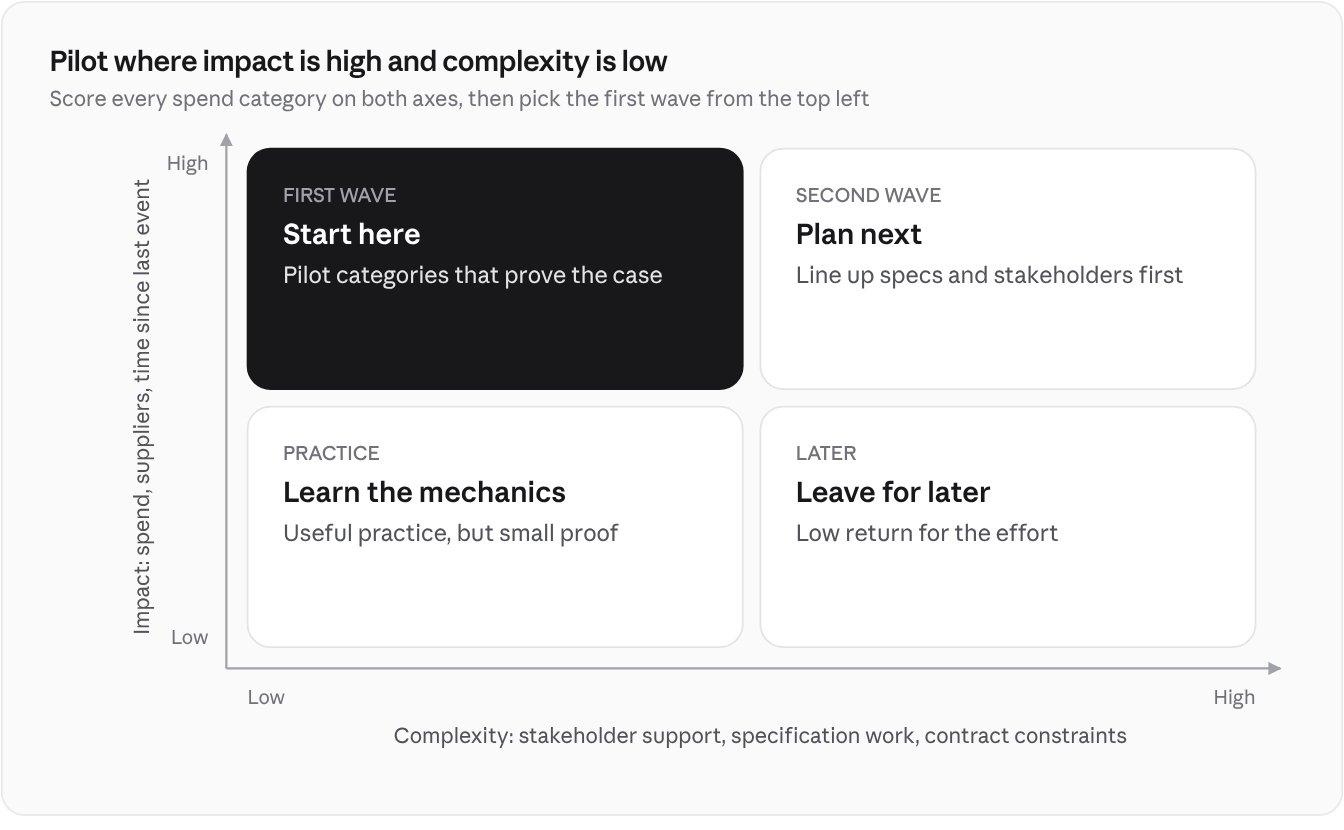
For negotiation tools, two conditions decide suitability: real competition, where two determined rivals can be enough, and business that is commercially attractive to suppliers. "This category is strategic" is a claim to test, not a reason to skip. For the cases where a competitive event really is the wrong call, see when should you not run an eAuction?
Prepare the data early. Procurement leaders estimate that only 63.9% of their master data is accurate, complete and current. Clean the supplier records and contract dates your pilot depends on, and define how results flow back into the ERP.
Configure, don't customise. Every bespoke change adds cost, delay and upgrade pain. Adapt your process to standard workflows wherever you reasonably can.
4. Bring your suppliers with you
In an eAuction rollout, suppliers are users too. That sets it apart from most implementations, which stay inside the business: data, workflows, approvals. A negotiation tool only works if suppliers trust the process and take part. If they don't, the best platform delivers nothing.
Their resistance usually comes from past experience: online events used as a benchmark before the incumbent wins anyway. Your first events must prove the opposite.
- Publish your rules. Only pre-qualified suppliers, the same information for all, awards on stated criteria, no offers outside the process.
- Honour the outcome. Agree award sign-off internally before the event. If the winner is not awarded as promised, every supplier notices.
- Explain the upside. A transparent process puts the outcome in the bidder's hands, removes weeks of back-and-forth and shows real market feedback.
- Train before the live event. A short session a few days ahead covers bidding, timing rules and who to call if something breaks.
When a supplier refuses to take part. Treat it as a concern to address, not a final answer. First confirm internally that everyone still backs the decision to run the event. Then talk to the supplier: most objections come from fear that winning will not mean being awarded, or that quality will be ignored in a price-only contest. If they still decline, either proceed without them or accept a best and final offer before the event and use it as the price others must beat.
A short survey after each event gives you evidence when someone claims "suppliers hate this". CROWN's AI supplier onboarding handles much of the preparation, and how to run successful eAuctions covers the event itself step by step.
5. Keep selling adoption long after go-live
Usage typically falls when attention moves on, a sponsor leaves, or leadership drops the target because the tool is "just how we work now". Declaring victory early is the surest way to lose the gains.
- Teach the why, not the buttons. Click-by-click training is forgotten in weeks. Teach how to build a negotiation strategy; let the owner, or an external partner, handle the mechanics.
- Build a case library. One page per successful event: situation, approach, result.
- Use your own data. After a few dozen events, internal patterns are hard to argue with.
- Put it in objectives. Once proven, add usage targets for the people who decide how categories are negotiated.
- Refresh every year. New targets, certifications, formats. Visible change keeps it on the leadership agenda.
A few people will resist whatever the evidence. Focus on the willing and let results do the rest. For the longer-term culture shift, see building a negotiation-first culture in procurement.
How CROWN Fits Into Your Implementation
CROWN pairs an eAuction platform that sits alongside your ERP or source-to-pay suite with procurement consultants who help design and run negotiations. That combination lets teams run live events within weeks, with expert support while their own capability grows. Book a demo to see how it would fit your rollout.
Implementation Ends at Go-Live. Adoption Does Not.
Name an owner. Define success first. Start where results show. Bring suppliers in as partners. Then keep working on adoption long after the launch is forgotten.
The teams that get the most from procurement technology do not treat it as a system they installed. They treat it as how they negotiate.
FAQ
What are the five best practices for implementing a new procurement solution?
Name a programme owner and executive sponsor; define objectives, baseline and KPIs before go-live; pilot on high-impact categories; bring suppliers in with clear rules and training; and keep driving adoption after launch.
How long does it take to implement procurement software?
A focused sourcing or eAuction tool can run live events within weeks. A full source-to-pay suite usually takes many months. Adoption work continues well beyond either.
Why do procurement software implementations fail?
Mostly on adoption: no clear owner, no agreed KPIs, button-only training, heavy customisation and lost momentum after launch.
How do you get suppliers to engage with a new sourcing platform?
Publish clear rules, invite only qualified suppliers, honour your award criteria and train bidders before each event.
Do you need to replace your ERP or S2P suite to digitise negotiations?
No. A dedicated negotiation tool such as CROWN works alongside existing systems.
What is the 80/20 rule in procurement?
It is the observation that roughly 80% of spend usually sits with about 20% of suppliers or categories. During an implementation, it tells you where to pilot: the few categories that carry most of the spend.
What are the 5 R's of procurement?
Right quality, right quantity, right time, right place and right price. They make useful success criteria for a new solution: it should improve price without weakening the other four, which is why total-value award criteria matter.

.png)