
.png)
No. A buyer is not legally required to award the contract to the lowest bidder after an eAuction, unless its own rules promise it.
Private buyers are bound only by what their event rules say. Public buyers award on published award criteria, which means the lowest price only when price is the sole criterion. In the UK, the Procurement Act 2023 lets them award to the most advantageous tender, not the cheapest.
Getting this wrong costs money. Award against your own rules and you invite a challenge. Ignore the result without a reason and suppliers stop giving their best price.
General information, not legal advice. Last reviewed: 9 October 2026.
Key takeaways
- No automatic duty. No law forces a buyer to award the contract to the lowest bidder after an eAuction.
- Private buyers are bound only by what their event rules promise.
- Public buyers award on published award criteria. The lowest price wins only when price is the sole criterion.
- Not awarding is allowed, with reasons and the required notice.
- Set the rule before the event, and honour it after.
What does "lowest bidder" mean in a reverse auction?
In a reverse auction, suppliers lower their prices live, against each other. The lowest bidder is the supplier with the lowest price when the event closes.
The lowest bidder is not always the winner. In a weighted eAuction, suppliers are ranked on a total score that combines price and quality. A supplier can bid the lowest price and still rank second. Our guide to digital negotiation formats explains the main types.
Price-only is a valid choice. But it should be a conscious one, made before the event, not a default discovered after.
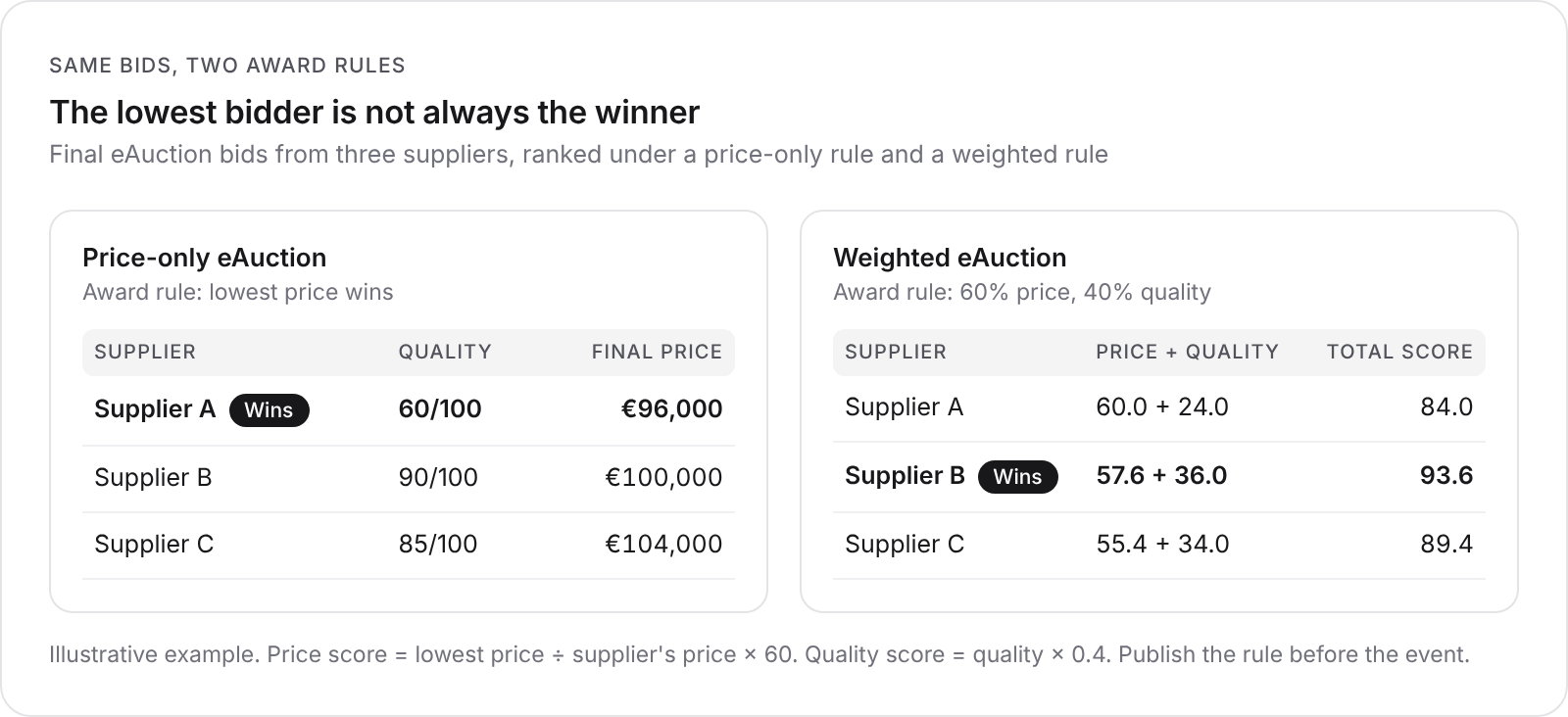
In CROWN, weighted decision logic lets you build quality, ESG or risk scores into the eAuction rules. Suppliers see how the winner will be chosen before the first bid.
Does a private buyer have to accept the lowest bid?
No. Under English contract law, three principles apply.
- An invitation to bid is not an offer. Since Spencer v Harding (1870), a request for tenders is an invitation to treat. The bids are the offers.
- Compliant bids must be considered. In Blackpool and Fylde Aero Club v Blackpool BC (1990), the court held that a bidder who submits a conforming tender on time has a right to have it considered. The buyer need not accept any tender.
- A promise can bind you. In Harvela Investments v Royal Trust Co of Canada (1986), an invitation that promised to accept the best compliant bid was treated as a binding offer.
The principle is still applied today: in 2026, the High Court relied on it in Ecolog International v Secretary of State for Defence to find a duty to consider a tender in good faith.
Legal freedom is not commercial freedom, though. If suppliers suspect the result will not be honoured, they follow the price down without trying to win. Committed auctions, where the award rule is known upfront and respected afterwards, tend to get better prices.
What do public procurement rules say about the lowest bid?
Public buyers must award on criteria published in advance. Those award criteria do not have to be price alone.
EU: Directive 2014/24/EU
- Basis of award: most economically advantageous tender (MEAT): price, cost or best price-quality ratio (Art. 67).
- Role of the electronic auction: award "on the basis of the results" (Art. 35).
- Abnormally low bids: ask for an explanation before rejecting (Art. 69).
- Not awarding: inform bidders of the grounds (Art. 55).
UK: Procurement Act 2023
- Basis of award: the buyer may award to the most advantageous tender against the award criteria (s.19).
- Role of the electronic auction: use of an auction is stated in the tender notice.
- Abnormally low bids: notify the supplier and give it a reasonable chance to show it can perform (s.19).
- Not awarding: publish a procurement termination notice (s.55).
The lowest price wins only when price is the only criterion, or the auction ranks on price. Public buyers can also decide not to award. The EU Court of Justice confirmed in Fracasso that a buyer is not required to award, even to the only suitable tenderer. That decision must be reasoned and can be reviewed.
When can you award to someone other than the lowest bidder?
When the reason was announced before the event, or follows from the law. It becomes risky when it looks like the rules changed after the bids came in.
Usually defensible
- Quality was weighted and another bidder scored higher.
- The lowest bidder failed due diligence.
- The bid was abnormally low and could not be justified.
- The rules reserved the right not to award, and you give reasons.
Usually risky
- Using award criteria that were never published.
- Promising the lowest bid wins, then choosing someone else.
- Rejecting a low bid without asking for an explanation.
- Running the reverse auction only to pressure the incumbent.
The last point is legal in many private contracts, but it backfires. Inviting suppliers you never intend to use, only to push prices down, damages trust fast. It is one of the common strategic mistakes with eAuctions.
How do you write eAuction rules that protect your decision?
Most disputes about the lowest bid start with vague rules. Six clauses settle the question before the event.
- State the award basis. Price only, or a weighted formula published in advance.
- Make bids binding. Each bid is a formal offer, valid for a set period.
- Reserve the right not to award. Commit to giving reasons.
- Make award subject to due diligence. Name the checks.
- Explain how very low prices are handled. You may ask for a cost breakdown.
- Avoid promises you cannot keep. "The lowest bid will be accepted" can bind you.
CROWN's activity log and PDF extract give you a record of the event to support the award decision. Our guide on how to run successful eAuctions shows where these clauses fit in preparation.
The bottom line
No law forces a buyer to award the contract to the lowest bidder after an eAuction. Private buyers are bound by what they promise. Public buyers are bound by the award criteria they publish. Decide the rule before the event, and honour it after.
The CROWN eAuction platform lets you share the event rules, award formula and bidder terms with suppliers before they bid, and keeps a record of every bid. Book a demo to see how it works.
FAQ
What does "lowest bidder" mean?
The lowest bidder is the supplier offering the lowest price for the same scope. In public procurement, it is usually the lowest compliant bidder: a supplier whose bid meets every requirement.
Do you have to accept the lowest bid in a reverse auction?
Not automatically. Private buyers can usually award to any bidder, or none, unless their rules promise the lowest bid wins. Public buyers award on their published criteria.
What criteria are used to award contracts in procurement?
Price, cost and quality factors such as technical merit, service levels, delivery and social value. Public buyers must publish the criteria, and how much each one counts, in advance.
What happens if there is only one bidder?
The buyer is not obliged to award. A reverse auction with one bidder creates no competition, so a direct negotiation usually works better. Public buyers must still follow their procedure rules.
Is a reverse auction bid legally binding?
Usually yes, for the supplier. Most event rules treat each bid as a formal offer. The buyer is normally not bound to accept it, unless the rules say so.
Can you reject the lowest bid as abnormally low?
Yes, but public buyers must first ask the supplier to justify its price. Rejection is allowed only if the explanation does not account for the low level.

.png)