
.jpg)
The Procurement Tech Paradox
Procurement has undergone a major digital evolution over the past decade. Purchase orders flow through ERP systems. Supplier data is centralized in dedicated platforms. Approvals are automatically routed, and spend is categorized and analyzed in real time. The function has, on the surface, reached an unprecedented level of digital maturity.
But look at where commercial value is actually determined: the negotiation itself. And there, the picture changes entirely.
In most large industrial groups, the diagnosis was unambiguous. Despite sophisticated Procuretech systems covering the entire upstream and downstream sourcing cycle, the negotiation act itself remained artisanal: fragmented email threads, follow-ups, improvised spreadsheets, informal back-and-forth exchanges with suppliers. An opaque process, barely auditable, and structurally incapable of generating the competitive forces required to capture maximum value.
Transitioning from artisanal negotiation to an industrial negotiation infrastructure is becoming a key topic in procurement transformation: not as a marginal productivity gain, but as a structural reset in how commercial value is captured at scale.
What this reveals is not a technological failure. It is a design failure. Procurement digitization has historically focused on the workflow, visibility, and reporting layers that surround negotiation, while leaving the negotiation mechanism itself largely untouched. Generalist suites like Ariba or Coupa addressed traceability and governance. They did not solve negotiation: too heavy to deploy, too rigid to cover spontaneous events, leaving the market without a dedicated solution.
The result: in many organizations, the most consequential moment in the sourcing cycle is still handled manually.
What negotiation actually controls in sourcing
To understand why this structural gap is critical, it helps to examine precisely what negotiation governs inside a sourcing process.
Negotiation is not simply a discussion about price. It governs the level of healthy competition among suppliers throughout the event. It shapes the information asymmetry between buyer and seller. It influences the pace at which suppliers revise their positions. It reinforces or weakens the credibility of available alternatives. These variables directly determine the final commercial outcome.
Yet very few systems are designed to manage them intentionally.
This is where the paradox becomes concrete. Many organizations have successfully digitized the processes surrounding negotiation, while leaving negotiation itself unstructured. The result: teams optimize inputs and outputs, then fall back on instinct, habits, and informal dynamics upon the precise moment that determines value creation.
The limits of the traditional negotiation model
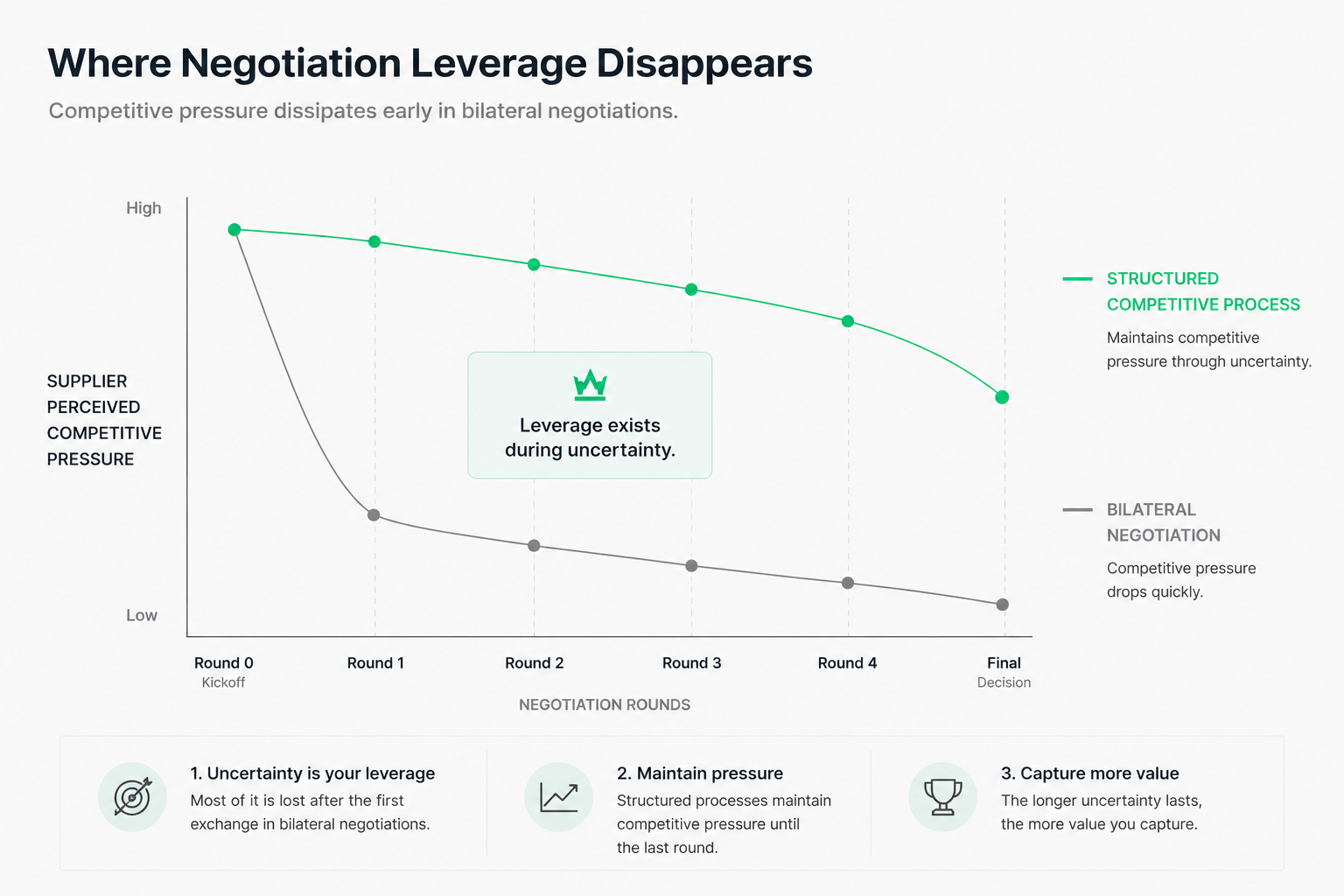
The dominant negotiation model in procurement remains bilateral and sequential. Buyers engage suppliers individually, often through loosely defined rounds with inconsistent information sharing and limited visibility into competitive forces. Even when multiple bids are collected through an RFQ process, the negotiation phase that follows rarely maintains meaningful competitive engagement.
This model produces three recurring structural flaws.
Rivalrous interactions dissipate too early. In a classic bilateral negotiation, suppliers quickly understand whether they are the preferred option. Once that perception sets in, the incentive to improve pricing or commercial conditions naturally erodes. The buyer’s leverage exists during the period of genuine uncertainty, but most processes allow that uncertainty to disappear long before available value has been captured.
Sequencing is left to individual talent, not to a system. High-performing negotiation processes are never improvised. They require structured sequencing, clear advancement criteria, controlled information flow, and visible competitive consequences between rounds. In practice, many teams rely on one or two informal rounds with no engineered architecture. Processes conclude not because all available value has been captured, but because time, internal alignment, or operational capacity ran out. This is the most widespread and expensive form of status quo: “We have always done it this way; our buyers have instinct.”
Anchoring happens by accident, not by design. The timing and framing of information disclosure have a measurable influence on commercial outcomes. A buyer who reveals budget expectations too early or reacts favorably to a first offer unintentionally anchors the negotiation around supplier expectations rather than market forces. This is not a talent problem. It is a process architecture problem. Without a structured process governing information flow, anchoring settles wherever the conversation deposits it.
What Leading Organizations Do Differently
Procurement teams generating consistently superior sourcing outcomes do not necessarily rely on more aggressive negotiators. They design negotiation environments more intentionally, before the event even begins.
This means defining how many rounds will take place, determining what information suppliers receive at each stage, establishing how advancement decisions are made, and preserving competitive dynamics throughout. Negotiation becomes less an improvised conversation and more a deliberately engineered mechanism. And critically, this shift liberates the senior buyer from administrative orchestration, freeing them to concentrate on category strategy, market intelligence, and supplier relationship architecture rather than managing email chains and chasing revised quotes.
The most capable procurement organizations are building market architects, not spreadsheet administrators. Infrastructure makes that possible.
In practice, this takes the form of structured competitive processes: eAuctions, sealed-bidding rounds, and digitally orchestrated negotiation events in which suppliers compete simultaneously within a transparent, predefined framework. And here, a supplier-centric reading is essential: one too often absent from the Procuretech conversation.
A well-organized negotiation event is not only a lever for buyers. For suppliers, it represents a fundamentally different and often preferable experience compared to opaque bilateral processes. Rules are explicit and communicated in advance. Evaluation criteria are defined before the first bid is submitted. Feedback is immediate: suppliers know precisely where they stand, rather than waiting weeks for an informal call that may never arrive. The process eliminates the asymmetric dynamics of relationship-driven negotiations, where outcomes depend more on proximity to the decision-maker than on the quality of the offer. For serious suppliers with a genuine value proposition, a fair, structured competitive process is not a constraint. It is a level playing field: the end of opaque pre-selection, undisclosed budget leaks, and back-channels that quietly favor an incumbent.
When suppliers understand they are participating in a credible process, with clear rules, known advancement criteria, and genuine competitive alternatives in play, their commercial engagement shifts. Not through pressure, but through clarity of rules and confidence in the process.
A strategic nuance matters here. This model is not a universal solution. Applied indiscriminately across the entire procurement portfolio, it can damage essential relationships in categories where scarcity, co-dependence, or technical value creation takes precedence. The Kraljic matrix continues the indispensable framework for reading. Structured digital negotiation performs well in Leverage categories: competitive markets, commodities, and significant volumes, where the mechanism creates value without disrupting critical relational balances. It brings full automation and simplification to Non-critical categories, freeing category manager bandwidth entirely. For Bottleneck as well as Strategic categories, different logics apply: partnership, co-development, and risk mitigation rather than competitive pressure. The infrastructure must serve the procurement strategy, not substitute for strategic judgment.
The Compounding Effect of Cycle Compression
One of the most underestimated consequences of structured negotiation is the strategic optionality that execution velocity creates: a point that deserves far more precision than it typically receives.
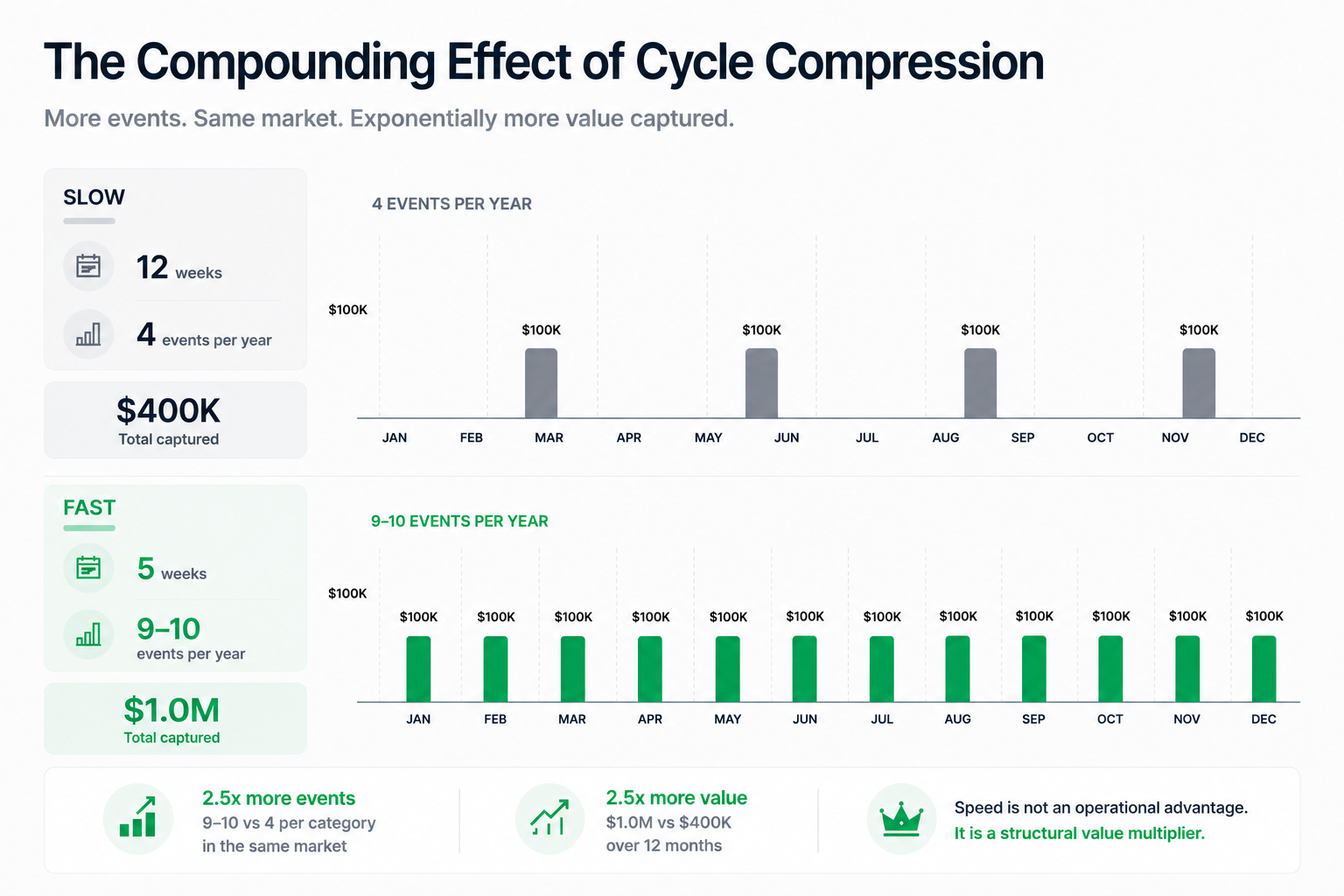
A sourcing process that takes 12 weeks does not simply produce value more slowly than one completed in 5. It produces less structural value because it cannot respond to market movements in time to capture them. Financial volatility does not wait for internal alignment. Raw material windows open and close within days. Supplier capacity constraints shift with production schedules. Geopolitical disruptions reprice entire categories before a bilateral negotiation has cleared its second round.
Speed is not an operational convenience. It is a tactical weapon.
Structured digital negotiation compresses cycle duration on two simultaneous fronts. First, it eliminates the elapsed time lost in sequential bilateral exchanges: instead of advancing supplier by supplier, all participants progress concurrently through the same organized framework, compressing weeks of asynchronous back-and-forth into focused, time-bounded competitive rounds. Second, it reduces preparation overhead with making negotiation frameworks repeatable: configured once, improved through practice, redeployed across events rather than rebuilt from scratch each time.
The compounding logic is precise: an organization capable of running three sourcing cycles in the time it takes a competitor to complete one does not simply save operational resources. It captures market opportunities that the slower organization cannot access structurally.
Our clients’ transition to a structured negotiation infrastructure illustrated this directly: cycle compression did not free capacity as an end in itself, but changed the procurement organization’s ability to act on market signals before those signals crystallized into unfavorable long-term conditions.
This is where the real return on negotiation infrastructure is generated: not in a single, incrementally better outcome, but in the cumulative advantage of consistently deploying execution speed across the full category portfolio, against a market that rewards the fastest actor.
The Infrastructure Question: And Why This Generation of Tools Is Different
For most organizations, the challenge is not understanding the value of structured negotiation. Most CPOs already know that a fair, structured competitive environment produces stronger commercial outcomes. The difficulty lies in operational implementation at scale, and in the tools available to deliver it.
Running a well-organized negotiation event requires supplier onboarding, event configuration, communication of rules, immediate monitoring, and rigorous documentation. When these tasks are managed manually, the overhead becomes substantial enough that structured formats are reserved for the largest spend categories only. For everything else, the default reverts to email and phone.
Generalist suites have not solved this problem. Ariba and Coupa worked around it: their negotiation modules exist, but deploying them for a single ad hoc sourcing event requires the same heavyweight implementation cycle as the rest of the suite. The negotiation capability is there; the operational responsiveness is not.
Specialized sourcing optimization platforms, algorithmically powerful and analytically sophisticated, introduced their own friction: complex configuration interfaces, dependency on procurement data scientists, and learning curves that make them de facto tools for the procurement IT team rather than the category manager running a negotiation next Tuesday.
CROWN occupies a different position entirely. It is an agile negotiation event platform, purpose-built to orchestrate eAuctions, sealed bidding rounds, and multi-round competitive negotiations, designed for operational immediacy. No ERP integration required to get started. No six-month implementation. No specialist training. Category managers configure and launch their first event within days of activation, without touching the core IT stack. The platform is plug-and-play by design: intuitive to event organizers, systematic and open for suppliers, and fully auditable for compliance and governance teams reviewing outcomes afterward.
This is the distinction that matters in practice. Not algorithmic complexity, but the absence of a barrier between the decision to run a structured negotiation and the ability to execute one. When configuration takes hours rather than months, structured competitive processes become scalable across the full category portfolio rather than reserved for the ten largest spend buckets. The question is no longer whether structured negotiation should be used, but how the process should be configured most effectively for each sourcing context.
This is what increasingly separates procurement organizations that produce consistent outcomes from those that produce inconsistent ones. The difference is not just category expertise or negotiator talent. It is the existence of infrastructure capable of making disciplined negotiation repeatable, measurable, and deployable at the speed the market calls for, without requiring a transformation program to activate it.
Procurement’s digital transformation has already reshaped much of the function. The act that still determines a decisive share of sourcing value is only beginning to catch up.