

For decades, enterprise resource planning systems (ERP of course) have served as the backbone of procurement operations, handling everything from purchase orders to supplier records and invoice approvals. These platforms were designed for a world that moved at a predictable pace, where annual contracts, quarterly reviews, and batch-processed data were perfectly adequate.
Spoiler Alert: That world no longer exists.
Today, procurement teams are expected to deliver real-time sourcing decisions, run complex multi-variable negotiations, and manage supplier risk across volatile geographies. When the underlying technology was built for transaction logging and rule-based workflows, the cracks show in ways that go far beyond a slow dashboard. If your procurement function feels like it is constantly fighting its own tools rather than leveraging them, chances are your ERP architecture is part of the problem.
Why Legacy ERP Becomes a Bottleneck for Procurement
Legacy ERP systems were not poorly designed but they were engineered for an era that prioritized stability, auditability, and centralized control. The issue is that the business environment around them has changed far more rapidly than these platforms were ever meant to accommodate.
Rigid Architecture That Resists Change
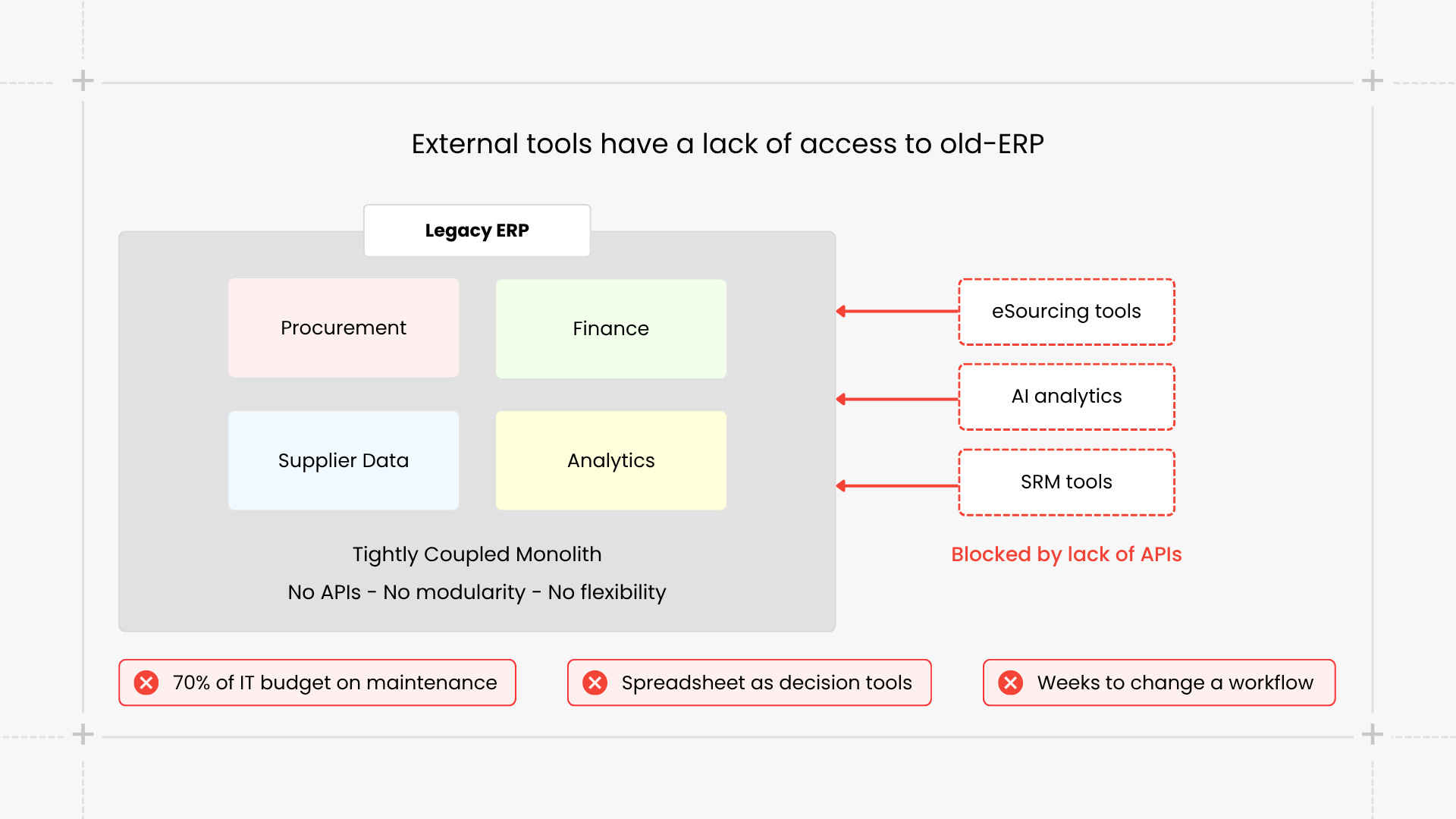
Most traditional ERP platforms were built as tightly coupled monoliths, where data models, business rules, and user interfaces are deeply intertwined. This ensures transactional consistency, but it also creates enormous rigidity. Every meaningful change introduces risk, and custom logic embedded in the core complicates upgrades over time. According to industry analyses, enterprises spend up to 70% of their IT budgets maintaining existing systems, leaving less than 30% for innovation.
For procurement, this rigidity manifests in painful ways. Adjusting an approval workflow to reflect a new category strategy might take weeks of IT tickets. Adding a new supplier scoring criterion requires custom development. Running a negotiation that factors in total cost of ownership rather than unit price alone may be technically impossible within the system's constraints.
Siloed Data and Slow Decision-Making
One of the most damaging effects of legacy ERP on procurement is data fragmentation. When procurement, finance, logistics, and supplier management all live in separate modules with limited interoperability, information silos prevent teams from seeing the full picture. Studies consistently show that over 60% of organizations identify decision speed and quality as a major challenge, and system fragmentation is a leading contributor. In practice, procurement leaders often rely on exported spreadsheets and manually assembled reports to make sourcing decisions.
Integration Barriers That Block Innovation
Perhaps the most strategically damaging consequence of legacy ERP is its inability to integrate with modern cloud applications, AI-powered analytics, and specialized procurement tools. Many older systems lack modern APIs, making it difficult to connect with innovative sourcing and negotiation platforms. Procurement teams attempting to introduce eAuction tools, AI-driven spend analysis, or automated supplier onboarding often find themselves stuck in months-long integration projects that dilute the very agility these tools were supposed to provide.
What Modern Procurement Architecture Actually Looks Like
The shift away from monolithic ERP is not about ripping out systems overnight. It is about rethinking how procurement technology is structured so that each component of the sourcing process is served by the best available tool, connected through open integration layers.
The Composable, Best-of-Breed Approach
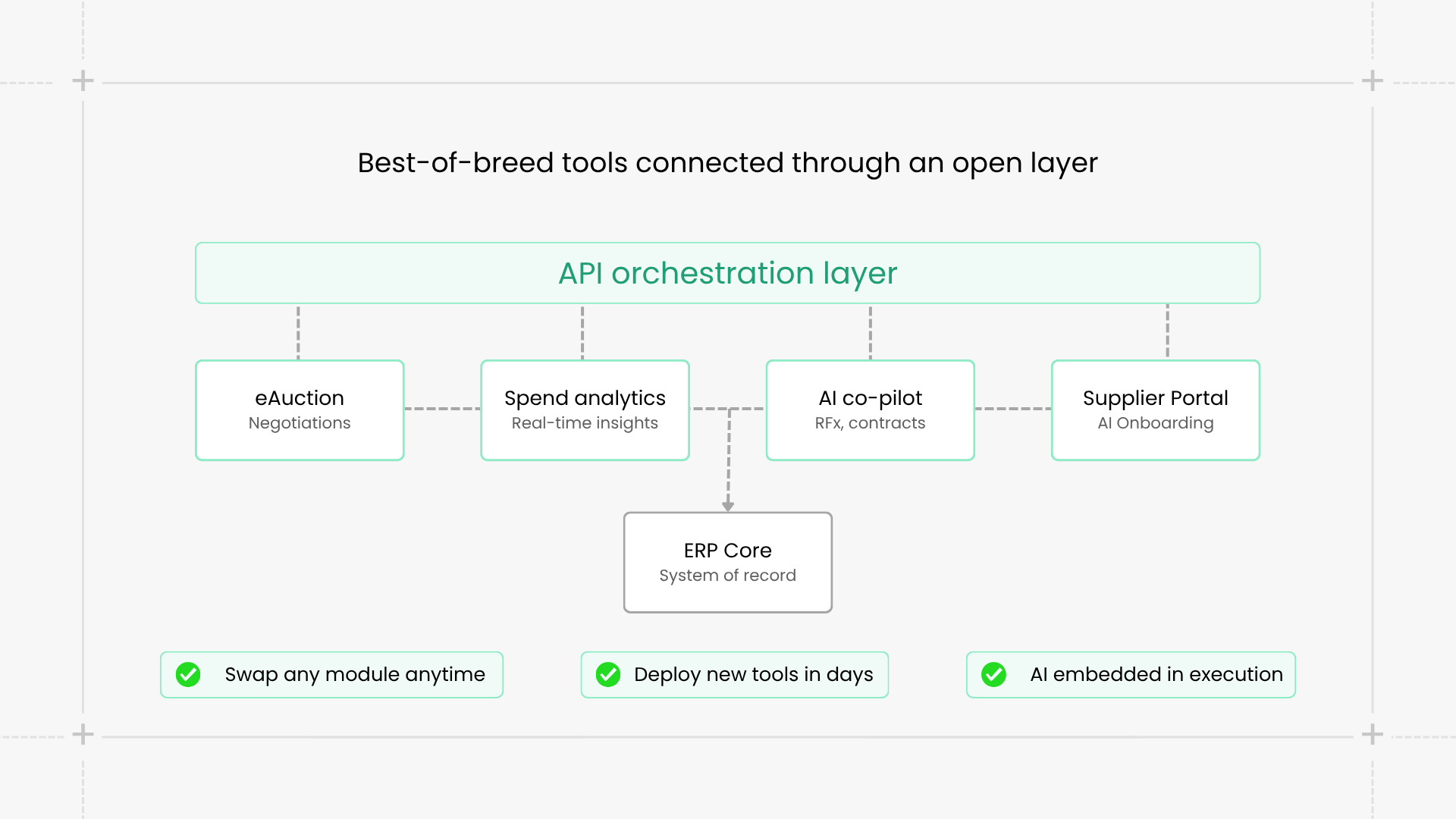
Modern procurement architecture follows what analysts increasingly refer to as a composable model. Rather than relying on a single vendor's monolithic suite to handle everything from requisition to payment, organizations assemble a stack of specialized, interoperable tools connected via APIs and orchestration layers.
The logic is straightforward: your contract management tool should be the best at contract management, your eAuction platform should be the best at running negotiations, and your spend analytics engine should be the best at turning raw data into actionable insight. When each component is independently deployable and replaceable, your procurement stack becomes more resilient and far easier to evolve.
This approach mirrors what Kearney's Purchasing Chessboard framework has long advocated at a strategic level. The Chessboard emphasizes that no single procurement strategy works for every category and market condition, and that teams need differentiated approaches matching the specific dynamics of supply power and demand power. The same principle applies to technology: a one-size-fits-all ERP module cannot deliver the specialization required to execute dozens of different sourcing methods effectively.
Cloud-Native Platforms That Scale with You
A defining characteristic of modern procurement platforms is their cloud-native foundation. Unlike legacy systems that require dedicated infrastructure and manual upgrade cycles, cloud-native tools receive continuous updates, scale automatically, and allow procurement teams to access the latest features without disruption.
For a team running eAuctions across multiple categories and geographies, this means the platform handles sudden spikes in live negotiation events without performance degradation, and new formats or onboarding flows can be deployed in days rather than months.
AI-Powered Execution, Not Just Reporting
One of the most significant differences between legacy and modern procurement architecture is the role of artificial intelligence. In older systems, analytics were retrospective at best, generating reports on what happened last quarter. Modern platforms embed AI directly into the execution layer, where it can actively shape outcomes in real time.
AI-driven tools can now recommend optimal eAuction formats based on sourcing event characteristics, analyze supplier bids against total cost of ownership models during live negotiations, and automate supplier onboarding through intelligent guided workflows. The shift is from AI as a passive observer to AI as an active co-pilot, enabling procurement professionals to focus on strategy rather than administrative coordination.
Seamless Integration Across the Procurement Lifecycle
Modern architecture does not mean abandoning your ERP entirely. For many organizations, the financial and transactional backbone of systems like SAP or Oracle still plays an important role. The key is to decouple procurement execution from that core, allowing specialized platforms to handle sourcing, negotiation, and supplier management while maintaining clean data flows back to the system of record.
API-first designs make this possible without the brittle integrations that plagued earlier best-of-breed attempts. When an eAuction concludes and a supplier is awarded a contract, the data flows seamlessly into the ERP for purchase order generation and financial tracking, without manual rekeying or spreadsheet exports.
The Strategic Cost of Doing Nothing
It is tempting to view ERP modernization as a future initiative. But the cost of inaction compounds far more rapidly than most organizations realize.
Every month that procurement teams spend working around rigid systems is a month of unrealized savings and decisions made on incomplete data. Organizations that completed modernization between 2022 and 2025 consistently report 25 to 35% reductions in infrastructure costs and 40 to 60% faster deployment cycles for new capabilities.
There is also a talent dimension. The procurement professionals you want to attract and keep are not interested in navigating clunky interfaces and manually stitching together information from five different systems. They want intelligent tools that amplify their strategic capabilities.
How to Start the Transition Without Disrupting Operations
Moving toward a modern procurement architecture does not require an all-or-nothing migration. The most successful transitions follow a phased approach.
Start with High-Impact, Low-Integration Use Cases
Identify areas where a modern, standalone tool can deliver immediate results without deep integration into your legacy core. Negotiation and eAuction platforms are a prime example, since they operate alongside existing systems while delivering substantial savings from day one. Spend audit tools that work from exported data are another quick win that builds the business case for broader modernization.
Build an Integration Layer Early
Invest in API middleware or an integration platform that can serve as the connective tissue between your legacy ERP and the specialized tools you introduce. This creates a foundation that makes each subsequent addition faster and less risky.
Prioritize Adoption and Change Management
Technology is only as effective as the teams using it. Choose platforms that invest in user experience, provide embedded training, and offer AI-guided onboarding for both internal teams and suppliers.
Conclusion
Legacy ERP systems served procurement well for the era they were designed for, but that era has passed. Modern procurement demands an architecture that is modular, intelligent, and built for continuous evolution. The organizations assembling composable, AI-powered procurement stacks today will not just save money on technology, they will outperform competitors in sourcing agility, supplier relationships, and total value delivery.
The question is no longer whether your legacy ERP is holding procurement back. The real question is how quickly you can start building something better.

.png)