
In 2026, more than 65% of procurement leaders and CPOs report being both concerned about rising costs and constrained by slow decision-making processes, highlighting a dual pressure on the procurement function. In an environment shaped by geopolitical tensions, supply chain disruptions, and increasing complexity, organizations must adapt faster while overcoming their own operational limitations.
Procurement technologies, particularly artificial intelligence, are therefore emerging as key drivers of transformation.
Yet beyond the technological momentum, a fundamental question remains: do these innovations truly transform procurement, or do they instead expose the limits of organizations in their ability to use them effectively?
Where is the procurement tech landscape really going: toward a lasting transformation, or toward a more gradual and uneven evolution?
In a volatile environment, procurement is undergoing a technological transformation.
In response to a structurally unstable environment, the procurement landscape is undergoing a profound technological shift. This transformation is not driven solely by innovation, but by the need to adapt to increasing structural constraints.
From fragmented solutions to orchestration platforms
Historically, procurement has relied on a wide range of specialized tools that often operate in isolation. This fragmentation creates information silos, slows decision-making, and limits coordination across functions.
This issue is clearly reflected in the data: 69% of organizations identify decision speed and quality as a major challenge. These internal frictions suggest that procurement challenges are not only external, but also rooted in organizational design.
In response, new players such as Zip position themselves as orchestration layers. Rather than replacing existing systems like SAP Ariba or Coupa, they connect them and streamline workflows across the organization.
Value therefore no longer lies in individual tools, but in the ability to orchestrate the entire procurement process.
Agentic AI: a shift toward autonomous execution
Agentic AI represents a fundamental shift by transforming artificial intelligence from a support tool into an execution engine. These systems go beyond recommendations by analyzing data, making decisions, and directly carrying out actions.
The impact is already measurable. Organizations that have adopted AI are 2 to 3 times more effective at protecting their operations from disruptions, and 3.7 times less likely to experience a significant drop in demand.
These gains are driven by solutions capable of automating execution. Arkestro, for instance, optimizes supplier negotiations in real time using predictive models, while Fairmarkit automates tail spend procurement by identifying suppliers and executing transactions with minimal human input.
Artificial intelligence is no longer simply supporting work. It is becoming an operational actor that fundamentally reshapes procurement processes.
From operational roles to strategic procurement functions
As repetitive tasks become automated, the role of procurement teams is shifting. Activities such as transaction processing or basic sourcing are increasingly handled by systems, allowing teams to focus on higher-value responsibilities.
This transition is not without challenges. Half of organizations cite a lack of skills as a major barrier, while 39% are deprioritizing hiring and instead focusing on upskilling their existing workforce.
In practice, platforms such as Coupa and GEP illustrate this shift. Procurement teams are no longer centered on execution, but on category strategy, supplier risk management, and long-term value creation.
Procurement is therefore evolving into a strategic function, closely linked to overall business performance.
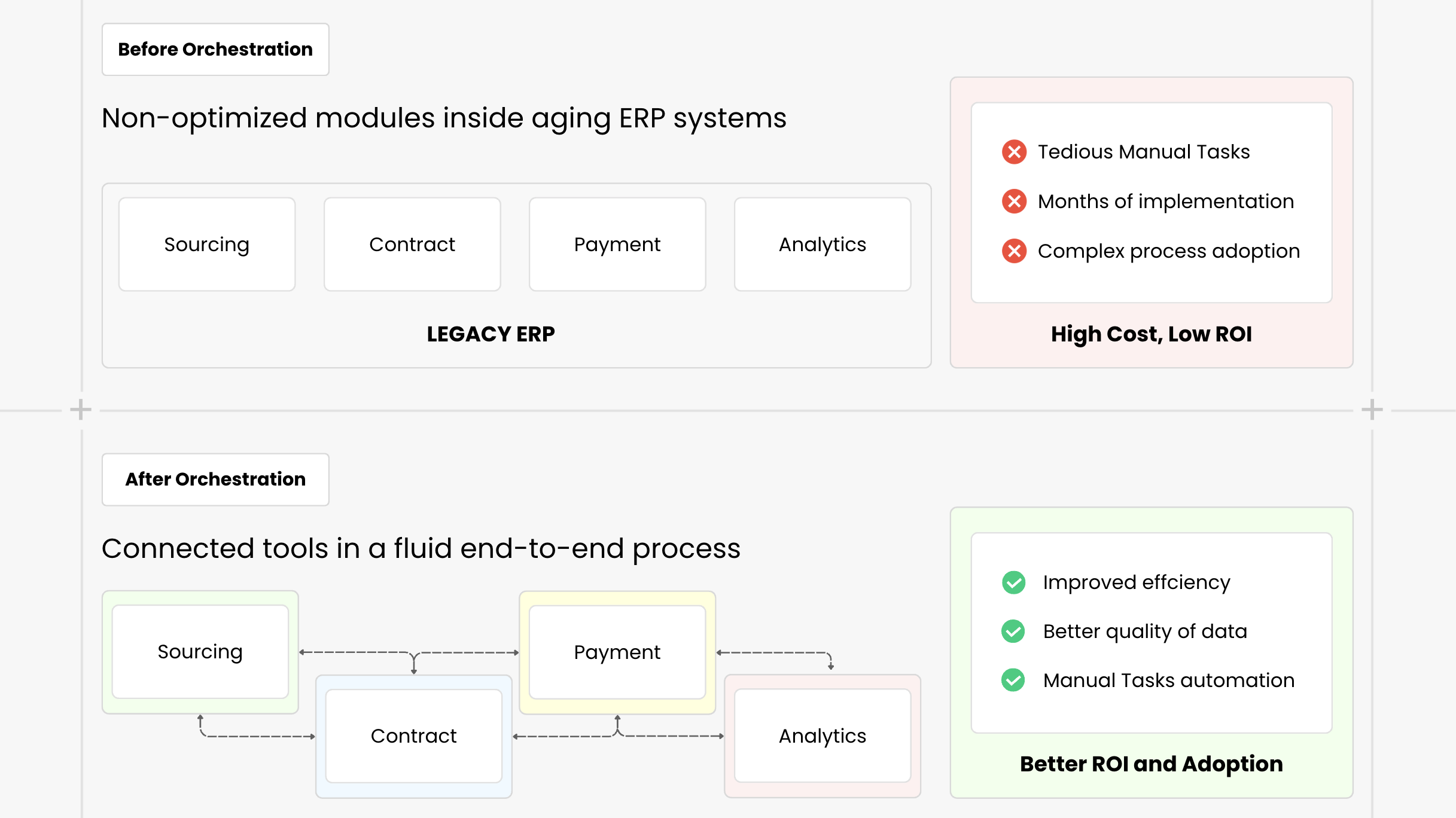
An incomplete transformation revealing the limits of the ProcureTech solutions.
Although technologies offer significant potential, their adoption and impact remain uneven. Technology only creates value when it is effectively integrated and used, highlighting a growing gap between organizations.
The rise of ROI expectations: the end of AI hype
The Procurement market is entering a phase where measurable value creation becomes essential. After a period of experimentation and enthusiasm around AI, organizations now demand tangible results.
This shift is reflected in the priorities of CPOs. Half of them focus on cost savings, while 38% prioritize risk management.
Business models are evolving accordingly. Solutions such as Keelvar and Arkestro increasingly rely on performance-based pricing models, aligning their incentives with client outcomes.
Technology is no longer a promise. It is expected to deliver measurable performance.
Market consolidation driven by weak differentiation
The market, shaped by a rapid increase in the number of players, is moving toward consolidation. Many AI-driven solutions struggle to demonstrate value beyond pilot phases.
This is reflected in adoption levels. More than half of organizations have not adopted AI or automation, while only a small minority have adopted both.
As a result, a natural selection process is taking place. As seen in previous technology cycles, only the most differentiated and value-driven players are likely to remain, while others will be acquired or exit the market.
The market is therefore entering a phase of concentration and rationalization.
Uneven adoption reveals operational constraints
The transformation of procurement is ultimately constrained by organizational factors. While technologies are available, their effective use depends on internal capabilities.
Key barriers include data quality issues, lack of skills, and resistance to change.
This leads to uneven outcomes. Some organizations fully leverage platforms such as SAP Ariba or Coupa, while others use only a fraction of their capabilities due to poor data or limited adoption.
The real challenge is no longer access to technology, but the ability to integrate and operationalize it effectively.
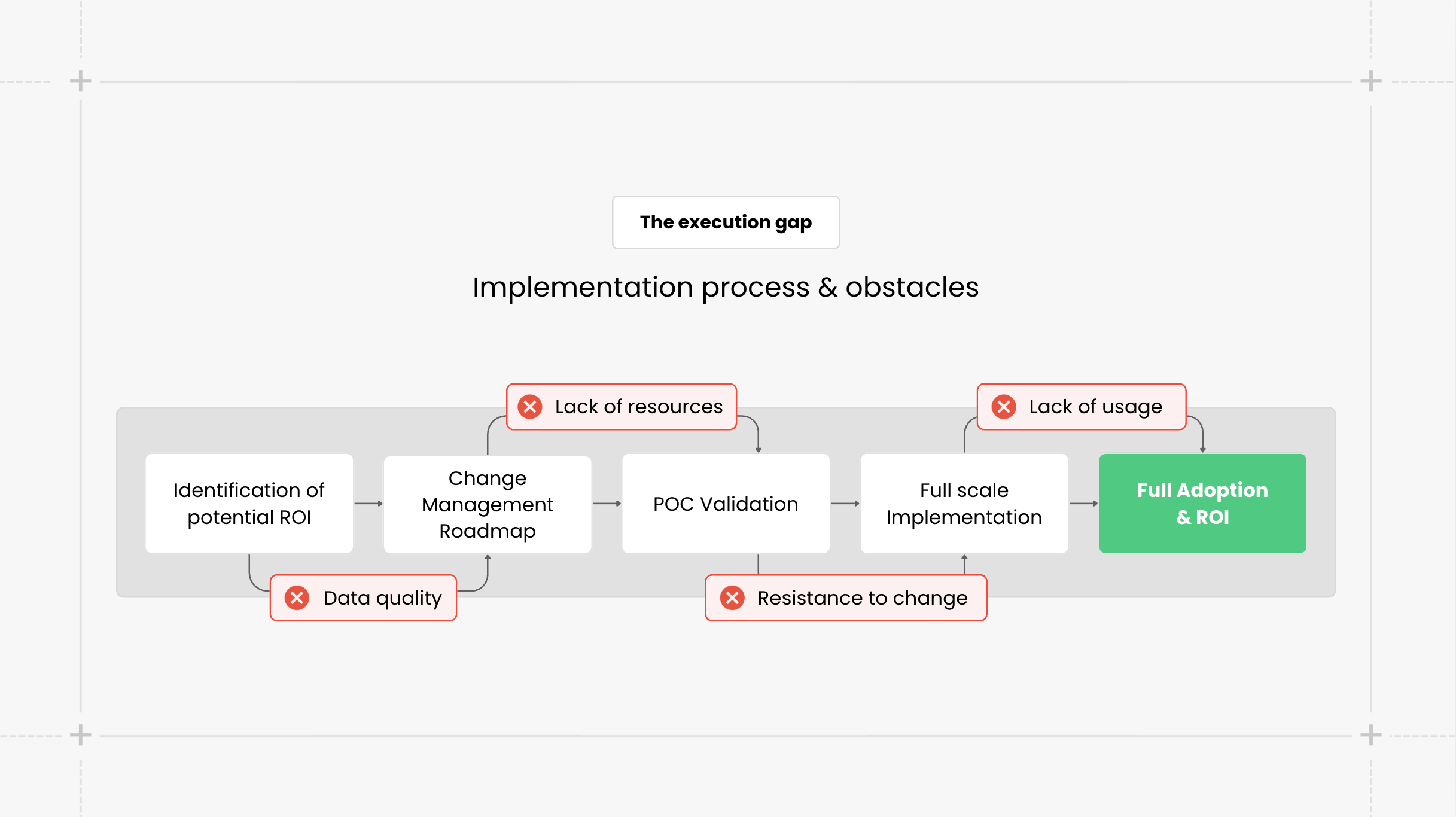
Bridging the execution gap: the CROWN approach
The Procurement market is not evolving toward a uniform transformation, but toward a growing divide between organizations that can effectively leverage technology and those that cannot. Execution, rather than technology itself, is becoming the main differentiating factor.
In this context, some companies are adapting their value proposition. Crown, for example, does not position itself solely as a technology provider, but as a partner combining a platform with operational expertise. By integrating automation tools, particularly through eAuctions, with strategic support such as auction design, supplier onboarding, and change management, Crown directly addresses the execution challenges.
In a market where technology alone is no longer sufficient, the most successful players will be those able to combine technological innovation with strong operational expertise.