
Most category managers have lived through the same story: a hopeful AI pilot launches, then quietly stalls a few months later. Not because the technology was bad, but because the data feeding it was a mess. Spend exports full of inconsistencies. Old sourcing files scattered across emails and spreadsheets. Supplier quotes arriving as PDFs that can't be compared side by side, leaving the buyer to piece everything together by hand.
Asking AI to work in that environment is like asking a powerful engine to run without oil. The parts are all there, but nothing is set up to let it actually run.
This is not a technology problem. It is a foundations problem. The companies that get AI right in procurement, in aerospace, manufacturing, and other industrial sectors, all followed the same order: get the basics working first, then bring in the technology.
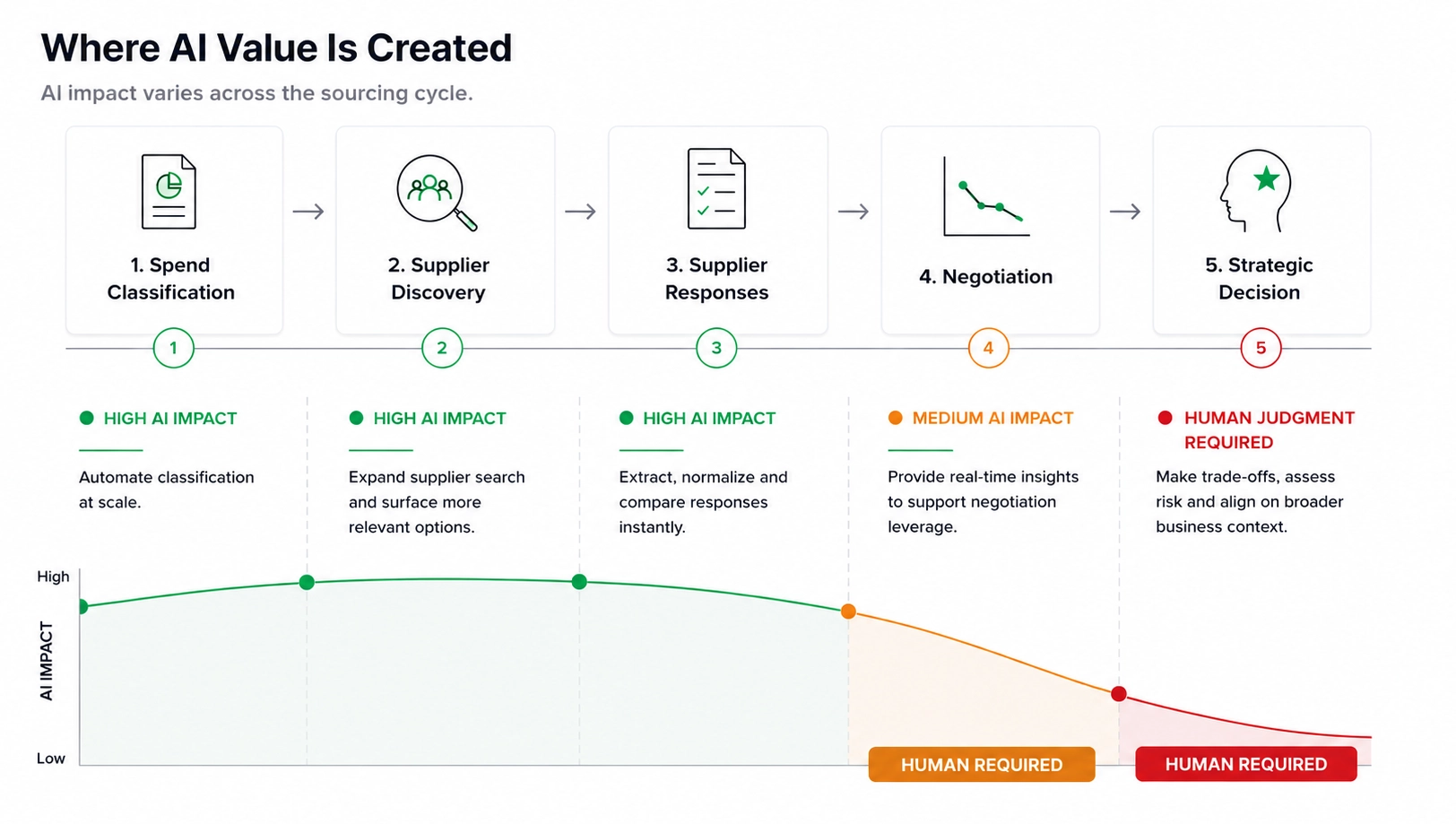
What AI actually does well in sourcing: where value is real and where it is not
The first mistake procurement teams make with AI is treating it as all-or-nothing: either go all in, or wait it out. The better question is simpler: where in your sourcing process is AI actually ready to help, and where would relying on it too much just create false confidence?
The pattern is easy to spot once you know what to look for: clean data, repetitive high-volume tasks, and decisions that follow a clear logic. When those three things line up, AI delivers real, consistent results. When even one is missing, it just adds more noise.
Spend classification: cleaning up your spend data
Sorting spend into the right categories has always been one of the most tedious and error-prone jobs in procurement, even though almost nobody calls it out as a real problem. Financial data comes in raw. Analysts assign categories by hand, using rules that shift every time the organisation changes. Mistakes pile up quietly. The result is a spend cube that's always a bit wrong and always a bit out of date.
AI changes this in a very practical way, especially for non-critical and leverage spend, because these categories involve high volumes and repeating patterns that AI can learn from reliably.
Why this matters most for leverage and non-critical spend
This is exactly where the Kraljic matrix becomes useful in practice. Leverage spend (high impact, low risk) and non-critical spend (high volume, low complexity) typically make up 60 to 75 percent of total spend in most industrial companies. That's the ideal ground for clean data to power a real competitive strategy.
The practical result: spend visibility that used to require a slow quarterly clean-up is now available continuously, and far more reliably than manual entry ever allowed. Category managers work with better information, and sourcing decisions are based on what's actually happening, not on guesswork.
Supplier identification and building competitive markets
Finding new suppliers has always been limited by how much time a team has. A category manager covering raw materials, packaging, logistics, or general services can only spend so much time researching before an event needs to go out. The usual result: supplier panels that are smaller than they should be, incumbents who haven't faced real competition in years, and prices that reflect that lack of pressure more than the actual market.
AI-assisted supplier discovery helps here by quickly building broader, more diverse longlists from public registries, databases, and industry sources, much faster than manual research ever could. Filtering, risk checks, and capability verification still need human judgment, but the raw material for stronger competition arrives faster and in better shape.
Why supplier data quality starts with the supplier experience
Here's something that almost never comes up in AI procurement discussions, but it matters a lot: the quality of the data you get depends on how easy it is for suppliers to provide it.
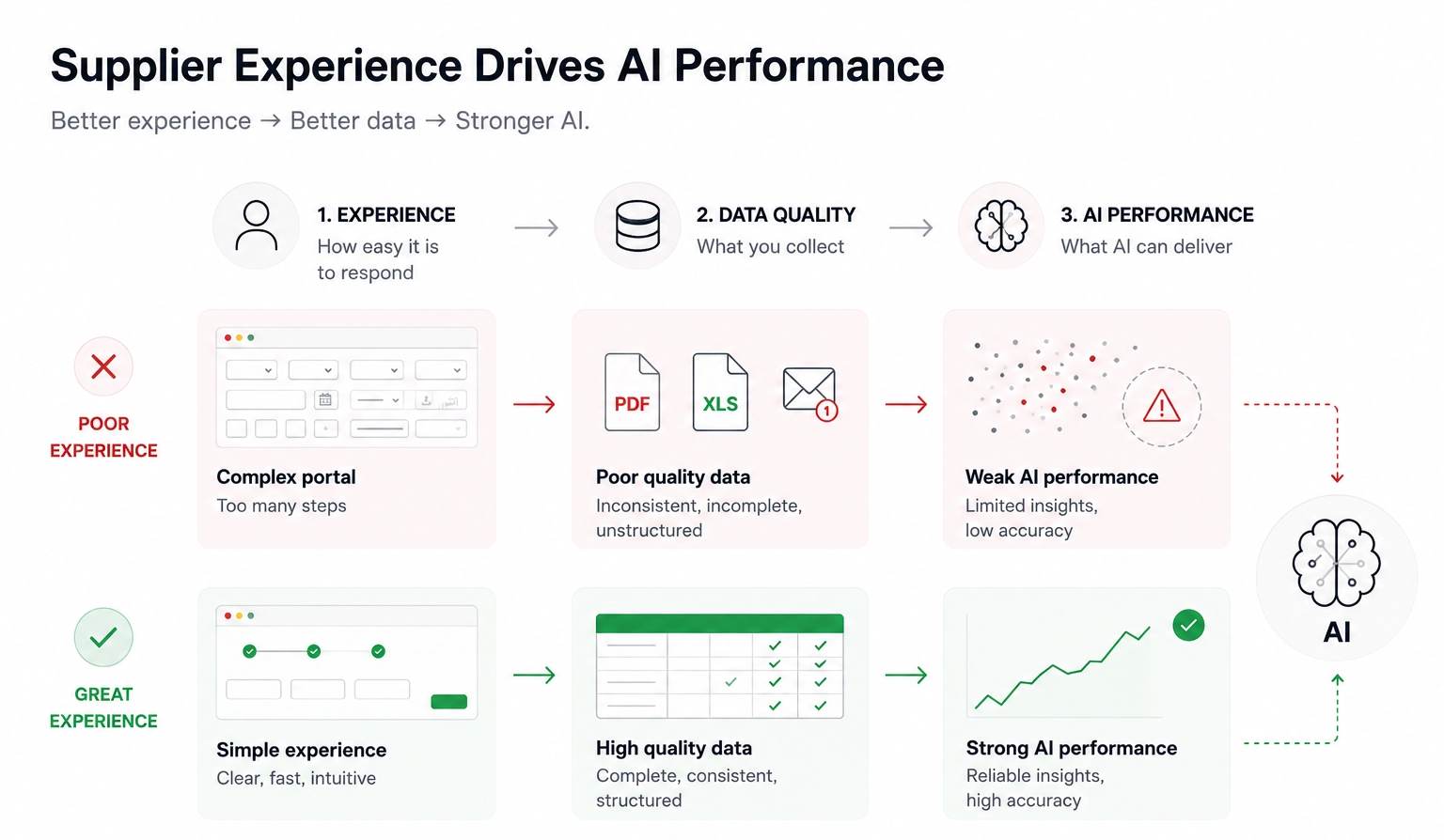
If your tool is clunky or forces suppliers through a long, confusing process, they'll find workarounds. They'll send a PDF instead. They'll call their sales contact. Or they'll quietly stop participating. The result is messy, inconsistent data, which is exactly what AI struggles with most.
This is a big part of why traditional procure-to-pay platforms often see disappointing supplier participation. These tools are built around the buyer's needs, not the supplier's, and that imbalance shows up as bad data right from the start, long before AI ever gets involved.
On the other hand, a clear, well-organised process with visible criteria and proper onboarding encourages suppliers to put in real effort from the beginning. They understand why they're in the panel, what's expected of them, and how they'll be judged. Response quality improves as a result. And just as importantly, a supplier who trusts the process won't pad their prices out of caution. They compete for real, which is exactly the kind of pressure that eAuctions on leverage and non-critical spend are designed to create.
Contract extraction and visibility over existing commitments
Procurement teams often have contract libraries that are technically organised but practically useless when a decision needs to be made quickly. Knowing which contracts are about to auto-renew, or which ones have pricing tied to commodity indexes, is information that exists somewhere in those documents but is almost never available at the moment it's needed.
AI-powered document processing can pull this information out reliably enough to actually be useful. And the impact on negotiation is direct: you can't renegotiate a pricing clause you don't know exists.
What AI does not do yet: where human judgment remains essential
To be fair, there's another side to this. And this is exactly where some teams get into trouble by moving too fast.
Handing a negotiation over to AI without first having structured workflows, clear evaluation criteria, and a documented supplier history is a mistake that tends to show up later, often without anyone connecting it back to the real cause. Knowing when to apply pressure, how to sequence concessions, or how to read a supplier's stated position versus their real margin: these are human calls, supported by data but never replaced by it. For strategic and bottleneck categories, where supply continuity and relationships matter most, AI works best as a research aid. Asking it to do more than that creates a false sense of confidence rather than real value.
Why AI procurement projects fail before they start: the execution infrastructure problem
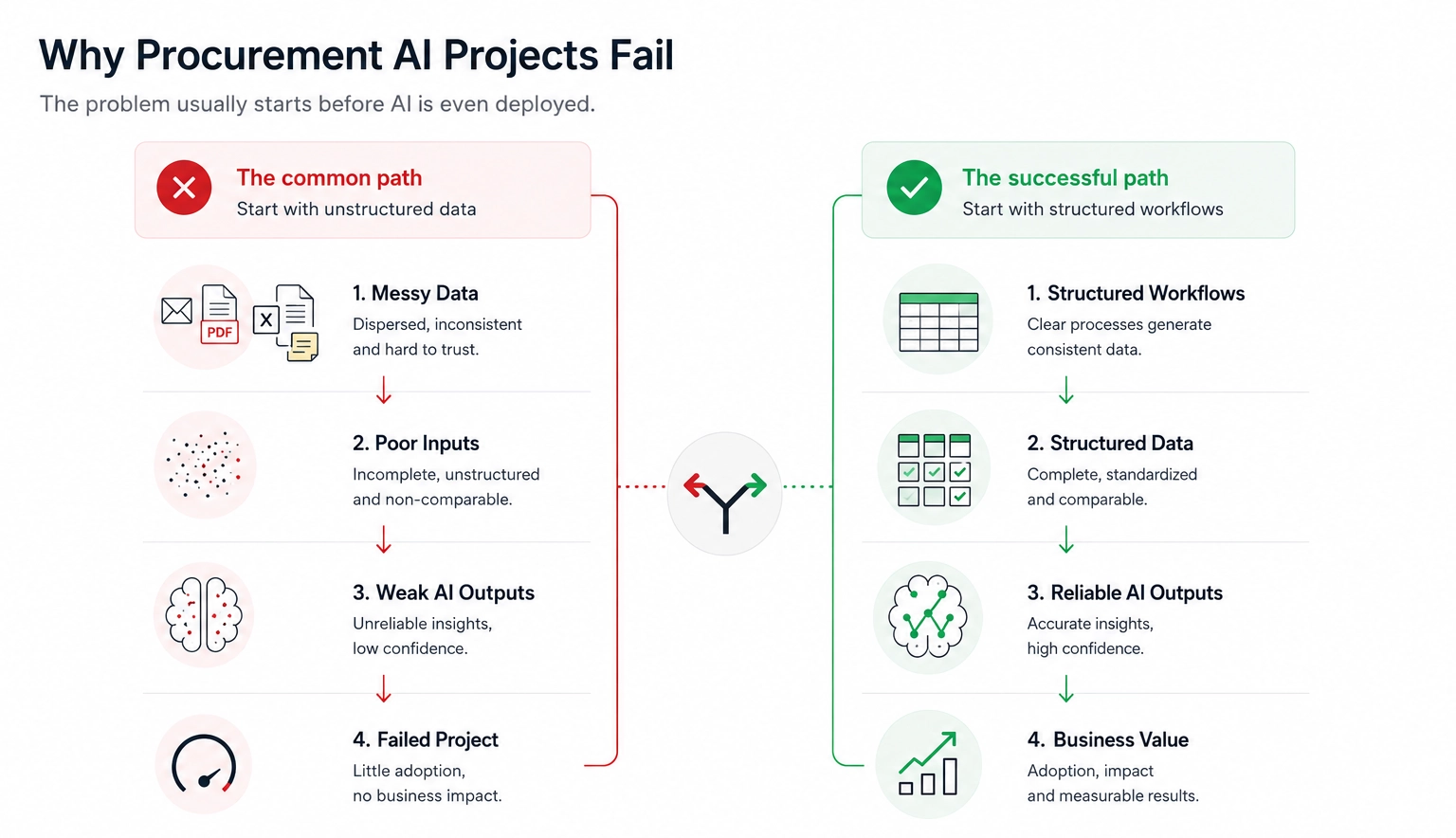
There's a structural issue underneath all of this that gets far less attention than AI itself, but it explains most of the gap between projects that work and projects that stall: most procurement teams aren't actually set up to use AI well, because their day-to-day operations don't generate the kind of data AI needs.
AI learns from patterns in consistent, structured data. If your sourcing runs through email, your supplier evaluations live in spreadsheets that look different every time, your RFQ responses come in as unformatted PDFs that can't be compared, and your negotiation history only exists in people's memories, you don't have a data asset. You have habits that don't build on each other and don't teach the organisation anything over time.
The 24-month tunnel: why legacy suites extend the problem rather than solving it
The big integrated procure-to-pay platforms sold the opposite idea: roll out the platform, and clean data will follow naturally. The experience of many European companies tells a different story. These projects often take 18 to 36 months. They use up a lot of IT resources, create dependencies that slow everything down, and produce results so delayed that stakeholders lose patience long before any savings show up.
The AI features these platforms promise sit on top of an execution layer that most companies haven't built yet, so the real payoff keeps getting pushed back with every new roadmap update. There's also a more concrete problem: the supplier experience inside these platforms. Clunky onboarding, portals that discourage participation, and data that's already poor quality before AI ever gets a chance to work with it.
Execution infrastructure as the cornerstone of leverage spend performance
Companies that get real value from AI in procurement have, whether on purpose or not, built a standardised execution layer first. Consistent sourcing workflows. Supplier responses in comparable formats. Clear evaluation criteria used every time. Negotiation results tracked properly. This is what produces the kind of data AI can actually work with.
Where this infrastructure pays off fastest
For leverage and non-critical spend, things like raw materials, packaging, logistics, facility management, and general services, this is exactly where that infrastructure pays off fastest. These categories have everything needed to make it work: competitive supplier markets, specifications standard enough to compare, and spend volumes that justify a more rigorous process. These are the Leverage and Non-Critical quadrants of the Kraljic matrix, where teams are stretched thinnest and where a well-run eAuction typically delivers 6 to 10 percent in additional savings on a much shorter timeline.
This is where CROWN comes in, and it's where time-to-value really matters. While traditional procure-to-pay suites need 18 to 24 months of setup before the first eAuction even runs, CROWN gets this execution layer up and running in weeks, with no IT involvement and no competing for internal resources. Events on leverage and non-critical categories are already running before legacy projects have even finished their setup phase. And because the supplier experience is built to encourage good participation rather than discourage it, the data from each event is usable right away, building up a data asset that gets more valuable with every event.
The teams that adopt this approach aren't the ones with the biggest budgets. They're the ones who understood that operational discipline comes first, and technology comes second, not at the same time. Today, they have faster sourcing cycles, suppliers actively competing for their business, and a growing data asset that keeps paying off.
Procurement doesn't change because AI is powerful. It changes because the teams that know how to use it built something it could actually work with.